3 Reasons Process Documentation Fails and How Living SOPs Fix Them
Process documentation fails for three structural reasons: it goes stale the moment work changes, it captures only what people can articulate while leaving out the judgment calls that make a process actually work, and no one owns keeping it accurate. Layer on retrieval friction, calendar-only reviews, and interviews that miss real exceptions, and the failure becomes predictable. The fix isn’t more writing. It’s ownership, event-driven triggers, and validation against real execution.
TL;DR:
- Automated process discovery tools produce continuous updates that reflect real work, reducing the decay and maintenance burden compared to static documents.
- Assigning a dedicated owner to each procedure and triggering updates based on actual events rather than scheduled reviews helps maintain document accuracy and relevance.
- Observation-based validation uncovers tacit knowledge, exceptions, and deviations that interviews and written procedures typically miss, improving process fidelity.
- Short, focused formats like decision trees and checklists are more practical than comprehensive playbooks, especially when embedded directly in tools used during the work.
- Team culture must shift from treating documentation as a project to maintaining it as infrastructure, with ongoing monitoring, ownership, and frictionless update systems.
Table of Contents
- Why process documentation fails: the common mistakes teams make
- Why tacit knowledge breaks the recipe approach to documentation
- How documentation decays and destroys reader trust
- Governance and maintenance rules that stop documentation rot
- Validation and testing: how to check documentation against real work
- Formats and tools that keep documentation useful at the moment of need
- How living documentation and automated discovery close the gap
- What separates teams that keep documentation alive
- A practical next step: build living SOPs instead of static ones
- Sources
- FAQ
Why process documentation fails: the common mistakes teams make
Most documentation problems trace back to a handful of repeatable mistakes, and most teams are making more than one at once. Recognizing which apply to your organization is the fastest route to fixing them.
Over-documentation is the completeness trap. Teams try to capture every edge case, every exception, every “what if,” and end up with a 40-page playbook nobody opens. The instinct is understandable. Thoroughness feels responsible. But a document optimized for completeness is usually a document optimized against actual use, because retrieval cost rises with every added page and readers give up before they find the step they need. Documents should be built for use, not coverage.
Under-documentation is the opposite failure. A process lives entirely in one person’s head, or in a two-line note that assumes context nobody else has. When that person leaves or gets pulled onto another project, the process doesn’t just get harder to run. It becomes undocumented in practice, even if a file technically exists.
Poor clarity encourages skimming, and skimming causes errors. Padded language, vague verbs (“handle the request,” “process as needed”), and inconsistent formatting all push readers to skip ahead, guess, or ask someone else instead of following the page in front of them.
Beyond writing quality, four operational gaps show up again and again:
- No named owner. A procedure with no accountable person has no update path, no escalation route, and no one who notices when it’s wrong.
- Missing from the point of work. Documentation stored in a shared drive three clicks away from where the task happens rarely gets consulted mid-task, no matter how good it is.
- Calendar-only reviews. Annual or quarterly review cycles assume change happens on a schedule. It doesn’t. A tool update, a policy shift, or a new client requirement can make a step wrong the day after it’s reviewed, and the review calendar is structurally late by design.
- High-friction updates. If editing a procedure requires a ticket, an approval chain, and a two-week wait, small corrections simply don’t get made. The gap between “someone noticed an error” and “the error is fixed” is where most documentation quietly rots.
One more pattern deserves its own line: relying on interviews instead of observation. Asking a subject-matter expert to describe their process produces a clean, linear narrative. Watching them do the process produces something messier and far more accurate, because it surfaces the workarounds, judgment calls, and shortcuts that never make it into a spoken description. Compliance research on standard operating procedures backs this up directly: poorly written procedures, missing maintenance processes, absent version history, and inadequate training are recurring findings in audits of regulated environments, and most of those root causes trace back to documentation built from a conversation rather than a real workflow. Understanding which document type actually fits your situation, whether that’s a quick map or a full written SOP, is often the first correction that matters.
Why tacit knowledge breaks the recipe approach to documentation
Every experienced worker carries knowledge they can’t fully put into words. Ask a ten-year veteran how they handle a specific exception, and they’ll often say something like “you just know” or “it depends.” That’s not evasiveness. It’s the nature of tacit knowledge, the practical, experience-based understanding that resists being written down as a clean instruction.
Knowledge management theory calls the process of turning tacit knowledge into explicit documentation “externalization,” one stage in the SECI model of knowledge creation. Externalization has a ceiling. A worker can describe the main path of a task fairly well. They struggle to describe the fifteen small judgment calls they make along the way, because those calls happen fast, feel automatic, and were never taught explicitly in the first place. Experienced practitioners internalize hundreds of these micro-heuristics, and a written procedure interview simply doesn’t have the bandwidth to extract them.
This is why subject-matter experts unintentionally omit exceptions during interviews. They’re not hiding anything. They’ve forgotten that the exception is a decision at all, because it’s become reflexive. A recipe written from that interview looks complete and reads cleanly, but it’s missing the branches that make the process actually work in the field.
Observation closes that gap. Watching someone execute the task, or reviewing a recorded session of them doing it, surfaces the hesitation points, the workarounds, and the deviations that never surface in conversation. Institutional knowledge research makes the same point: some knowledge simply can’t be externalized through description alone; it has to be captured through structured observation.

There are clear signals that tacit knowledge is the real problem in your documentation. If new hires follow the written steps precisely and still make mistakes, if the same “obvious” question keeps coming back to the same senior person, or if the SOP describes a single path but the team routinely takes three different ones depending on the situation, you’re not looking at a writing problem. You’re looking at a capture problem.
How documentation decays and destroys reader trust
A process document is at its most accurate on the day it’s written. From that point on, accuracy only degrades, because the underlying work keeps changing while the page sits still. A tool gets updated, a policy shifts, a client adds a new requirement, and the document doesn’t know any of it happened.
The dangerous part isn’t the first inaccuracy. It’s what happens after a reader finds it. Encountering a single stale or wrong step is often enough to break confidence in an entire library, not just the one page. Once a reader hits a step that doesn’t match reality, they don’t file a correction. They quietly stop trusting the source and go back to asking a colleague instead, which is exactly the outcome documentation was supposed to prevent.
That reaction cascades. If one page is wrong, the reader assumes others might be too, so they start double-checking everything against a person rather than the page, and eventually stop opening the document at all. The library isn’t deleted. It’s just abandoned in practice, which is functionally the same as never having written it.
There’s a second, quieter failure sitting next to decay: retrieval friction. A document can be perfectly accurate and still fail if nobody can find it fast enough to matter mid-task. Availability isn’t usability. A procedure buried in a folder structure four levels deep, with no search-friendly title and no link from the tool where the work happens, gets bypassed even when it’s correct.
Watch for the warning signs before they become a full-blown trust problem. A steady decline in document lookups, paired with a rise in interruptions to your subject-matter experts for questions the documentation is supposed to answer, is a reliable early indicator. Teams often notice the interruptions before they notice the drop in usage, and by then the damage to trust is already partly done.
Governance and maintenance rules that stop documentation rot
Documentation doesn’t decay because teams don’t care. It decays because nobody owns the job of noticing when it’s wrong. Fixing that requires a handful of concrete governance rules, not a bigger writing project.
- Assign a named owner to every procedure. Not a department, not a team inbox. One accountable person who is responsible for accuracy and who gets flagged when something breaks.
- Use event-driven triggers, not just calendar reviews. A tool migration, a repeated deviation from the written steps, or an incident tied to a process should automatically trigger a review, regardless of where that process sits in the annual review schedule. Calendar-only cycles are structurally too slow to catch real change.
- Make updates genuinely low-friction. An open edit flow, visible version history, and a simple change log turn a correction from a two-week project into a two-minute fix. If updating a procedure feels like filing a change request with legal, it won’t happen.
- Set a lightweight test step before republishing. A quick walk-through with a front-line user before a revised procedure goes live catches errors that a desk review alone will miss.
Operationalizing this at scale is less about writing better prose and more about building the systems and cadence that keep any large body of content current, a discipline that applies just as directly to process libraries as it does to editorial ones.
Pro Tip: Attach the owner’s name directly to the document header, not to a separate governance spreadsheet. If the accountable person isn’t visible at the point of reading, readers won’t know who to flag when something looks wrong, and the correction never reaches them.
Validation and testing: how to check documentation against real work
A procedure that reads well on paper hasn’t been validated. It’s only been drafted. Real validation means checking the written steps against what actually happens when someone runs the task, and that check has to happen more than once.
Start with a walk-through. Hand the document to a front-line user who hasn’t seen it before and watch them follow it step by step, without help. Every hesitation, every “wait, that’s not quite right,” and every moment they skip ahead and guess is a data point about where the document breaks down in practice.
- Run live tests with users who weren’t involved in writing the procedure, since familiarity hides gaps that a fresh reader will hit immediately.
- Capture real executions through direct observation, recorded sessions, or automated process discovery to catch exceptions that a single walk-through might miss.
- Instrument signals that indicate drift is happening, including rising escalations, repeated rework on the same task, and onboarding errors tied to a specific step.
- Tie validation checks into onboarding, routine quality assurance, and any post-change review, so testing isn’t a one-off event tied only to the initial launch.
Watching the work beats reading the procedure for one simple reason: observation recovers exceptions and hidden rules that interviews and written descriptions consistently miss. A document that’s only ever been reviewed at a desk will look complete and still be wrong.
Formats and tools that keep documentation useful at the moment of need
The format a procedure is written in matters almost as much as its accuracy, because a technically correct document that nobody opens mid-task delivers zero value. Compact, runnable formats beat comprehensive ones for day-to-day use: short decision trees, checklists, and single-purpose reference cards get consulted precisely because they answer one question fast instead of demanding a full read-through.
Where the document lives matters just as much as what it says. In-app help, step overlays, and searchable metadata attached to the tool itself put the instruction in front of the worker at the exact moment the question comes up, rather than requiring them to remember a separate system exists. This is the “missing prompt” problem in reverse: instead of hoping someone thinks to look, the instruction shows up unprompted.
Automated discovery and session capture solve a specific version of the tacit knowledge problem: recovering what actually happens when direct observation of every worker isn’t feasible at scale. Recording how work genuinely gets done, including desktop-level workflow steps that never make it into a written narrative, surfaces branches a traditional interview-based writing process would miss entirely.
The practical tradeoff comes down to maintenance cost. A wiki is cheap to start and expensive to keep accurate, since nothing forces an update when reality shifts. A living SOP built on continuous capture costs more to set up but stays current with less manual effort. Embedded in-app help sits in between: accurate at the point of use, but only as good as whatever process feeds it new information.
How living documentation and automated discovery close the gap
Traditional documentation is a snapshot: accurate on the day someone wrote it, degrading from that point forward. Living documentation flips the model by treating capture as continuous rather than a one-time writing project.
Automated discovery records how work actually happens across the tools people use daily, surfacing subprocess branches, exceptions, and client-specific rules that never made it into an interview-based SOP. Because the capture is ongoing, continuous update candidates get generated as the underlying work changes, rather than waiting for a person to notice the document is wrong.
That doesn’t remove the need for governance. It changes what governance looks like. Instead of a human writer trying to catch every change manually, an owner reviews automatically flagged discrepancies between the documented process and observed execution, then approves or rejects each proposed update. Ownership stays with a person. The detection work, the part most teams currently do badly or not at all, gets handled continuously in the background.
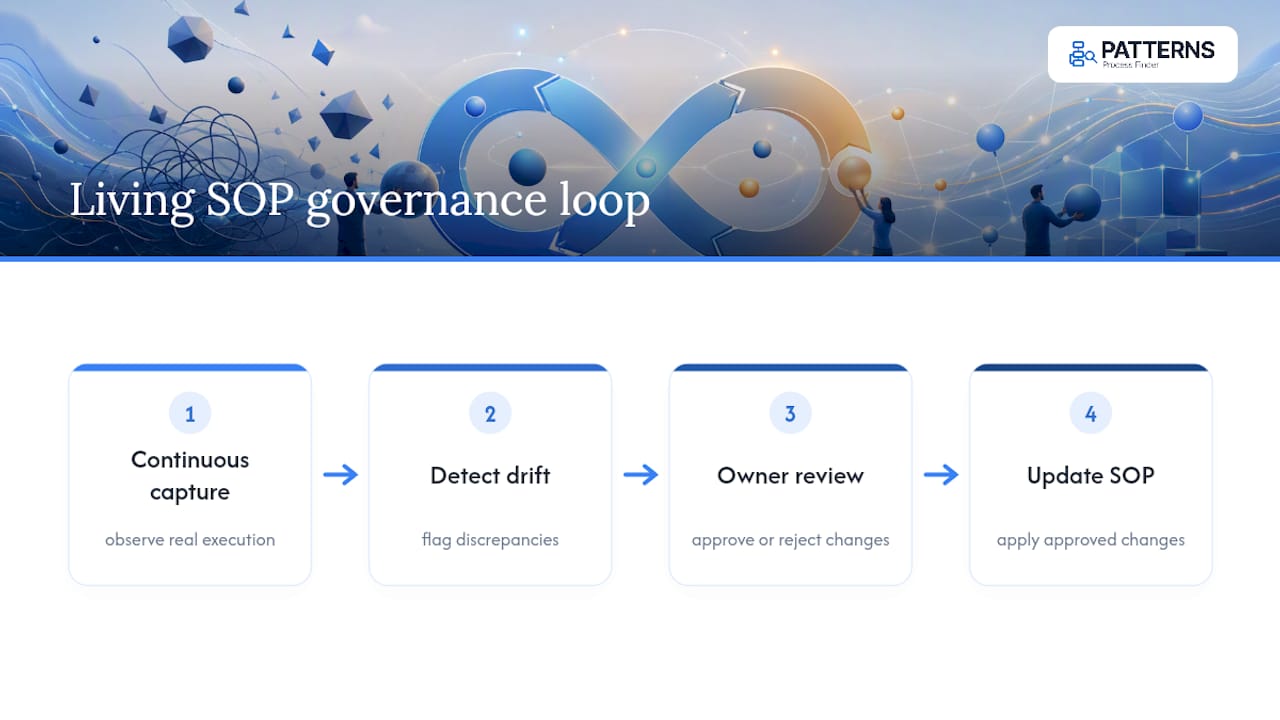
This model directly targets the three root causes covered earlier: it recovers tacit exceptions through observation rather than interviews, it prevents decay by flagging drift as it happens instead of waiting for a scheduled review, and it gives the named owner something concrete to act on instead of an open-ended maintenance obligation.
What separates teams that keep documentation alive
The teams that keep documentation accurate don’t run better documentation projects. They stop treating documentation as a project at all and start treating it as infrastructure, something that needs monitoring and upkeep the same way a production system does.
The cultural shift is small but specific: a named owner for every procedure, a review triggered by a real event rather than a date on a calendar, and enough friction removed from the update process that fixing an error takes minutes, not weeks.
— Malek
A practical next step: build living SOPs instead of static ones
If the failure modes above sound familiar, the fix isn’t a documentation sprint. It’s changing how documentation gets built in the first place. Automated process discovery tools capture how work actually happens across desktop and browser applications, surfacing the subprocess variations and client-specific rules that interviews and manual write-ups routinely miss.
Instead of a document that’s accurate for one day and stale for the next hundred, automated discovery generates continuous update candidates as real execution shifts, which targets the exact decay problem covered earlier without requiring a writer to manually catch every change. Ownership still sits with a person. What changes is the detection work behind it, handled through privacy-conscious behaviour tracking rather than another round of interviews. Teams evaluating whether this fits their situation can compare Basic, Pro, and Enterprise plans to see which level of deployment matches their current documentation gaps, or start with a request for a demo to see how the capture process works against a real workflow before committing to anything.
Sources
For deeper background on the ideas covered here, the SOP maintenance guide from Trainual covers event-driven review triggers in detail, while Flowscope’s piece on documentation rot makes the strongest case for observation over interviews. The ComplianceOnline breakdown of SOP audit failures is worth reading for anyone in a regulated industry.
- The trust protocol: building user confidence through transparent documentation
- Top 5 issues with the creation, management and implementation of standard operating procedures
FAQ
What is the best way to document a process?
The most reliable approach combines direct observation of the work with a short, runnable format rather than a long written narrative. Watching how a task actually gets done recovers exceptions and judgment calls that interviews miss, and pairing that observation with a lightweight checklist or decision tree keeps the result usable at the moment someone needs it.
How do you fix a documentation error once it’s found?
Fix it immediately and visibly, not on the next scheduled review cycle. Give the correction a low-friction path (an open edit flow with version history) and make sure the named owner is notified, since structurally late calendar reviews are one of the main reasons small errors sit unfixed for months.
What are common poor documentation practices in process records?
Three recur constantly: writing steps from an interview instead of observed execution, which misses tacit exceptions; leaving no named owner accountable for accuracy; and reviewing only on a fixed calendar instead of reacting to real triggers like tool changes or repeated deviations. All three show up repeatedly in audit findings across regulated industries.
What are the best tools for process documentation?
The right tool depends on how much the underlying process changes. A static wiki works for stable, rarely changing tasks, while fast-changing or exception-heavy workflows benefit from automated discovery tools that generate living SOPs from real execution data. Certain tools are built specifically to capture actual workflow behaviour rather than relying on someone’s memory of how the process should run.
How much does Patterns Process Finder cost?
Pricing is organized into Basic, Pro, and Enterprise plans, and current details are available directly on the pricing page.