
Conformance checking: a practical guide for process professionals
Conformance checking is the process-mining method that compares an event log against a process model to detect, localise, and quantify deviations between how a process was designed and how it actually executes. The three most common applications are compliance auditing and cost avoidance, model evaluation during process improvement projects, and continuous operational monitoring. Running a conformance check requires two inputs: an event log (structured records of real process executions) and a reference process model. The primary techniques you will encounter are:
- Token-replay: a heuristic method that simulates token flow through a Petri net to count produced, consumed, missing, and remaining tokens
- Alignments: an optimal-search method that finds the lowest-cost mapping between each observed trace and the model
- Footprint matrices: a behavioural comparison of activity ordering patterns between log and model
Key takeaways
Conformance checking delivers its highest value when token-replay screening is combined with selective alignment-based diagnosis, grounded in clean event logs and well-specified reference models.
| Point | Details |
|---|---|
| Start with token-replay | Use token-replay for fast, large-scale fitness screening before committing to computationally expensive alignment runs. |
| Alignments for root cause | Apply alignments selectively to the highest-deviation cases to get exact, auditable localisation of compliance failures. |
| Data quality is the bottleneck | Preprocessing (label standardisation, timestamp sorting, incomplete-trace filtering) determines diagnostic reliability more than algorithm choice. |
| Govern continuously | Move beyond one-off checks by building pipelines, setting fitness thresholds, and assigning named process owners with remediation SLAs. |
| Patterns Process Finder accelerates the workflow | Automated process discovery with Patterns Process Finder provides clean, continuously updated event sources and living SOPs that reduce time-to-diagnosis in conformance workflows. |
Table of Contents
- Why does conformance checking matter in process mining and BPM?
- What inputs and model types does conformance checking need?
- What are the main conformance checking techniques and when should you use each?
- Which algorithms and tools implement these techniques?
- How do you measure and interpret conformance results?
- What are the common pitfalls and how do you avoid them?
- How do you operationalise conformance checking at scale?
- Where conventional wisdom on conformance checking falls short
- How Patterns Process Finder supports conformance workflows
- Useful sources and further reading
- FAQ
Why does conformance checking matter in process mining and BPM?
Process mining sits at the intersection of data science and business process management. Discovery algorithms build models from logs; enhancement algorithms improve them. Conformance checking is the third pillar: it measures the gap between the reference model and observed behaviour, giving organisations a quantified, evidence-based view of process adherence.
Three mini-cases illustrate the practical stakes:
Audit and cost avoidance. A North American healthcare insurer running a claims-processing audit used token-replay to screen a large volume of traces in hours. Deviations flagged by the fitness score pointed to a cluster of claims where mandatory pre-authorisation steps were skipped, exposing the organisation to regulatory penalties and unnecessary payouts.
Fraud detection. A financial services firm applied alignment-based conformance analysis to its loan-origination log. Cases where the sequence of identity verification and credit-check activities was inverted correlated strongly with fraudulent applications, a pattern invisible to rule-based monitoring.
Model validation. A logistics company used footprint matrices to compare a newly designed BPMN model against six months of historical execution data before deploying an RPA bot. The comparison revealed that the model omitted a frequent exception path, preventing a costly automation failure at launch.
The organisational outputs practitioners should expect include:
- A fitness score (0–1) quantifying how well the log conforms to the model
- Localised deviations pinpointing which activities or transitions are problematic
- Diagnostic traces showing case-level deviation patterns for root-cause analysis
- Precision and generalisation scores indicating whether the model is over- or under-specified
Pro Tip: Before investing in alignment computation, run a quick fitness screen with token-replay. A fitness score above 0.95 on a representative sample often means the model is sound and deeper diagnosis can be scoped to the outlier cases only.
The state-of-the-art literature on conformance techniques notes that current research concentrates heavily on control-flow, leaving data and role perspectives as meaningful blind spots. Practitioners working in regulated North American industries should treat control-flow conformance as a floor, not a ceiling.
What inputs and model types does conformance checking need?
Event log essentials
Every event log must carry at minimum three attributes per event: a case identifier (the process instance), an activity name, and a timestamp. Optional but high-value attributes include resource (who performed the activity), cost, and outcome. Missing any of these degrades diagnostic quality.
Model types and their requirements
| Model type | Formalism | Log requirement | Typical use |
|---|---|---|---|
| Petri net | Places, transitions, arcs | Activity labels matching transitions | Token-replay, alignments |
| BPMN | Gateways, tasks, events | Activity labels matching tasks | Model evaluation, stakeholder review |
| Declarative (e.g., Declare) | Constraints (existence, response) | Full trace with all activities | Constraint-based conformance |
| Process tree | Hierarchical operators | Activity labels | Efficient alignment computation |
BPMN models are often converted to Petri nets before algorithmic analysis because most conformance tools operate natively on Petri net semantics.
Preprocessing checklist
| Issue | Symptom | Recommended fix |
|---|---|---|
| Out-of-order timestamps | Negative durations, replay errors | Sort events by case ID then timestamp |
| Incomplete traces | Artificially low fitness | Filter or flag open cases separately |
| Label inconsistency | High missing-token counts | Standardise activity names to a controlled vocabulary |
| Abstraction mismatch | Model too coarse or too fine | Align log granularity to model level before running checks |
| Duplicate events | Inflated trace lengths | Deduplicate on (case ID, activity, timestamp) |
Spending time on preprocessing consistently returns better diagnostic signal than spending the same time tuning algorithm parameters.
What are the main conformance checking techniques and when should you use each?
Technique families
Token-replay simulates each trace through a Petri net, producing and consuming tokens at transitions. When a required token is absent, a missing token is created artificially; tokens left at the end are counted as remaining. The four counters (produced, consumed, missing, remaining) feed directly into the fitness formula. The method is fast and scales to large logs, but it is heuristic: it does not guarantee the globally optimal match between trace and model.
Alignments treat conformance as an optimisation problem. For each trace, the algorithm searches for the sequence of model moves and log moves that minimises a cost function, producing the optimal alignment. This guarantees the best possible match and provides precise localisation of deviations, but the computational cost grows with model complexity and log size.
Footprint matrices compare the directly-follows relations observed in the log against those permitted by the model. The method is fast and model-agnostic but produces only aggregate statistics; it cannot localise deviations to individual cases.
Multi-perspective checks extend control-flow conformance to include data payloads, resource assignments, and timing constraints. These are particularly relevant for sanctions and sensitive compliance contexts where a correct activity sequence with the wrong data values still constitutes a violation.
Technique comparison
| Dimension | Token-replay | Alignments | Footprint matrices | Multi-perspective |
|---|---|---|---|---|
| Type | Heuristic | Optimal | Behavioural | Hybrid |
| Scalability | High | Low–Medium | Very high | Medium |
| Diagnostic depth | Trace-level (approximate) | Trace-level (exact) | Aggregate only | Trace + data/resource |
| Input requirement | Petri net + log | Petri net/process tree + log | Any model + log | Extended model + enriched log |
| Best use case | Early screening, large logs | Root-cause diagnosis | Quick model comparison | Regulated compliance |
Decision rules for practitioners
- Use token-replay when you need a fast fitness estimate across a large log or want to triage which cases warrant deeper analysis.
- Use alignments when you need exact deviation localisation, root-cause evidence for auditors, or are evaluating competing model variants.
- Use footprint matrices when comparing two model versions or doing a preliminary behavioural sanity check before committing to replay or alignment computation.
- Use multi-perspective checks when the compliance requirement involves data values, roles, or timing, not just activity order.
Which algorithms and tools implement these techniques?
The core algorithmic families are well-established, but recent research has addressed practical limitations that matter for production deployments.
Token-replay variants have evolved beyond the original formulation. Improved token-based replay implementations increase scalability and address token-flooding, a failure mode where a model with many parallel branches generates an exponential number of tokens that distort fitness scores. Mitigation strategies include model simplification, subnet localisation, and projection onto relevant subprocesses.
Alignment algorithms use A* search or variants over the product of the log trace and the model’s state space. For complex Petri nets, the state space explodes, making alignments impractical without decomposition or approximation. Process trees reduce this cost significantly because their hierarchical structure limits the search space.
Federated conformance checking is an emerging area relevant to North American organisations that cannot centralise logs across business units or partners due to privacy regulations. Recent preprint work on federated approaches demonstrates that conformance analysis can run on distributed logs without aggregating sensitive data, a capability increasingly relevant under provincial and state privacy frameworks.
Key tools and resources:
- PM4Py: Python library maintained by Fraunhofer that implements token-replay, alignments, footprint matrices, and diagnostics. The primary open-source entry point for practitioners.
- Conformance Checking Challenge (CCC 2020): Provides real-world event logs and reference models for benchmarking algorithm implementations. Useful for validating your tool setup before applying it to proprietary data.
The RWTH Aachen process mining resource provides accessible explanations of token-replay and alignment mechanics alongside use-case summaries, making it a reliable starting point for teams new to the field.
How do you measure and interpret conformance results?
Core metrics
| Metric | What it measures | Formula basis | Interpretation |
|---|---|---|---|
| Fitness | Fraction of observed behaviour the model can reproduce | Missing/remaining tokens or alignment cost | > 0.95: high conformance |
| Precision | Fraction of model behaviour actually observed in the log | Escaping edges or anti-alignment cost | Low precision = over-general model |
| Generalisation | Degree to which the model covers unseen but plausible behaviour | Frequency-weighted node coverage | Low generalisation = overfitted model |
| Simplicity | Structural parsimony of the model | Arc/transition ratio | Low simplicity = model too complex to maintain |
High fitness combined with low precision is a common and underappreciated pattern. It means the model accepts almost everything, including behaviour that should be flagged as deviant. A model that allows every possible activity sequence will always score perfect fitness but provides no diagnostic value.
What are the common pitfalls and how do you avoid them?
- Model over-specification. A model that mandates every observed variant will flag legitimate process behaviour as deviant. Expert interviews on automated compliance checking consistently identify over-specification as a primary source of false positives. Iterative model refinement with stakeholder input is the standard mitigation.
- False confidence from control-flow-only checks. A process can be perfectly sequenced yet still non-compliant if the wrong resource performed a step or a data value was incorrect. Automated compliance checking research confirms that combining semantic methods with structured rule representation increases coverage, but human judgement remains necessary for subjective requirements.
How do you operationalise conformance checking at scale?
Moving from a one-off conformance check to a continuous monitoring capability requires deliberate governance, not just better tooling.
Building the pipeline
- Connect your event-log source to a scheduled extraction job (daily or weekly depending on process velocity).
- Apply the preprocessing pipeline automatically: timestamp sorting, label normalisation, incomplete-trace filtering.
- Run token-replay on the full log; store fitness, precision, and deviation counts in a time-series database.
- Trigger alignment runs automatically when fitness drops below the defined threshold or when a new model version is deployed.
- Push results to a dashboard visible to process owners, compliance leads, and auditors.
Continuous compliance automation reduces repeated evidence collection and supports a shift-left approach where compliance issues are caught close to execution rather than at the annual audit. The efficiency gains are most pronounced in high-volume, regulated processes such as financial transaction processing, healthcare claims, and supply-chain approvals.
Governance checklist
- Assign a named owner for each monitored process model (process owner or compliance lead)
- Define fitness and precision thresholds with documented rationale
- Set remediation SLAs: how quickly must a flagged deviation be investigated and resolved?
- Version-control all reference models alongside their deployment dates
- Document waiver decisions (cases where a deviation is accepted as a legitimate variant) to improve model accuracy over time
- Maintain an audit trail of every conformance run, threshold change, and remediation action
Pro Tip: When presenting conformance results to regulators or auditors, use visual process maps that overlay deviation frequency directly on the model. A heat-map view of where deviations concentrate is far more persuasive than a fitness score in isolation, and it reduces the time auditors spend interpreting raw diagnostic output.
For teams scaling governance across multiple processes, an automation centre of excellence provides the organisational structure to standardise thresholds, share model libraries, and coordinate remediation across business units.
Pro Tip: Capture every waiver decision in a structured log with the case ID, the deviation type, the approver, and the business justification. Over time, clusters of waivers for the same deviation type are strong evidence that the reference model needs updating, not that the process is non-compliant.
Where conventional wisdom on conformance checking falls short
Most practitioners treat conformance checking as a measurement exercise: run the algorithm, read the fitness score, report to the audit committee. That framing misses the most valuable part of the work.
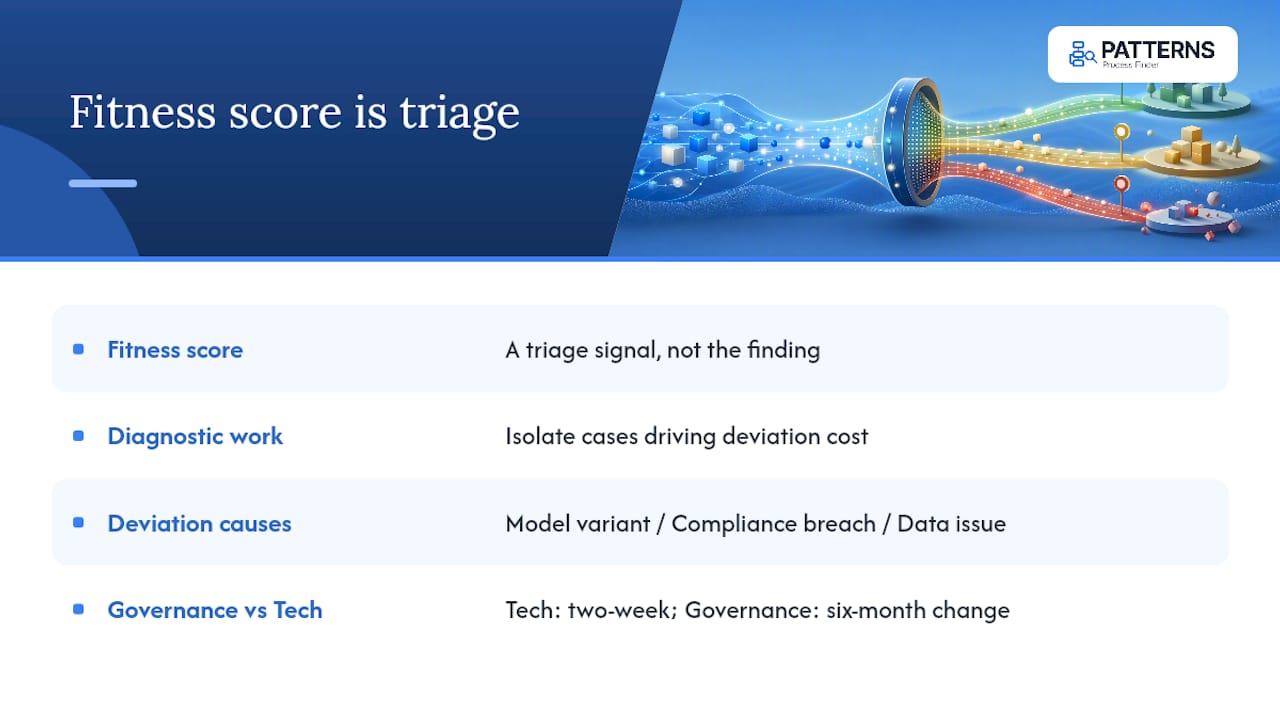
The fitness score is not the finding. It is the triage signal. The real diagnostic work happens when you isolate the cases driving deviation cost and ask whether you are looking at a process variant that should be modelled, a genuine compliance breach that needs escalation, or a data-quality problem that invalidates the analysis entirely. Conflating these three categories is the most common and costly mistake in applied conformance work.
There is also a persistent overconfidence in control-flow conformance. A process can execute in perfect sequence and still be non-compliant: the wrong person approved a transaction, a required data field was blank, a timing constraint was violated. The literature is clear that control-flow conformance is a necessary but insufficient condition for regulatory compliance in most North American regulated industries. Multi-perspective checks are not an advanced option for researchers; they are a practical necessity for anyone running conformance analysis in healthcare, financial services, or supply chain.
The governance piece is where most organisations stall. Building a conformance pipeline is a two-week project. Building the ownership model, the remediation SLAs, and the waiver-documentation process is a six-month organisational change. The technology is the easy part.
How Patterns Process Finder supports conformance workflows
The hardest part of conformance checking in practice is not the algorithm. It is getting a clean, reliable event log that actually reflects how work happens, not how the system was configured to record it.
Patterns Process Finder captures real user actions across desktop and browser applications automatically, producing event logs that reflect actual execution rather than idealised system records. When deviations surface in a conformance check, Patterns reduces time-to-diagnosis by providing the subprocess-level detail and exception patterns that standard system logs omit. Conformance findings feed directly into living SOPs that update as process behaviour changes, closing the loop between diagnosis and remediation.
For teams ready to move from one-off conformance checks to continuous monitoring, Patterns provides the operational visibility layer that keeps process owners and compliance leads informed between formal audit cycles. Request a demo or start with the process-mining tool to see how automated discovery integrates with your conformance workflow.
Useful sources and further reading
- Techniques for conformance checking and multi-perspective algorithms (Springer)
- Improved token-based replay and PM4Py implementation (CEUR)
- Conformance checking: a state-of-the-art literature review (ACM)
- The challenge of automated compliance checking: review and domain applications (SSRN)
- Conformance checking - Process Mining (RWTH Aachen)
- Federated conformance checking (arXiv)
- Conformance Checking Challenge (CCC 2020)
- Exploring continuous compliance automation in 2025 (RegScale blog)
- The challenge of Automated Compliance Checking: a regulatory view (doi.org/ec3.2025.264)
FAQ
What is conformance checking?
Conformance checking is a process-mining technique that compares an event log of real process executions against a reference process model to detect and quantify deviations. It produces metrics such as fitness and precision, and localises where in the process the observed behaviour diverges from the modelled behaviour.
What is conformance checking in process mining?
In process mining, conformance checking is one of three core functions alongside process discovery and process enhancement. It takes an event log and a process model as inputs and uses techniques such as token-replay or alignments to measure how well actual executions conform to the intended process design.
How does a conformance checker work?
A conformance checker replays each trace from the event log against the process model, either by simulating token flow (token-replay) or by computing the lowest-cost mapping between observed and modelled behaviour (alignments). The output includes a fitness score, deviation locations, and case-level diagnostic traces.
When should I use alignments instead of token-replay?
Use alignments when you need exact, auditable localisation of deviations for root-cause analysis or regulatory reporting. Use token-replay when you need fast, large-scale fitness screening across a high-volume log and are willing to accept approximate diagnostics in exchange for speed.
What does conformance mean in a process context?
In a process context, conformance refers to the degree to which actual process executions match the behaviour specified by a reference model. High conformance means the process runs as designed; low conformance signals deviations that may indicate compliance failures, process variants, or data-quality issues requiring investigation.