
Operational visibility: the APD guide for ops teams
TL;DR:
- Operational visibility, through automated process discovery software, reveals actual work processes across applications in real time. Running scoped pilots on high-volume subprocesses with strong governance and validation ensures measurable ROI and accurate documentation. Continuous observation of deviations and exceptions helps maintain effective automation, reducing failure rates and improving process evaluation.
Operational visibility, in the context of this article, means automated process discovery (APD): software that records real user actions across desktop and browser applications to reveal how work actually happens, not how it was documented years ago. The recommended next step for most mid-to-large organisations is a scoped pilot targeting one high-volume or high-error subprocess, run over a few weeks to validate ROI, data controls, and developer handoffs before any enterprise rollout.
A solid pilot covers these essentials:
- A clearly bounded subprocess (invoice processing, onboarding, claims handling)
- Stakeholder alignment across process owners, security, and automation leads
- Privacy controls confirmed before capture begins (PII redaction, retention limits)
- Baseline KPIs measured before day one so gains are provable
- Developer-ready artefacts as the exit criterion, not raw click logs
Pro Tip: Target a subprocess where you already suspect a gap between documented and actual behaviour. That gap is where APD pays off fastest.
Table of Contents
- What operational visibility actually means here
- How AI-powered automated process discovery works
- What APD delivers for operations and automation teams
- Signs your organisation needs APD now
- A practical playbook: from pilot to scale
- Security and privacy when capturing user activity
- How to measure whether APD is working
- Common pitfalls and how to avoid them
- Evidence that APD produces measurable outcomes
- Key takeaways
- The case for treating visibility as infrastructure
- Patterns Process Finder gives you discovery that pays for itself
- Useful sources
- FAQ
What operational visibility actually means here
Operational visibility, as used throughout this article, refers specifically to APD and workflow capture. It is the practice of using AI to observe, record, and structure real user behaviour across applications so that process teams can see, with evidence, how work gets done.
Core capabilities that define APD:
- Living SOPs: — captured workflows are turned into continuously updated documentation that reflects current execution
This article does not cover IT or infrastructure observability (system monitoring, availability dashboards, or telemetry pipelines). That is a separate discipline with a different audience.
How AI-powered automated process discovery works
Automated process discovery uses AI and machine learning to record user actions across multiple applications and infer the underlying process structure from real behaviour. The pipeline runs silently in the background, which reduces the observer effect and produces more honest data about how work actually gets done.

The data flow moves through five stages:
| Stage | What happens |
|---|---|
| Capture | A lightweight desktop agent records application events, clicks, and keystrokes in real time |
| Ingest | Raw event streams are encrypted in transit and stored with short retention windows |
| Process | ML clusters events into sequences, detects variants, and identifies exception branches |
| Map | The engine generates visual process maps and living SOPs from confirmed patterns |
| Handoff | Developer-ready artefacts (step-by-step workflows, exception maps, test assets) are exported to RPA or BPM teams |
Security controls sit at every stage: encryption in transit and at rest, automatic PII redaction before storage, role-based access to captured data, and audit logs of every query or export. The non-disruptive capture model matters because employees who know they are being watched tend to follow the documented process rather than the real one.
What APD delivers for operations and automation teams
APD reduces discovery time, lowers automation failure rates, and creates accurate living SOPs that update as processes evolve. Those three outcomes address the most common reasons automation projects stall: developers build against a process that does not match reality, and the bot fails in production.
Top benefits:
- Faster discovery-to-automation cycle, cutting weeks of manual process interviews
- Reality-based process maps that capture what employees actually do, including workarounds
- Automatic exception detection, surfacing the costly deviations that manual documentation misses
- Continuous SOP upkeep without recurring workshop effort
- Cleaner developer handoffs with structured, test-ready artefacts
Use cases where APD delivers measurable value:
- RPA candidate identification: rank subprocesses by automation potential based on frequency, variation, and exception rate
- Release testing assets: generate test scripts directly from captured user paths
- Onboarding SOPs: produce accurate training documentation from top-performer workflows
- Compliance evidence: maintain an auditable record of how regulated processes are actually executed
- Continuous improvement: track process drift over time and flag when a subprocess diverges from its baseline
Academic research confirms that adopting APD improves an organisation’s ability to visualise and evaluate operational performance, closing the information gap between process teams and domain experts.
Signs your organisation needs APD now
Prioritise APD when documented processes diverge from outcomes, automation failure rates are high, or exception handling consumes disproportionate time. The signals are usually visible before any tooling is deployed.
Checklist — act if two or more apply to a top-10 process:
- Automation bots fail or require frequent manual intervention
- Process documentation was last updated more than 12 months ago
- Onboarding new staff to a process takes more than two weeks
- Exceptions and rework account for a significant share of processing time
- Different teams or sites handle the same process differently with no documented reason
- Manual handoffs between systems are long and error-prone
If two or more of these are true for a process in your top 10 by volume or cost, a pilot is justified. The cost of not knowing is already showing up in your error rates and developer rework.
A practical playbook: from pilot to scale
A scoped pilot of limited duration is the right first move for most mid-to-large organisations. It is short enough to produce credible evidence and bounded enough to manage privacy and governance risk.
Sequenced steps:
- Define scope: select one high-volume or high-error subprocess
- Align stakeholders: process owner, security/privacy lead, automation developer, analyst, executive sponsor
- Set up data governance: confirm PII redaction rules, retention windows, and access controls
- Deploy collectors: install lightweight agents on a representative sample of workstations
- Run capture: observe the process for 2–4 weeks across sufficient transaction volume
- Validate maps: review generated process maps with process owners for accuracy
- Prioritise automations: rank identified variants and exceptions by effort and value
- Measure pilot KPIs: compare against pre-capture baseline (see Section 8)
- Plan scale: document governance model, integration points, and rollout sequence
Prototype timeline:
| Weeks | Activity |
|---|---|
| Initial weeks | Scope, stakeholder alignment, governance setup |
| Following weeks | Capture and data collection |
| Subsequent weeks | Map validation and exception review |
| Later weeks | KPI measurement, artefact packaging, scale planning |
Pilot success criteria: multiple automation opportunities identified, developer-ready artefacts produced, privacy controls validated by the security lead, and baseline KPIs measured.
Security and privacy when capturing user activity
APD can be secure when it uses encryption, automatic redaction, minimised retention, access controls, and audit logging. These are not optional features; they are the conditions under which employee activity capture is ethically and legally defensible.
Essential controls to validate before pilot rollout:
- Encryption in transit (TLS) and at rest for all captured event data
- Automatic PII redaction before data leaves the endpoint
- Short retention windows for raw captures (typically 30–90 days)
- Role-based access so only authorised analysts can query process data
- Employee notice and consent practices aligned with your jurisdiction’s privacy requirements
- Audit logs recording every access, export, and deletion event
- Integration with existing identity providers (SSO, directory services)
Governance responsibilities should be assigned explicitly: a privacy lead reviews the data governance plan before capture begins, legal confirms notice obligations, and the security team validates that the collector integrates with existing SOC tooling. Patterns Process Finder’s security and privacy controls cover encryption, access management, and redaction practices for teams that need to review a vendor’s posture before procurement.
How to measure whether APD is working
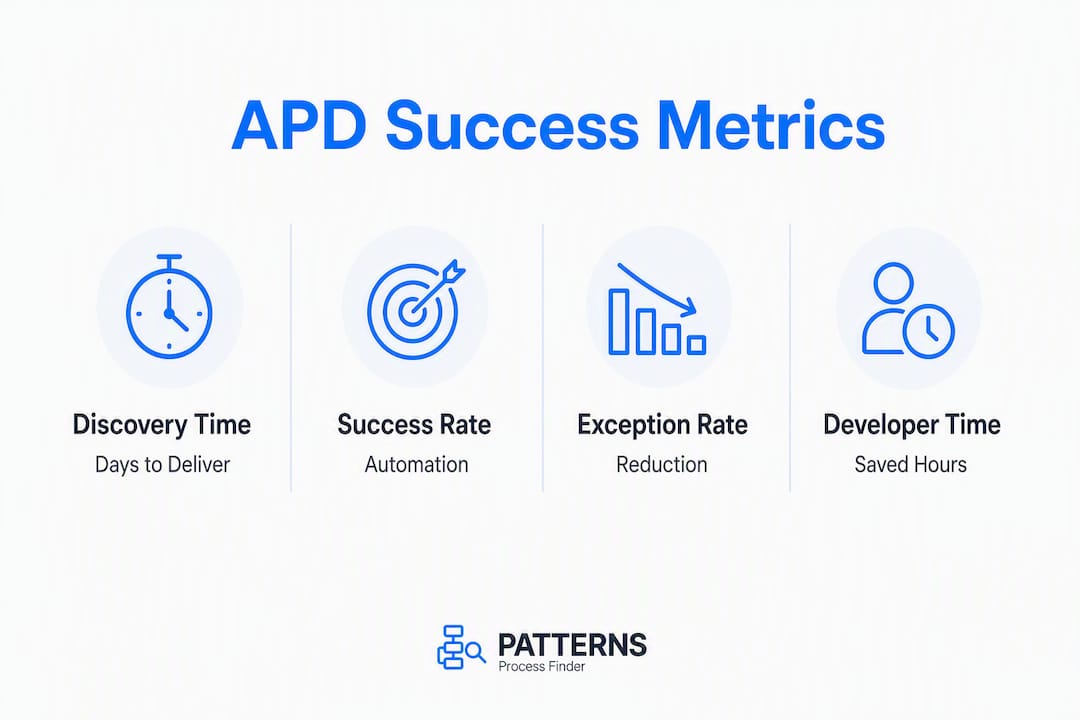
Measure discovery velocity, automation success rate, exception rate reduction, developer time saved, and cost per transaction. Each metric needs a pre-capture baseline to be meaningful.
| KPI | Formula / measure | Measurement window |
|---|---|---|
| Discovery time | Days from project start to developer-ready artefacts | Pilot: compare to previous manual effort |
| Automation success rate | Completed automated runs ÷ total runs | Pilot: 4–12 weeks; Scale: 3–6 months |
| Exception rate | Exceptions logged ÷ total transactions processed | Pilot baseline vs. post-optimisation |
| Developer throughput | Artefacts produced per sprint | Pilot vs. pre-APD sprint velocity |
| Cost per transaction | Total process cost ÷ transaction volume | Scale: 3–6 months post-deployment |
Baseline sources include historical ticket data, RPA run logs, and time-and-motion studies conducted before capture begins. Without a baseline, pilot results are directional at best.
Common pitfalls and how to avoid them
Most APD pilots fail because of poor scope, a focus on the happy path only, weak governance, or insufficient stakeholder buy-in. Each failure mode has a straightforward mitigation.
- Scope too broad: capture across 15 processes simultaneously produces data overload and no clear wins. Start with one subprocess.
- Happy-path bias: if capture runs for too short a period, exceptions are underrepresented. Run capture long enough to observe a full distribution of transaction types.
- Insufficient privacy controls: deploying collectors before redaction rules are confirmed creates compliance exposure. Governance setup must precede capture.
- No developer handoff plan: raw process maps without structured artefacts slow RPA teams down rather than accelerating them. Define the artefact format before capture begins.
- One-time project mindset: treating APD as a discovery sprint rather than a continuous capability means process drift goes undetected. Schedule recurring capture cycles tied to your change-control calendar.
Evidence that APD produces measurable outcomes
Independent research and client case evidence show APD reduces discovery time and improves process accuracy. The gains are not theoretical.
- Academic case study evidence from an IT service provider confirms that APD adoption improves an organisation’s ability to visualise and evaluate operational performance, closing the gap between process teams and domain experts.
- Citi Ventures describes APD as a technology that works in the background, takes screenshots for user-perspective insights, and identifies hidden subprocesses and common patterns that manual documentation misses.
- Patterns Process Finder’s process discovery platform frames discovery as a capability that reduces time-to-insight and produces developer-ready artefacts to speed automation pipelines.
The highest-value discoveries consistently come from exception patterns rather than the happy path. Capturing and analysing deviations reveals the costly inefficiencies that documented SOPs never show.
Key takeaways
Operational visibility through APD is a continuous capability, not a one-time project: organisations that treat it as such reduce automation failure rates, accelerate developer handoffs, and maintain accurate SOPs as processes evolve.
| Point | Details |
|---|---|
| Pilot scope matters | Target one high-volume or high-error subprocess for a 2–4 week pilot to produce credible, bounded results. |
| Governance before capture | Confirm PII redaction, retention windows, and access controls before any collector is deployed. |
| Measure against a baseline | Establish discovery time, automation success rate, and exception rate before capture begins so pilot gains are provable. |
| Exceptions are the signal | Capturing deviation patterns, not just the happy path, reveals the inefficiencies that cost the most. |
| Patterns Process Finder | Patterns Process Finder automates capture, generates living SOPs, and produces developer-ready artefacts; request a demo to validate fit before committing to a rollout. |
The case for treating visibility as infrastructure
The conventional wisdom in automation circles is that process discovery is a phase: you do it once, hand off the maps, and move on. That framing is why so many RPA programmes plateau after the first wave of bots. Processes drift. Exceptions accumulate. The documented SOP from 18 months ago no longer reflects what the team actually does, and the next automation project starts from the same flawed baseline.
The more useful mental model is to treat operational visibility the way you treat monitoring in a production environment: as infrastructure that runs continuously and alerts you when something changes. The organisations that get compounding value from APD are the ones that schedule recurring capture cycles, tie them to their change-control calendar, and use the output to keep their automation backlog current.
The other underestimated point is the exception data. Most teams focus APD on confirming the happy path, then wonder why their bots still fail. The real intelligence is in the deviations: the client-specific rules, the workarounds, the one-in-ten transactions that a senior analyst handles differently. Those patterns are invisible to interviews and workshops. They show up only when you observe at scale.
Patterns Process Finder gives you discovery that pays for itself
Stop building automation on process maps that were outdated before the project started. Patterns Process Finder captures real user execution across desktop and browser applications, surfaces hidden subprocess variations and exception patterns, and turns that data into living SOPs and developer-ready artefacts your RPA team can act on immediately.
Security and governance are built in: encryption in transit and at rest, automatic PII redaction, role-based access, and audit logging are standard, not add-ons. Subscription tiers from Basic through Enterprise mean you can start a scoped pilot without a long procurement cycle, then scale when the evidence is there. Review pricing options or request a demo to see capture, map validation, and artefact output on a process you choose.
Useful sources
- Automated Process Discovery: Smarter Automation through AI (Citi Ventures) — Authoritative definition of APD, how background capture works, and how hidden subprocesses are identified.
- Academic case study on process discovery benefits (WU Vienna) — Independent research confirming that APD improves process visibility and evaluation in an IT service provider context.
- Process clarity that pays for itself | Patterns Process Finder — Overview of Patterns’ capabilities, business value framing, and how discovery reduces time-to-insight.
- Living SOPs and workflow capture | Patterns Process Finder — Details on how captured workflows become continuously updated SOPs and developer-ready artefacts.
- Security and data privacy | Patterns Process Finder — Encryption, redaction, access controls, and governance practices for teams evaluating pilot security posture.
- Process mining tool for business analysts | Patterns Process Finder — Analyst-focused discovery capabilities, trial sign-up, and AI-driven insights for operations teams.
- Pricing plans | Patterns Process Finder — Subscription tiers and trial pathways for teams moving from pilot to procurement.
- Request a demo | Patterns Process Finder — Starting point for teams that want to validate capture quality and artefact output before committing to a rollout.
FAQ
What is operational visibility in the context of automation?
Operational visibility refers to automated process discovery (APD): software that records real user actions across applications to reveal how work actually happens, enabling accurate SOPs and reliable automation.
How long does an APD pilot typically take?
A scoped pilot targeting one subprocess typically runs 2–4 weeks, covering capture, map validation, exception review, and KPI measurement before any scale decision is made.
What security controls are required before deploying APD?
At minimum: encryption in transit and at rest, automatic PII redaction, short retention windows for raw captures, role-based access controls, and audit logging of all data access and exports.
How does Patterns Process Finder support developer handoffs?
Patterns Process Finder produces developer-ready artefacts including step-by-step workflows, exception maps, and test assets, giving RPA teams structured inputs rather than raw event logs.
How do you measure the success of an operational visibility pilot?
Track discovery time, automation success rate (completed runs ÷ total runs), exception rate, and developer throughput, all measured against a pre-capture baseline established before the pilot begins.