
Scale Automation With a Governance-First CoE Framework for Ops Teams
An automation CoE framework is the operating model that governs, prioritizes, and scales automation across an organization, turning scattered bot projects into a repeatable value engine. The single biggest driver of success is governance, not tooling: start with centralized decision rights and rigorous intake scoring, then evolve toward hybrid or federated delivery only once standards and platform guardrails are proven, as explored in detail in Government affairs outsourcing explained for leaders.
TL;DR:
- A formal CoE becomes necessary when automations grow beyond a handful, as it reduces friction, standardizes practices, and improves reuse and visibility.
- Starting with a centralized model is recommended if maturity is low or risk is high, then shifting towards hybrid or federated models as guardrails prove effective.
- An effective intake process requires scoring requests on value, complexity, and risk with a minimum threshold to ensure only high-priority automations proceed.
- Monitoring and incident management should be established before automations go live, with clear runbooks and purpose-built tools to handle outages efficiently.
- Process discovery tools surface hidden subprocess variants, improving intake accuracy and reducing rework caused by undocumented exception paths.
Table of Contents
- What is an automation CoE framework?
- Which operating model fits: centralized, hybrid, or federated?
- How do you govern intake, prioritization, and hypercare?
- Which roles do you need first, and when do you add more?
- What systems and standards does the CoE need to own?
- How do you prove the CoE is working?
- How does a CoE mature and when should it decentralize?
- How does process discovery cut CoE rework?
- Author perspective: a pragmatic playbook and three pitfalls
- Where discovery and living SOPs fit into your CoE
- Sources
- FAQ
What is an automation CoE framework?
A CoE is an operating model, not just a team. It owns the standards, platform, security baseline, and decision rights that let automation scale safely, while it enables business units to build within those guardrails rather than build everything itself.
Organizations typically need a formal CoE once they run more than a handful of automations, or once failure rates and rework start eating the savings automation was supposed to deliver. Below that threshold, ad hoc project teams can usually cope.
Forrester’s research found that the biggest wins from a mature CoE come from reducing organizational friction and tightening governance, not from more sophisticated bots. A functioning CoE delivers consistency across teams, visibility into what is actually running in production, and a growing library of reusable components that shortens every subsequent build.
Which operating model fits: centralized, hybrid, or federated?
The three models differ mainly in who builds and who governs.
- Centralized: the CoE builds and governs everything. Fast to control, slow to scale, and best suited to early-stage programs or heavily regulated environments.
- Hybrid (hub-and-spoke): the CoE owns the platform, standards, and identity/security layer while trained teams in the business build their own automations within approved patterns.
- Federated: business units own build and much of the governance, with the CoE limited to setting policy and auditing outcomes. This suits organizations with strong internal maturity and low regulatory risk.
Microsoft’s guidance on CoE operating models recommends starting central when maturity is low or risk is high, then migrating toward hub-and-spoke as teams and guardrails mature. In practice, expect to run two or three of these patterns simultaneously across different business units rather than picking one forever. The rule of thumb that holds up across most enterprise rollouts: start central, automate the guardrails so they don’t depend on manual review, then federate delivery once those guardrails hold under real load.
How do you govern intake, prioritization, and hypercare?
A short charter prevents the drift that kills most CoEs within eighteen months. It should state, in a page or less, what the CoE owns (platform, standards, security, exception handling) versus what it enables (citizen-built automations within approved patterns), plus one explicit scope boundary, such as “the CoE does not build automations touching regulated financial data without architecture sign-off.”
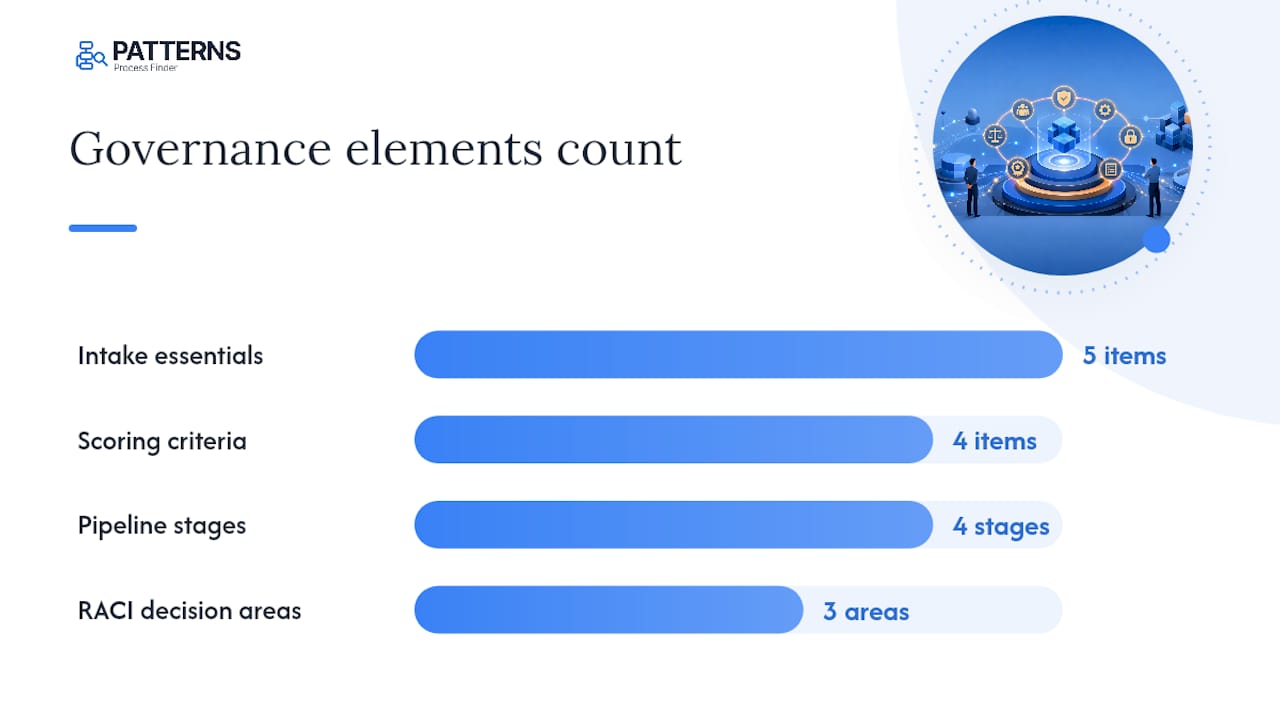
Automation Anywhere’s build guidance recommends pairing that charter with a RACI matrix. A workable sample assignment:
- Prioritization decisions: CoE lead is Accountable, business sponsor is Responsible, finance is Consulted, IT security is Informed.
- Architecture approval: Automation architect is Accountable and Responsible, CoE lead is Consulted, compliance is Informed.
- Exception and incident handling: Ops/support lead is Responsible, CoE lead is Accountable, affected business unit is Consulted.
Intake forms need five essentials: process description, estimated volume, current cycle time, systems touched, and exception frequency. Score each request against value, technical complexity, risk, and strategic fit, on a simple 1 to 5 scale per criterion, and require a minimum combined score before a process enters the pipeline. Pipeline stages should run idea, then queued, then in build, then deployed, and every deployment needs a mandatory hypercare window of two to four weeks before ownership transfers to steady-state support.
Pro Tip: Never skip hypercare to hit a launch date. The processes that fail early almost always fail on an exception path that was not scored during intake.
Which roles do you need first, and when do you add more?
Start with three to five roles: a CoE lead who owns the roadmap and stakeholder relationships, a solution architect who sets technical standards, an automation developer who builds the first wave, and an operations/support role who handles monitoring and incidents. A citizen-developer coach comes next once demand from business teams outpaces what the core team can build alone.
Expand the CoE when the intake queue consistently outpaces delivery capacity, or when a second business unit requests its own build rights under hub-and-spoke.
- Add a dedicated business analyst once intake volume exceeds roughly ten qualified requests per quarter.
- Add a security/compliance liaison once automations start touching regulated data or customer records.
- Build a champions network across business units to spread adoption without growing headcount.
- Run a structured curriculum, ideally with a certification checkpoint, before granting any citizen developer build access to production systems.
What systems and standards does the CoE need to own?
The CoE needs clear ownership over the automation platform, environment strategy, and identity/security integration, since inconsistent access controls are one of the fastest routes to a security incident in a scaled program. That means single sign-on, role-based permissions, and a documented pattern for how automations authenticate against enterprise systems.
Reusable component libraries and “golden path” templates matter more than most teams expect. A library of pre-approved connectors, error-handling patterns, and logging modules can cut build time on a new automation by a meaningful margin, because developers stop reinventing exception handling for every process.
Monitoring and incident ownership need a home before the first production failure, not after. A runbook naming who gets paged, what the rollback procedure is, and how incidents get logged saves hours during an actual outage. Purpose-built monitoring tools scale better than spreadsheets once you’re running more than a dozen production automations, mainly because spreadsheets don’t alert anyone at 2 a.m.
How do you prove the CoE is working?
A balanced scorecard across four pillars keeps the CoE honest and fundable: financial (hours saved, cost avoided), adoption (number of active builders, requests submitted), operational (uptime, exception rate), and delivery (pipeline velocity, reuse rate of components).
Camunda’s CoE handbook recommends keeping this set compact, with each metric assigned a named owner and a review cadence, because a short, auditable KPI set is more persuasive to finance than a headline “hours saved” figure alone.
A concrete practice worth adopting: measure hours saved against actual redeployment plans, not theoretical capacity. If a saved hour doesn’t map to a task someone was reassigned to, finance will discount the number, and rightly so.
Set review points at 30, 90, and 180 days after each automation goes live. The 30-day review checks for hypercare issues, the 90-day review checks adoption and reuse, and the 180-day review checks whether the financial case held up against actual production data.
How does a CoE mature and when should it decentralize?
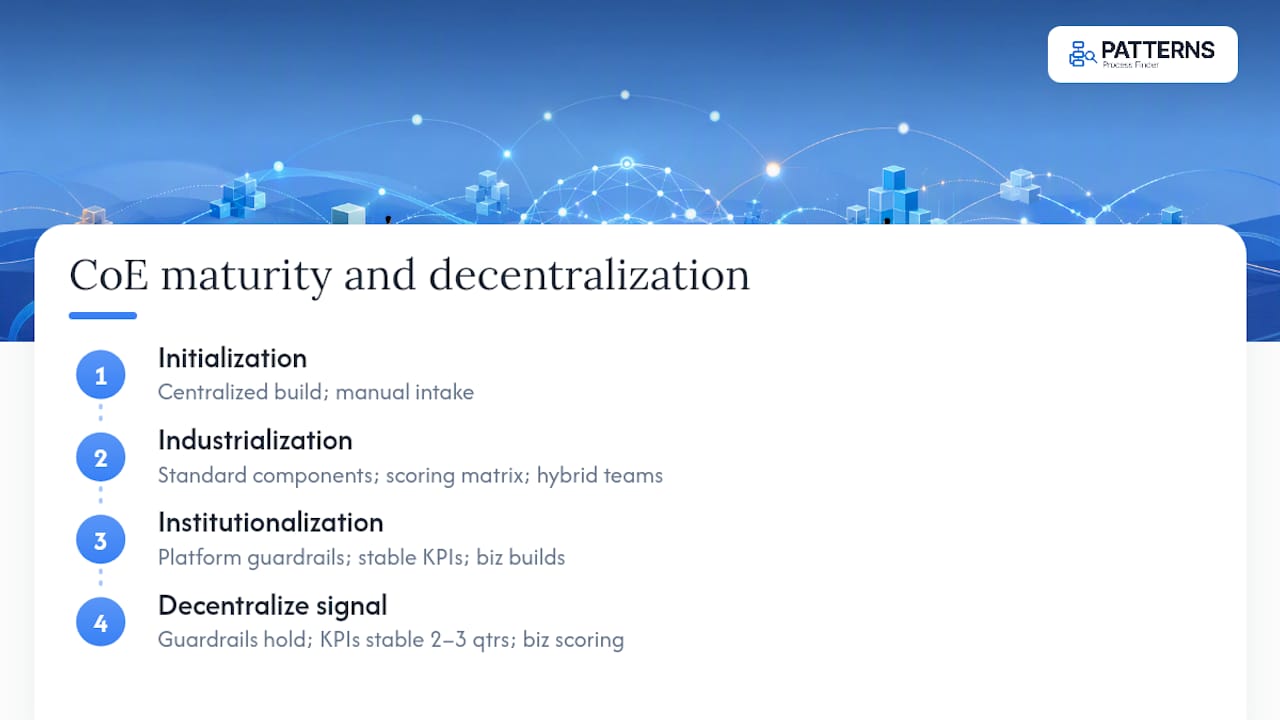
Most programs move through three stages. Initialization is centralized build, manual intake, and a small pipeline focused on proving early wins. Industrialization adds standard components, a formal scoring matrix, and the first hybrid delivery teams in the business. Institutionalization means platform-enforced guardrails, stable KPIs across multiple quarters, and business units building independently under audit rather than direct oversight.
The signal to decentralize isn’t a calendar date. It’s platform guardrails that hold without manual review, KPIs that stay stable for two or three consecutive quarters, and a business team that has already run its own scoring and intake process successfully at least once.
Scaling itself is a different kind of problem than piloting. Analysis on enterprise AI complexity shows that exception paths and integration complexity multiply faster than volume as programs scale, so adding developers alone never fixes a scaling problem. A CoE that succeeds treats itself as scaffolding, deliberately shrinking its hands-on role as capability spreads into the business rather than growing headcount indefinitely.
How does process discovery cut CoE rework?
Most automation failures don’t come from bad bot logic. They come from intake documentation that describes how a process is supposed to run, while the person actually doing the work follows three undocumented exception rules nobody wrote down. Automated discovery closes that gap by capturing real user actions across desktop and browser applications, surfacing hidden subprocess variants before a build ever starts.
- Discovery finds client-specific rules and exception branches that traditional interview-based mapping misses entirely.
- Living SOPs that update as the process changes give builders a reality-based specification, which shortens both the build phase and hypercare.
- A scoring matrix for deciding when to automate pairs well with discovery output, since accurate volume and exception data make intake scores far more reliable.
Pro Tip: Pilot discovery on one high-volume, high-exception process before rolling it out CoE-wide. That single pilot usually surfaces enough hidden variants to justify the approach on its own.
Author perspective: a pragmatic playbook and three pitfalls
If I had to compress a CoE launch into one sequence, it’s this: write the charter, staff the core team, build intake and scoring before you build anything else, prove value on two or three processes, then scale. The three mistakes I see most often are over-engineering the platform before proving demand, leaving decision rights vague so every exception becomes a political negotiation, and skipping hypercare to hit a launch date. Fix the second one first. Unclear decision rights are what actually kills momentum, long before technology does.
— Malek
Where discovery and living SOPs fit into your CoE
Intake accuracy is only as good as the process knowledge behind it, which is exactly where Patterns Process Finder earns its place in a CoE toolkit: it replaces guesswork-based documentation with living SOPs generated from observed work execution, rather than relying solely on process maps.
Manual process mapping still works for simple, low-volume processes with few exceptions. Once you’re scoring intake for a process with multiple system touchpoints and unpredictable exception rates, though, a discovery tool captures the real variants a workshop-based interview will never surface, and it does so in a fraction of the time.
If you’re running an SAP-heavy environment, SAP process discovery can produce living SOPs in two to four weeks, fast enough to feed straight into your next intake cycle. Start with one process on your CoE backlog, run it through discovery, and compare the resulting SOP against what your intake form currently assumes. If the gap surprises you, request a demo and pilot the approach on a second process before committing it to your standard playbook.
Sources
- Best practices for automation centers of excellence (Forrester)
- Operating models for automation CoEs (Microsoft Learn)
- How to build a center of excellence for automation (Automation Anywhere)
- Process automation CoE handbook (Camunda)
FAQ
What does CoE mean in technology?
CoE stands for Center of Excellence, a team or operating model that sets standards, governs decisions, and enables the rest of the organization to adopt a capability, such as automation, consistently and safely.
What is the Center of Excellence model?
It’s an operating structure that centralizes ownership of platform, standards, and governance while enabling business units to build within approved guardrails, rather than a single team that does all the work itself.
How do you build a CoE?
Start with a short charter defining what the CoE owns versus enables, staff a core team of three to five roles, set up intake and scoring criteria, and prove value on two or three processes before scaling the operating model outward.
What operating model should a new automation CoE choose?
Start centralized when maturity or risk is high, then evolve toward hub-and-spoke or federated delivery once platform guardrails and team readiness are proven, per Microsoft’s operating-model guidance.
How does process discovery improve CoE intake accuracy?
Automated discovery captures real user actions and hidden exception paths that manual interviews miss, giving intake scoring more accurate volume and complexity data before a process enters the build pipeline.