
Prevent Bot Failures With Data Anonymization Monitoring for Ops
Data anonymization monitoring, in the context of process discovery, means tracking anonymized employee activity and workflow-capture data to find how work actually happens without exposing who did it. The payoff is direct: teams uncover real process variants and automation candidates that documentation never captures, while privacy stays intact. The sections below walk through the techniques, the metrics that prove the trade-off is working, and the steps to run it on your own workflows.
TL;DR:
- Smaller, sensitive logs benefit from differential privacy with subsampling, while larger logs may require encryption-based discovery to balance utility and privacy.
- Re-running process discovery every six to twelve months with utility and coverage checks helps detect process drift before automation fails.
- Continuous privacy-aware monitoring reduces the risk of automation errors by revealing real process variations that static documentation often misses.
- Using metrics like process fitness, precision, and privacy epsilon ensures the anonymization maintains enough process detail for reliable automation decisions.
- Practical implementation requires careful scope definition, pilot testing, and governance to avoid distorted insights caused by incomplete logs or excessive noise.
Table of Contents
- What data anonymization monitoring looks like for process discovery
- Why privacy-preserving monitoring matters for automation programs
- Core techniques for privacy-preserving monitoring
- How to measure privacy vs. utility in monitoring outputs
- Operational checklist for implementing anonymization monitoring
- Patterns’ operational perspective on privacy-first monitoring
- The gap between academic anonymization and operational monitoring
- Try privacy-aware process discovery on your own workflows
- Sources
- FAQ
What data anonymization monitoring looks like for process discovery
This is not the general practice of scrubbing personal fields out of a customer database. In a process-discovery context, data anonymization monitoring means watching anonymized event logs and task-capture traces closely enough to confirm they still reveal genuine process behaviour after the identifying details are removed or masked.
The inputs look different from a typical de-identification project. A process-mining feed usually needs a case ID (often pseudonymized rather than deleted, since discovery depends on stitching events together), an activity label, a timestamp, and a resource identifier that has been swapped for a token instead of a name. Strip too much and the workflow capture loses the sequence information that makes discovery useful in the first place. Strip too little and you have not actually protected anyone.
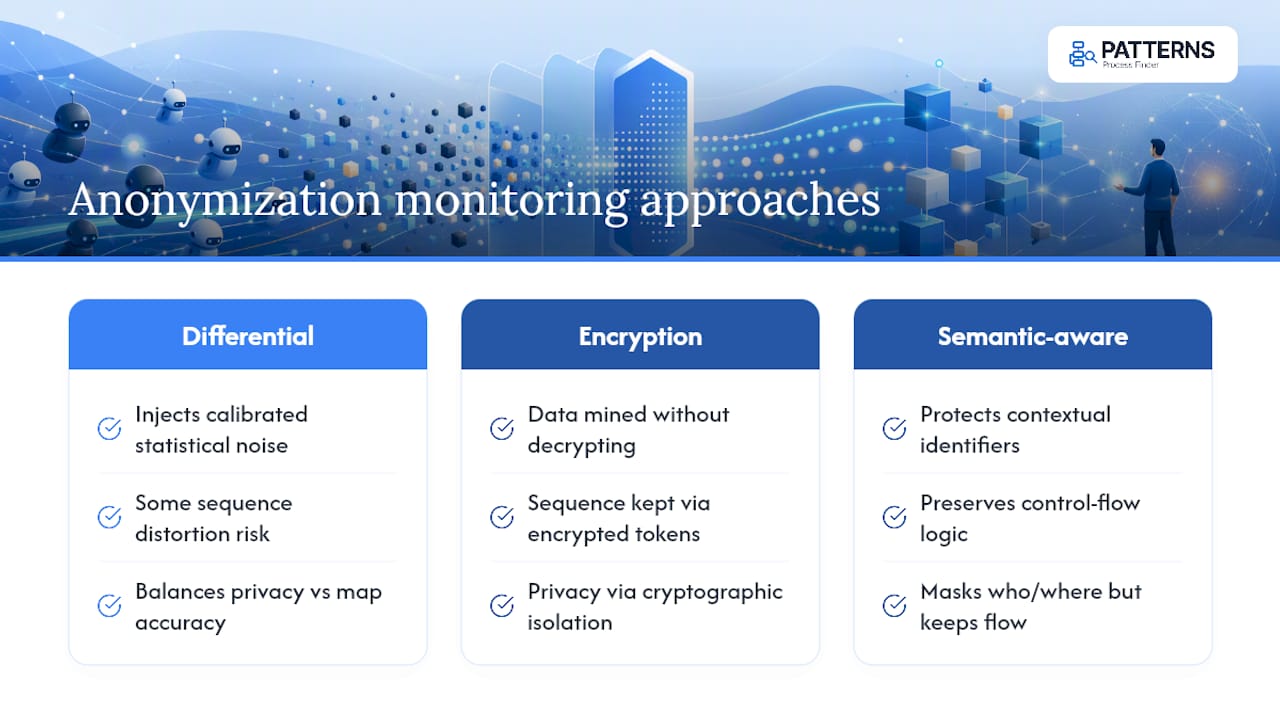
Three broad technique categories handle that balance, and they reappear throughout this guide: differential privacy methods that inject calibrated statistical noise, encryption-based approaches that let algorithms mine data without ever decrypting it, and semantic-aware anonymization that protects context (who did something, where, in what department) while keeping the control-flow logic intact. Each solves a slightly different version of the same problem, which is how much you can obscure before the map of the process stops matching the territory.
Why privacy-preserving monitoring matters for automation programs
Anonymized monitoring exists to answer one operational question: does the SOP on file match what people are actually doing? Most of the time it does not. Hidden subprocess branches, client-specific exceptions, and workaround steps accumulate quietly, and they are exactly what trips up an automation opportunity built on outdated documentation.
Skip the monitoring step and the failure mode is predictable. A bot gets built against the “official” version of a process, hits a variant nobody logged, and breaks in production. Multiply that across a backlog of automation candidates and you get the familiar pattern of high build costs and disappointing return on investment.
Continuous, privacy-preserving monitoring changes the sequencing. Instead of documenting once and automating blind, teams re-run discovery against fresh anonymized logs, catch process drift as it happens, and rank automation candidates by how stable and well-understood the variant actually is. That stability check is the difference between a bot that survives contact with real work and one that gets quietly disabled three weeks after launch.
Core techniques for privacy-preserving monitoring
Four technique families dominate the current research, and each trades off privacy strength against how much process detail survives.
- Differential privacy with subsampling. Libra draws multiple subsamples from an event log, applies differential privacy to each, then composes the results. That subsampling step amplifies the privacy guarantee, which means Libra can hit the same privacy target as noise-only methods while preserving more discovery utility.
- Encryption-based discovery. ECS and AlphaSec both produce encrypted directly-follows-graph structures that discovery algorithms can mine without decryption. Experimental evaluation on medical event logs found no loss of utility [encryption-based discovery assessment] under tested conditions; ECS pushes more computation onto the data owner, AlphaSec leans on cloud compute instead.
- Semantic-aware anonymization. SaCoFa, SaPa, and PRIPEL protect contextual attributes, such as who performed a step or which resource handled it, while preserving control-flow semantics that naive noise injection tends to destroy.
- Event partitioning. Splitting a log into sub-logs before anonymizing can reduce how much noise each partition needs, which improves utility for directly-follows-based discovery, though it can also lose signal that only shows up across partitions.
Pro Tip: Start with whichever technique matches your risk tolerance, not the newest paper. If your logs already carry a re-identification risk from small case volumes, partitioning plus differential privacy is a safer starting combination than encryption alone, which protects confidentiality but assumes your log volumes are large enough to still be useful once mined.
Choosing among these comes down to three practical questions: how much compute you can spare, how sensitive the underlying activity really is, and how much utility loss your discovery outputs can absorb before automation decisions built on them become unreliable.
How to measure privacy vs. utility in monitoring outputs
Every anonymization choice removes some signal. The question worth asking before you trust an automation candidate list is how much, and whether that loss is acceptable for the decision you are about to make.
Utility gets measured through familiar process-mining metrics: fitness (does the discovered model actually reproduce the logged behaviour), precision (does it avoid describing behaviour that never happened), directly-follows-graph similarity against a non-anonymized baseline where one exists, and whether rare-but-real variant frequencies survive the anonymization step or get smoothed away.
Privacy gets measured differently. Differential privacy techniques report an epsilon value. A smaller epsilon means a stronger guarantee and more injected noise, which is a direct trade against utility described in the Libra research. Where DP is not in play, teams should still run a disclosure-risk or re-identification-risk estimate before trusting output.
Before either of those numbers matters, run a coverage check. Process mining requires completeness, accurate timestamps, and sufficient granularity in the underlying event log [process mining AI automation opportunities].; a log missing large chunks of activity will mislead discovery no matter how well the anonymization was executed.
Watch for these red flags before acting on discovery output:
- A sharp utility drop between raw and anonymized model fitness with no matching privacy justification.
- Log coverage below expected volume for a known process (a sign of missing sources, not a quiet process).
- Discovered models that “bounce” between runs on the same underlying period, suggesting noise is dominating signal.
Operational checklist for implementing anonymization monitoring
Running this well is less about picking the perfect algorithm and more about sequencing the work correctly.
- Scope your sources. Identify which event logs and task-capture feeds actually feed the process you want to discover, and exclude fields you already know are sensitive before anonymization even starts.
- Pilot on a small sample. Run discovery on a clear version and an anonymized version of the same slice, then compare fitness and precision to see the real utility cost of your chosen technique.
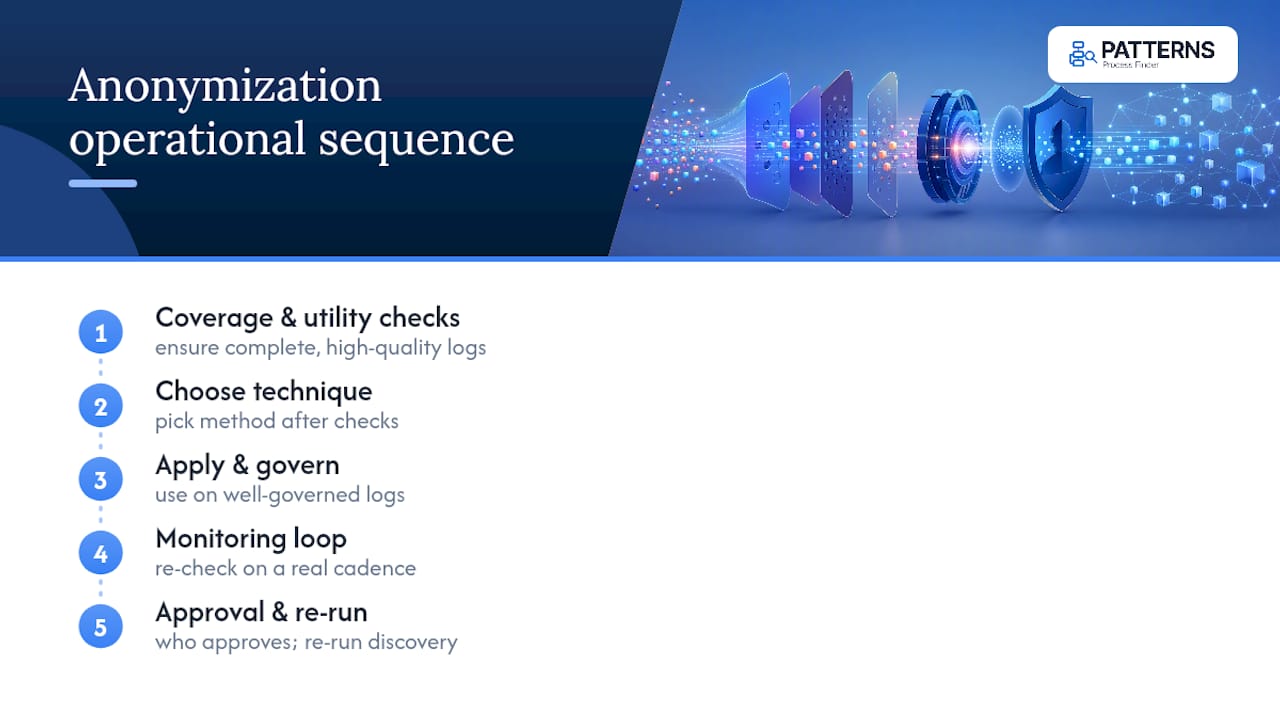
- Set a re-discovery cadence. A six to twelve month interval is a reasonable default for catching process drift before it becomes an automation failure, rather than treating discovery as a one-time audit.
- Add drift and utility alerts. Automate a flag when a re-discovery run shows a meaningful fitness drop or coverage gap so someone investigates before decisions get made on bad output.
- Lock down governance. Role-based access, audit trails, and an approval gate before any bot acts on discovery insights keep the monitoring loop accountable, not just accurate.
- Feed the automation backlog. Rank candidates by variant stability, generate living SOPs from the confirmed patterns, and track post-automation exception rates to close the loop.
Pro Tip: Treat step 2 as non-negotiable even under deadline pressure. A pilot that skips the clear-versus-anonymized comparison is the single most common reason teams discover, months later, that their automation backlog was built on a distorted map.
Governance frameworks built for adjacent platforms are a useful reference point here too. A practical Power BI governance framework covers access-control patterns that translate cleanly to process-mining data, and risk-assessment guidance built for fraud analytics offers a decent starting checklist for re-identification risk if you have not run one before.
Patterns’ operational perspective on privacy-first monitoring
Patterns Process Finder captures real user actions across desktop and browser applications, which is exactly the raw material privacy-preserving discovery techniques were built to protect. That capture surfaces the hidden subprocess branches and client-specific rules that static documentation misses, and turns them into living SOPs that update as the process itself changes.
Continuous discovery paired with privacy-conscious tracking controls does two things at once: it keeps automation candidates grounded in what people actually do, and it reduces the failure rate that comes from building bots against outdated process assumptions.
The gap between academic anonymization and operational monitoring
Most of the research on privacy-preserving process mining, Libra, PRIPEL, SaCoFa, the encryption papers, solves a narrower problem than operations teams actually face. These techniques prove you can anonymize a log without destroying discovery utility. They do not tell you when to re-run discovery, who approves an automation candidate built on anonymized output, or how to catch drift before it causes a bot failure.
That is the gap conventional advice glosses over. Teams treat anonymization as a one-time compliance checkbox rather than a monitoring loop, then wonder why automation projects built on six-month-old process maps keep breaking. The academic techniques are sound; the operational discipline around them is usually missing.
If there is one priority to take from this, it is sequencing. Get your coverage and utility checks right before you argue about which anonymization algorithm is theoretically superior. A well-chosen technique applied to incomplete logs will still mislead you. A modest technique applied to complete, well-governed logs, re-checked on a real cadence, will outperform it every time.
— Malek
Try privacy-aware process discovery on your own workflows
Most anonymization guidance stops at “protect the data” and leaves the harder question unanswered: how do you keep discovering real process behaviour once the identifying details are gone? Patterns Process Finder is built around that exact question. It captures actual user actions across desktop and browser tools, applies privacy-conscious tracking as it does it, and turns the result into living SOPs your team can trust without waiting on a manual documentation refresh every quarter.
Because the discovery runs continuously rather than as a one-off audit, your automation backlog stays ranked against what is actually happening this month, not what was true when someone last wrote a procedure down. If you want to see how that looks against your own workflows, request a demo or explore the process mining tool directly.
Sources
Key references include the Libra differential privacy study, the encryption-based discovery assessment, the event-partitioning research, and the PC4PM privacy tooling paper. Run small controlled experiments on your own logs before trusting any technique at scale.
- Libra: differential privacy for event logs (process mining)
- Impact of event data partitioning on privacy-aware process discovery
FAQ
What is data anonymization monitoring in process discovery?
It means tracking anonymized event logs and task-capture data over time to confirm they still reveal accurate process behaviour, so automation decisions are not built on distorted or stale information.
Which anonymization technique should I start with?
It depends on data sensitivity and compute budget: differential privacy with subsampling (Libra-style) suits smaller, sensitive logs, while encryption-based approaches like ECS and AlphaSec fit larger outsourced discovery scenarios.
How often should I re-run discovery on anonymized data?
A six to twelve month cadence catches most process drift before it causes automation failures, though high-change processes may need shorter cycles.
What metrics prove anonymized monitoring is working?
Track fitness, precision, and directly-follows-graph similarity for utility, alongside an epsilon value or disclosure-risk estimate for privacy strength.
Can Patterns Process Finder support anonymized monitoring?
Yes. Patterns Process Finder captures real workflow behaviour with privacy-conscious tracking built in, then turns confirmed patterns into living SOPs that update as processes change.