Before Your Experts Leave: 90 Day Capture Plan for Ops Teams
Capturing tribal knowledge means deliberately identifying the people and context that hold undocumented expertise, then embedding what they know into documentation that stays current. The first move is not a survey or a wiki page. It’s mapping who holds the riskiest, least-documented knowledge in your operation, then working outward from there. The methods and prioritisation steps below tell you exactly how.
TL;DR:
- Prioritizing risk, safety, and business criticality ensures capturing tribal knowledge focuses on the most impactful processes first.
- Using routine operations like shadowing, short interviews, and multimedia capture minimizes disruption and accelerates knowledge transfer.
- Automated process discovery tools help identify undocumented exception paths and variations that interviews often overlook, improving SOP accuracy.
- Living documentation that updates continuously through real execution data prevents processes from becoming outdated and supports automation efforts.
- Starting with a high-impact pilot helps demonstrate tangible improvements in onboarding time, error rates, or repair speed before scaling the program.
Table of Contents
- What is tribal knowledge, exactly?
- What does losing tribal knowledge actually cost you?
- How do you capture tacit knowledge without stopping the work?
- How do you decide what to capture first?
- Which tools actually make captured knowledge usable?
- How living process discovery closes gaps that static capture misses
- What leaders get wrong about knowledge capture programmes
- Get your SOPs to match how work actually happens
- Sources
- FAQ
What is tribal knowledge, exactly?
Tribal knowledge is the working expertise people carry in their heads but never write down. Researcher Ikujiro Nonaka called this “tacit” knowledge in his influential 1994 theory of organisational knowledge creation, distinguishing it from “explicit” knowledge, the kind already captured in manuals and databases. Tacit knowledge resists easy transcription because it’s bound up in judgment, timing, and physical feel, not facts you can list.
You’ve likely seen it without naming it:
- A machine operator who knows a press is about to jam from the sound it makes, three seconds before any sensor would flag it.
- An account manager who knows a client always says yes to a phone call but stalls on email, and structures every renewal accordingly.
- A support technician who has a workaround for a software bug that’s never made it into a ticketing system.
- A warehouse lead who reroutes picking during peak season based on a pattern no dashboard shows.
The phrase “tribal knowledge” itself draws criticism for its origin, and many operations teams now prefer “undocumented expertise,” “institutional knowledge,” or simply “tacit knowledge” in employee-facing communication. The concept matters more than the label. Whatever you call it, the goal is the same: get it out of one person’s head and into a form your whole team can use.
What does losing tribal knowledge actually cost you?
The financial exposure is bigger than most operations leaders assume until they run the numbers. Aggregated industry data compiled by Lore shows a substantial share of critical operational knowledge exists only in individual employees’ heads, with real time lost every week as people search for answers nobody wrote down.
Manufacturers face a compounding risk: every retirement or resignation without a capture plan quietly resets the clock on troubleshooting speed and quality consistency, according to Dirac’s analysis of factory knowledge loss.
The failure pattern is familiar. A senior technician retires; the next breakdown takes three times as long to diagnose because nobody else recognized the failure signature. A key account handler leaves; the replacement rediscovers, the hard way, which clients need a call instead of an email. Automation projects stall because the RPA developer built a bot around the documented process, not the six exception paths the team actually runs.
Done well, capture reverses all three failure modes. Faster onboarding, shorter mean time to repair, and automation pipelines built on what people genuinely do rather than what a flowchart claims. That last point deserves attention: automation failure rates climb sharply when the underlying process map misses the exceptions frontline staff handle daily.
How do you capture tacit knowledge without stopping the work?
The best capture methods meet people where they already work, rather than pulling them into a separate documentation exercise they’ll resent. NASA’s guidance on knowledge continuity during employee transitions makes a similar point: build capture into routine operations rather than waiting for a retirement notice to trigger a scramble.
Here’s a practical toolkit, roughly ordered by how much disruption each method causes:
- In-flow capture. Shadowing and paired work let a newer employee observe an expert mid-task, then narrate back what they saw. Observation notes taken during real work beat any retrospective interview because nothing gets forgotten or smoothed over.
- Structured interviews. A K-Pro or K-Quest style interview, borrowed from knowledge continuity management practice, walks an expert through a fixed set of questions about what they do, why, and what would break if they stopped doing it. Run these as short monthly micro-interviews rather than one exhausting session; people remember more in five focused minutes than in a sixty-minute marathon.
- Multimedia capture. A two-minute phone video of a repair, an annotated photo of a control panel with the “actual” settings marked, or a voice memo recorded right after a tricky client call, all outperform written notes for anything involving a physical sequence or a tone of voice.
- Co-creation. Pair a novice with an expert to co-write the SOP together. The novice asks the questions a manual usually skips; the expert supplies the answer. This apprenticeship model produces documentation that actually reads the way a new hire thinks.
- Passive capture and verification. Work orders, maintenance logs, and support chat threads already contain signals about how work really happens. Tools that extract patterns from these artefacts can accelerate capture, but every output needs verification against the specific plant, client, or team before anyone treats it as fact. Unverified passive capture is a liability, not a shortcut.
Pro Tip: Never rely on a single interview to capture a critical process. Run the same K-Quest questions with two or three people who do the job, then compare answers. The gaps between their responses usually reveal the riskiest undocumented variation in the whole workflow.
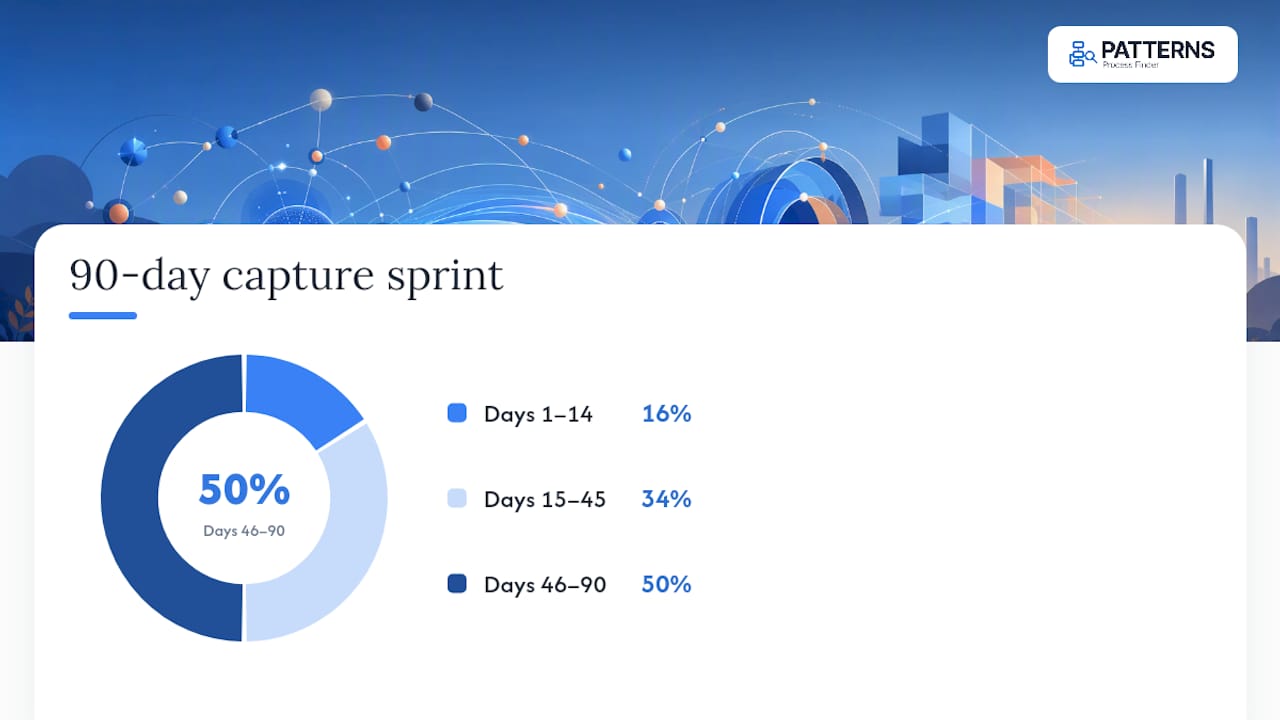
A 90-day sprint turns this toolkit into a result instead of a wish list. Days 1 to 14 focus on mapping the five highest-risk processes and naming a custodian for each. Days 15 to 45 run the actual capture: shadowing sessions, K-Quest interviews, and short videos, targeting one process per week. Days 46 to 90 shift to co-creation and verification, where a second expert reviews every captured artefact before it becomes the SOP of record, and you measure onboarding time or MTTR against your pre-sprint baseline.
How do you decide what to capture first?
Not every undocumented process deserves the same urgency. Prioritise by risk, not by convenience.
Rank candidates against four criteria:
- Safety exposure. Anything where a mistake could hurt someone or violate regulation goes first, no exceptions.
- Downtime impact. How much revenue or output stops if this knowledge disappears tomorrow?
- Single points of failure. Is exactly one person able to do this task? That’s your highest-priority target regardless of how routine the task looks.
- Business criticality. Does this process touch a top client, a compliance deadline, or a regulatory filing?
Once you’ve ranked candidates, build a simple knowledge map: list each critical process, name its current custodian, and name a designated successor who will shadow that custodian first. Assign an owner for the resulting documentation (usually a team lead, not the original expert) and set a review cadence, quarterly for high-risk processes, annually for the rest. Version control matters here too; a living SOP that changes without a change log is almost as risky as no SOP at all.
A working K-Pro checklist should include: the process name and risk rank, the custodian’s name, the capture method used, the date captured, the reviewer who verified it, and the next scheduled review date. Track success with two metrics: the percentage of high-risk processes with a named successor, and the drop in average onboarding time for roles tied to those processes.
Which tools actually make captured knowledge usable?
Capturing knowledge is only half the job. If nobody can find it later, you’ve built an archive nobody opens.
Four tool categories cover most needs:
- Knowledge hubs with semantic search let staff search by describing a problem in plain language rather than knowing the exact document title.
- Video repositories tagged by process and equipment type turn shadowing footage into a searchable library instead of a folder of orphaned clips.
- Living SOP platforms update documentation as work changes, instead of freezing a snapshot that goes stale within months.
- Automated process discovery tools observe how work actually happens across systems and surface the subprocess branches and exception paths that interviews alone often miss.
Integration matters as much as the tool choice. Capture outputs should link into your CMMS for maintenance procedures, your LMS for onboarding content, and your intranet for general reference, rather than living in a fourth system nobody checks. Whatever platform you use, run every automated output through a human verification step before publishing, and confirm your data residency and privacy settings meet your industry’s requirements before anyone records video or audio of staff at work. Guidance on when to map a process versus when to write an SOP is worth reading before you commit resources to either format at scale.
Automated discovery and human capture solve different problems. Discovery tools are fast and objective. They show you what people actually click, type, and route, at a scale no interview schedule could match. Human capture supplies the judgment and context behind those actions, the “why” that no click-stream can explain. Use discovery to find the gaps, and use interviews and shadowing to fill them.
How living process discovery closes gaps that static capture misses
Most tribal knowledge programmes stall for a predictable reason: the documentation they produce describes the process as it was on the day someone wrote it down, not as it runs six months later. Patterns Process Finder approaches this differently by automating the discovery of how employees actually execute work across desktop and browser applications, rather than relying solely on interviews and self-reported workflow maps.
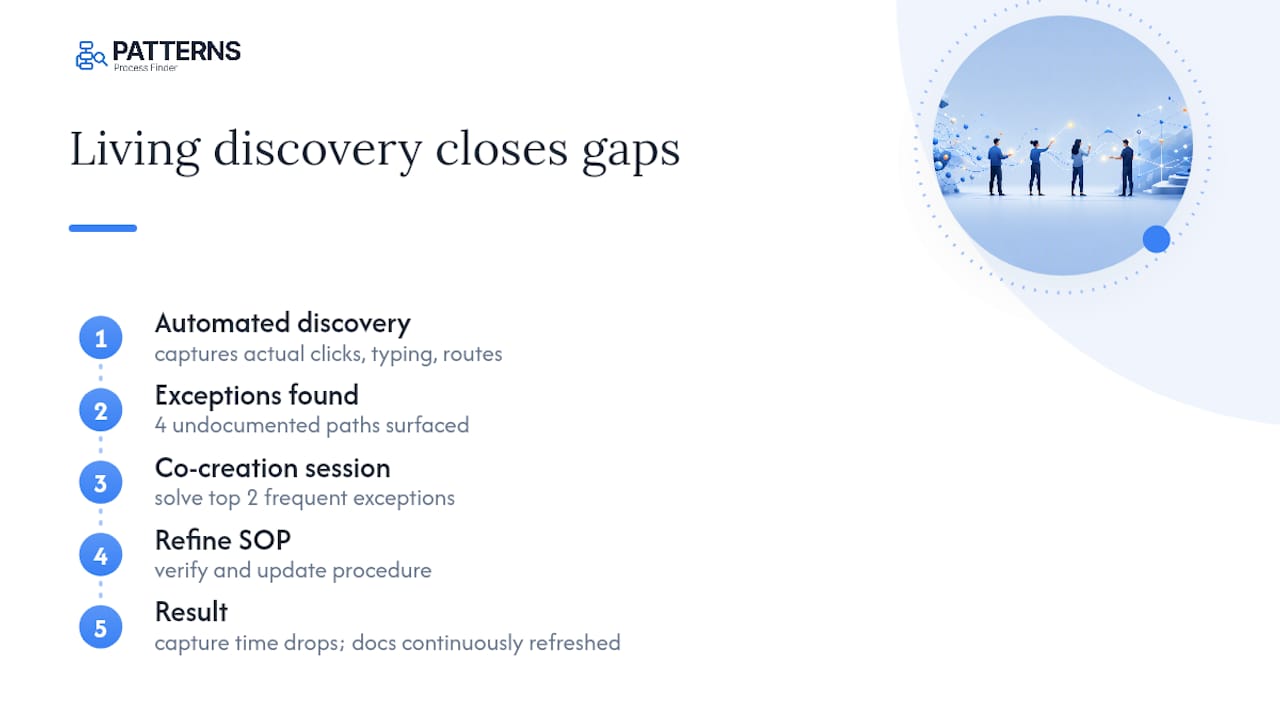
That distinction matters in practice. Interviews capture what an expert believes they do. Automated discovery captures what they actually clicked, typed, and routed, including the subprocess branches and client-specific exceptions that experts often forget to mention because the exception feels routine to them.
Bridging the gap between how work is supposed to happen and how work actually happens inside complex organizations is what separates documentation that gets used from documentation that gets ignored.
A practical scenario shows why this pairing works. A transformation team runs automated discovery across a claims-processing workflow, surfacing four undocumented exception paths within days. Instead of guessing which exceptions matter, the team brings the two most frequent ones to a co-creation session with the process experts who handle them, verifying and refining the SOP together. Capture time drops because the discovery phase already did the hard part: finding what to ask about.
Static documentation captured once and never revisited is the norm most organisations default to. Living documentation, refreshed continuously against real execution data, closes that gap without requiring every expert to sit through another interview.
What leaders get wrong about knowledge capture programmes
The biggest mistake I see is treating capture as a documentation project instead of a trust project; for a practical implementation plan, see zarządzanie wiedzą w kancelarii. Employees don’t withhold expertise because they’re precious about it. They withhold it because nobody has made clear that sharing it protects their team rather than replacing them. Fix the incentive structure before you fix the template.
Start with one high-impact pilot, not an enterprise rollout. Pick the single process where losing the custodian would hurt most, run the 90-day sprint, and measure something concrete: onboarding time, error rate, and repair speed. A visible win buys you the political capital to expand.
Mentorship and communities of practice do more heavy lifting than any interview format. Governance should stay light and iterate constantly. A capture programme that never changes its own process is already failing at the thing it’s trying to teach.
— Malek
Get your SOPs to match how work actually happens
Most capture programmes hit a wall the moment documentation goes stale, because writing SOPs by hand can’t keep pace with how fast real workflows shift. Some process discovery tools aim to automate discovery of real employee execution across desktop and browser applications, so SOPs can update as the work itself changes, instead of freezing the moment someone last interviewed an expert.
That matters most for operations, automation, and transformation teams who’ve been burned by automation pipelines built on outdated process maps. Rather than guessing which subprocess variations and client-specific rules actually matter, discovery surfaces them directly from execution data, then pairs with the co-creation methods covered above to verify and refine what’s captured. If your team is facing high automation failure rates tied to undocumented exceptions, this is the kind of process intelligence that closes that gap.
Review the Basic, Pro, and Enterprise plans to see which fits your team’s scale, or start with a focused pilot on your highest-risk process by requesting a demo.
Sources
- A dynamic theory of organizational knowledge creation (Nonaka, 1994)
- Ensuring knowledge continuity during employee transitions report (NASA)
- The ticking clock: capturing your factory’s tribal knowledge (Dirac Inc.)
- Tribal knowledge loss statistics (Lore)
FAQ
What’s a better way to say “tribal knowledge”?
Many operations teams now use “undocumented expertise,” “institutional knowledge,” or “tacit knowledge” instead, since the original phrase draws criticism for its origin. The concept, expertise held by individuals rather than written down, stays the same regardless of the term you choose.
What does it mean when someone says “tribal knowledge”?
It refers to operational know-how that exists only in employees’ heads rather than in any manual, system, or document. Nonaka’s 1994 theory of organisational knowledge creation calls this “tacit” knowledge, distinguishing it from “explicit” knowledge already written down.
What are some real examples of tacit knowledge?
Common examples include a technician recognizing an equipment failure by sound before any sensor triggers, a sales rep knowing which clients respond better to calls than emails, and a support agent using an unlogged workaround for a recurring software bug. Each case involves judgment built through repetition, not a fact that fits neatly on a checklist.
How do you actually capture tacit knowledge?
Use methods that meet experts where they already work: shadowing and paired observation, structured K-Quest style interviews, short videos of hands-on tasks, and co-writing SOPs alongside novices who ask the questions a manual skips. Passive capture from logs and work orders can accelerate the process, but every output needs verification against your specific operation before it becomes documentation of record.
Can software help capture tribal knowledge, or does it require interviews?
Both work best together. Automated discovery tools like Patterns Process Finder reveal what employees actually click and route across systems, surfacing exception paths experts often forget to mention, while interviews and shadowing supply the reasoning behind those actions that no click-stream can show on its own.