
7 Steps to Test First Business Rules Discovery for Practitioners
Business rules discovery is the process of extracting the operational logic buried inside applications, workflows, and data so it can be documented, tested, and reused. The methods that reliably work combine automated extraction (static code analysis, process and event-log mining, data mining, or black-box output analysis) with structured validation, including test-driven techniques and formal SME sign-off. No single technique catches everything, and no extracted rule is trustworthy until someone or something verifies it against real behaviour.
TL;DR:
- Combining multiple techniques such as static code analysis, process mining, and black-box extraction improves rule discovery coverage for legacy and complex systems.
- Validating rules through automated, test-driven methods before SME review reduces error reconciliation time and ensures higher rule trustworthiness.
- Rules should be documented in atomic, declarative formats like decision tables or Gherkin scenarios to maintain clarity and ease of maintenance.
- Continuous governance involves assigning ownership, regular reviews, and tracking automated validation metrics to sustain rule accuracy over time.
- Using process discovery tools like Patterns Process Finder helps reveal undocumented rules by capturing real work flows and exceptions, speeding up discovery cycles.
Table of Contents
- What is business rules discovery and which methods work?
- How do you run a business rules discovery project step by step?
- What format should discovered business rules take?
- How do you validate and govern business rules after discovery?
- How does automated process discovery speed up rule extraction?
- What most teams get wrong about business rules discovery
- Try Patterns Process Finder for your next discovery pilot
- Sources
- FAQ
What is business rules discovery and which methods work?
Business rules discovery means finding the “if this, then that” logic that governs how a system or team actually operates, then converting it into a form people can read, test, and maintain. The IIBA’s BABOK guide frames business rules analysis as identifying, expressing, validating, and organizing these rules so they stay atomic, declarative, and independent of any one implementation. That last point matters more than most teams realize: a rule tied to a specific screen or codebase dies the moment that screen gets replaced.
Four techniques dominate practical discovery work, and each answers a different question.
- Static code analysis answers “what does the code say it does?” by parsing source into an abstract syntax tree and mapping variables to their role in the logic.
- Process and event-log mining answers “what sequence of steps actually happens?” by mining logs and process repositories for behavioural patterns.
- Data mining and correlation analysis answers “what calculation or definition produces this output?” by comparing inputs against results across large record sets.
- Black-box, test-driven extraction answers “does this rule hold up against history?” when source code isn’t available at all.
Static analysis works best when you have source access and need precision. Tools that parse mainframe or COBOL applications can build a knowledge database linking identifiers, conditions, and code blocks, then translate that structure into business rules expressed in Gherkin for traceability. The output is exact, but only as good as the variable mapping underneath it. A well-known failure mode here: analysts who don’t classify each variable as input, output, or predicate end up with rules that look correct but apply to the wrong scope, a mistake documented in research on extracting business rules from legacy COBOL code.
Process mining takes a different route. Rather than reading code, it mines model repositories and event logs to recover sequence constraints and behavioural rules directly from how work actually flowed. This approach has been extended to web applications, too. One research prototype converts raw HTTP traffic into event logs and recovers authorization and conditional rules with strong precision, which is useful when the “system” is really a web app with no clean audit trail.
Data mining and correlation techniques suit definitional and calculation rules, the kind of logic that determines pricing tiers, eligibility thresholds, or discount stacking. You compare known inputs against known outputs across enough historical records to infer the underlying formula, then confirm it holds.
Black-box extraction is the fallback when none of the above apply, typically on legacy systems where source code is missing, locked, or too risky to touch. A peer-reviewed study demonstrated a five-phase black-box extraction method validated through test-driven development on a large governmental payroll system, generating computational rules purely from historic outputs and then proving them against constructed test cases. Related work on legacy systems shows the same pattern: extracted rules can satisfy most historic test cases automatically, leaving domain experts to focus only on the discrepancies instead of reviewing everything from scratch.
Ontology-driven methods, which map extracted terms to a shared conceptual model, add value mainly on large, fragmented estates where the same business concept hides under five different variable names across systems. Whichever method you pick, expect to need read access to source repositories or logs, a sample of historic transactions, and a business glossary before you start. Skip any of those and the most common failure follows fast: technically correct rules that nobody trusts because nobody can explain what they mean.
How do you run a business rules discovery project step by step?
A discovery project fails most often at the edges, not the middle. Teams jump straight to extraction without scoping properly, or they extract hundreds of rules and never get around to validating them. A repeatable sequence closes both gaps.
- Scope and inventory sources. List every stakeholder, application, log source, and process boundary in play. Note which systems have code access and which are black-box only.
- Prepare inputs. Pull log extracts, slice relevant code sections, gather sample datasets, and draft a starter glossary of business terms so extracted logic has somewhere to land.
- Run automated extraction. Apply the technique or combination of techniques suited to each source, and pool the candidate rules into one working list rather than scattering them across tools.
- Validate automatically first. Build test cases from historic outputs and run them against each candidate rule, a black-box, test-driven approach that reduces the domain-expert time needed before a human ever looks at the list. Triage the failures; they’re where the real ambiguity lives.
- Bring in SMEs for the exceptions. Review only the rules that failed automated validation or that automation couldn’t reach, and have subject matter experts author or correct them in plain business language.
- Canonicalize and store. Convert validated rules into decision tables, Gherkin scenarios, or atomic statements in a single repository, with traceability back to the source code, log, or dataset each one came from.
- Roll out and keep discovering. Feed validated rules into the target system or business rules management platform, then treat discovery as ongoing rather than a one-time project.
Stakeholder interviews and workshops still matter here, particularly for step one and step five. Tacit rules, the ones nobody wrote down because “everyone just knows,” rarely show up in code or logs at all. A structured stakeholder mapping exercise before validation workshops helps you identify who actually has authority to confirm a rule versus who simply uses it downstream.
Pro Tip: Build your test cases from historic outputs before you touch a single line of extraction logic. Teams that validate last end up re-extracting half their rule set once SMEs finally see it, which costs more time than front-loading validation ever would.
Conflicts surface constantly during this process, two rules that both claim authority over the same decision point, usually because they were written for different exceptions and nobody reconciled them. Flag conflicting rules the moment automated testing exposes them rather than letting SMEs discover the contradiction mid-review.
What format should discovered business rules take?
Atomic, declarative rules beat bundled logic almost every time. BABOK’s guidance on business rules analysis recommends keeping each rule single-sourced and independent of any specific process or system, because a rule tangled up with implementation detail breaks the moment that implementation changes. One rule, one statement, one place it lives.
Format choice depends on what the rule needs to do:
- Decision tables suit grouped, related rules, like tiered pricing or eligibility matrices, where several conditions interact in predictable combinations.
- Gherkin scenarios suit behavioural rules, capturing “given this condition, when this action, then this outcome” in a format both engineers and business stakeholders can read without translation.
- Fact models and a shared glossary stop ambiguity before it starts. A rule referencing “customer tier” only works if everyone agrees on what “tier” means, and a glossary linkage forces that agreement.
Version every rule with a status field: validated, obsolete, or pending review. This alone prevents the most common post-discovery failure, where a team keeps automating against a rule that was quietly superseded months earlier. Trace each rule back to its source code, log, or dataset so anyone questioning it can find the origin fast, and consider export formats that support interoperability if a modernization project is on the horizon.
How do you validate and govern business rules after discovery?
Discovery without validation just relocates the ambiguity. Automated, test-driven validation is the most defensible method available: construct test cases from historic system outputs and run each candidate rule against them, an approach demonstrated on a large payroll system with strong test-case coverage and comparatively little domain-expert time required.
The workflow splits into distinct stages:
- Automated testing first. Every candidate rule runs against historic outputs before a human sees it.
- SME workshops for exceptions. Only the rules that fail testing, or that automated methods couldn’t reach at all, go to subject matter experts.
- Conflict detection. Cross-check overlapping rules against each other, not just against historic outputs, since two individually valid rules can still contradict each other in edge cases.
- Governance ownership. Assign a named owner to each rule domain, with a defined review cadence and clear escalation when a rule looks stale.
Rule health at a glance: the study on black-box extraction found that TDD-style testing let researchers validate a substantial share of extracted rules automatically, narrowing SME review to genuine exceptions rather than the full candidate list.
Track a small set of monitoring metrics rather than dozens: percentage of rules currently validated by automated tests, number of exceptions still in the SME queue, and rules flagged obsolete but not yet retired. Reviewing process improvement KPIs alongside these figures helps connect rule health to the automation or process outcomes it’s supposed to support, rather than treating rule governance as an isolated exercise.
How does automated process discovery speed up rule extraction?
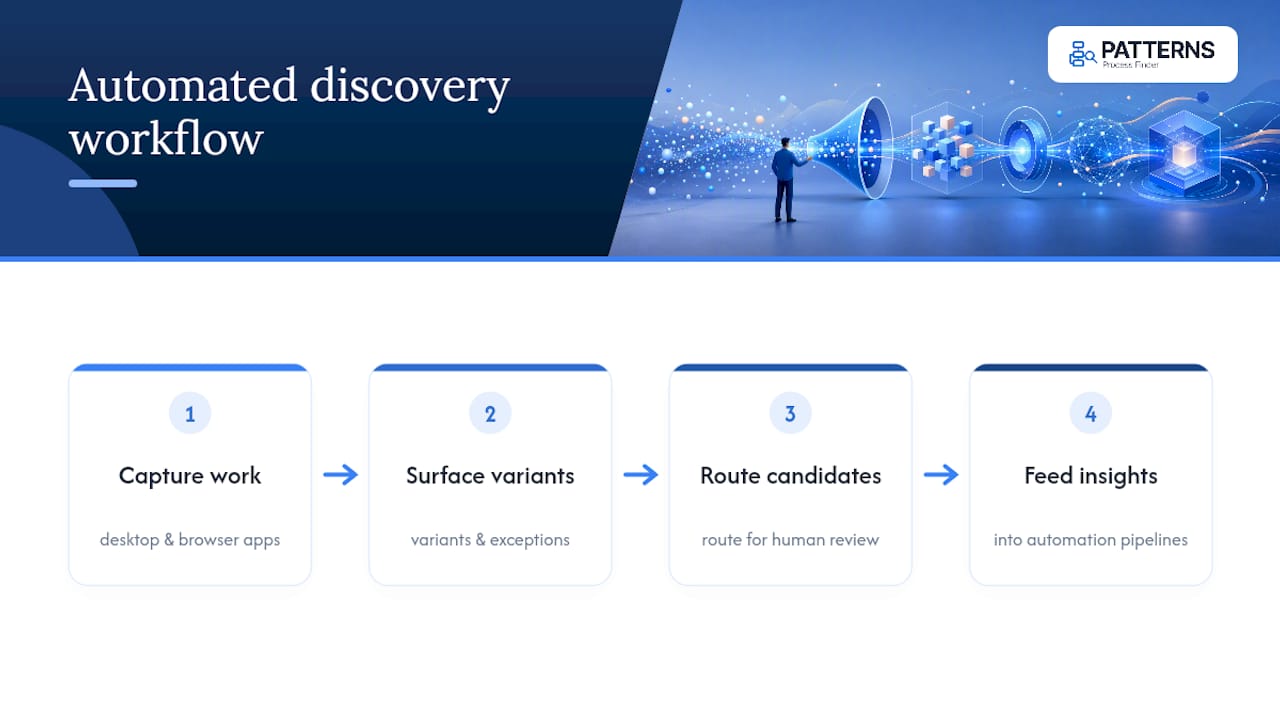
Automated process discovery tools capture how work actually happens across desktop and browser applications, which matters because hidden subprocess variations and exception patterns are exactly where undocumented rules hide. By surfacing which variants and exceptions genuinely need human review, Patterns’ automated documentation workflow capture cuts down the hours SMEs spend triaging rule candidates by hand. Such tools can fit naturally into automation pipelines, modernization pilots, and teams facing repeated automation failures traceable to undocumented exceptions.
What most teams get wrong about business rules discovery
The three mistakes I see most often, in order of frequency: skipping the source inventory and discovering halfway through that nobody mapped which systems actually feed the process, leaning on one extraction technique when the estate clearly needs two or three, and treating validation as the last step instead of the second one.
Building test cases from historic outputs early, before extraction finishes, catches contradictions while they’re cheap to fix. A shared glossary sounds bureaucratic until the second time two teams argue about what “active customer” means. And combining code parsing with process mining and black-box methods isn’t redundancy. It’s coverage. Legacy estates rarely offer one clean source of truth, and pretending otherwise is how teams end up automating rules that were already wrong.
— Malek
Try Patterns Process Finder for your next discovery pilot
Some process discovery solutions map directly onto the discovery framework above: capturing real workflows as they happen, flagging subprocess variants and exceptions that manual review might miss, and turning captured activity into living SOPs instead of static documents that go stale. Where code parsing and log mining tell you what a system was built to do, Patterns tells you what people are actually doing on top of it, which is often where the highest-value undocumented rules live.
A typical pilot or demo produces sample discovered workflows from your own environment, a first set of rule candidates drawn from real execution patterns, and draft SOP output you can hand straight to an SME for validation. That’s a faster starting point than a blank extraction backlog. If your team is planning a SAP process discovery pilot or evaluating a process mining tool for ongoing rule discovery, request a demo and see what surfaces in your own data before committing to a broader rollout.
Sources
- 10.9 Business Rules Analysis | IIBA®
- A Black-Box Computational Business Rules Extraction Approach through Test-Driven Development
- Business Rules Discovery from Process Design Repositories
- Extract business rules | Mainframe Assessment Tool | Google Cloud Documentation
FAQ
What are the three main types of business rules?
Most frameworks group business rules into structural (definitions and relationships, like “a customer must have one billing address”), operative or behavioural (constraints on actions, like eligibility rules), and computational (calculations, like pricing formulas). BABOK’s approach to rules analysis treats all three as candidates for the same discovery and validation process.
What is a business rules management system used for?
A business rules management system (BRMS) stores validated rules separately from application code so business teams can update logic like eligibility thresholds or pricing tiers without a full development cycle. Discovery is the step that fills a BRMS with accurate, tested rules in the first place.
What are the basic business rules every discovery project should capture?
At minimum, capture definitional rules (what terms mean), computational rules (how values are calculated), and behavioural rules (what sequence of actions is permitted or required). Validating each category separately, using techniques matched to how that rule type actually surfaces in code, logs, or data, produces far more reliable results than one blanket extraction pass.
How do you handle conflicting business rules found during discovery?
Flag contradictions as soon as automated testing or SME review exposes them, rather than resolving them silently. Most conflicts trace back to rules written for different exceptions that were never reconciled, so the fix is usually clarifying scope rather than picking one rule over the other.
Can automated tools like Patterns Process Finder help with business rules discovery?
Yes. Tools that capture real workflow execution, like Patterns Process Finder, surface the hidden subprocess variations and exceptions that static code analysis or log mining alone can miss, which narrows the field of candidate rules an SME needs to review by hand.