
Automation risk assessment for operations leaders
An automation risk assessment is the scoring method that produces an immediate go/no-go decision for a workflow and a prioritised risk register to guide a safe pilot. Run these five checks before committing a single development hour:
- Process stability window: Has the process run without structural change for at least 90 days?
- Exception rate: Do unhandled exceptions account for fewer than 5% of runs?
- Data sensitivity class: Are all inputs either non-personal or covered by a documented privacy control?
- Integration complexity: Does the process touch three or fewer external systems?
- Governance sign-off: Has an RPA committee or equivalent authority approved the candidate?
Verdict line (copy into your project brief): If all five pass, proceed to pilot. If one or two fail, require remediation before build. If three or more fail, the process is a no-go until root causes are resolved.
Key takeaways
A formal automation risk assessment, grounded in real execution data and scored against measurable thresholds, is the most reliable way to prevent costly RPA failures and produce a defensible go/no-go decision.
| Point | Details |
|---|---|
| Five-check go/no-go | Pass all five readiness checks (stability, exception rate, data class, integration count, governance) before committing to build. |
| Exception rate threshold | Keep the exception rate below 5% over a 90-day window; above 15% is a hard stop requiring process redesign. |
| Controllability over impact | Score risks by controllability first; system integration is the hardest factor to control per expert assessment. |
| Pilot scope discipline | Test at least 50 transactions stratified by exception type, using anonymised data and documented acceptance criteria. |
| Patterns Process Finder | Use automated process discovery to capture real execution paths and generate living SOPs that feed readiness metrics directly. |
Table of Contents
- Why poor process selection causes most automation failures
- The eight risk domains every assessment must cover
- Readiness metrics and thresholds you can use today
- A repeatable method: discovery through to pilot plan
- Governance controls to require before go-live
- Designing a safe pilot
- Remediations and hard red flags
- How Patterns Process Finder reduces unknown variation before you build
- How to select processes that are genuinely controllable
- An assessor’s perspective on what actually matters in practice
- Patterns Process Finder accelerates safe process discovery
- Sources
- FAQ
Why poor process selection causes most automation failures
The single biggest driver of RPA failure is not bad code. It is choosing the wrong process. A 2026 systematic literature review found that successful RPA requires deep technical knowledge, specific organisational capabilities, and formal governance — and that treating RPA as a lightweight, low-risk deployment is a recurring mistake. A separate 2024 literature review synthesised ten recurring implementation challenges, with process selection, security, and maintenance cited most frequently as causes of underperforming projects.
The practical implication: teams that skip a structured readiness check spend more time in remediation than in production. A formal assessment shifts that ratio by surfacing hidden variation, undocumented exceptions, and integration fragility before a single line of bot code is written.
The eight risk domains every assessment must cover
Map your workflow to each domain before scoring. Missing even one creates blind spots that surface as production incidents.
Process: High variation between operators, frequent manual overrides, paper-to-digital handoffs, and undocumented exception types all signal instability.
Data: Unstructured inputs, inconsistent field formats, personally identifiable information (PII) without a documented handling policy, and cross-border data flows each raise the risk profile.
People: Change resistance, skill gaps in the operations team, unclear process ownership, and undocumented tribal knowledge are people-domain risks that no technical control can fully offset.
Integration: The number of external systems, API stability, legacy screen-scraping dependencies, and the frequency of UI changes in target applications. Per an expert impact-uncontrollability assessment, system integration is significantly harder to control than any other risk factor in RPA projects.
Automation design: Over-scoping the first bot, hard-coding business rules that change quarterly, and insufficient error-handling logic.
Management/governance: Absence of an RPA committee, no formal change-approval process, and unclear escalation paths for bot failures.
Maintenance/continuity: No documented rollback procedure, no owner assigned for post-production monitoring, and no scheduled review cycle for bot performance.
Security and privacy: Credential storage practices, encryption standards for data in transit and at rest, and whether the process handles regulated data under PIPEDA, HIPAA, or SOC 2 scope.
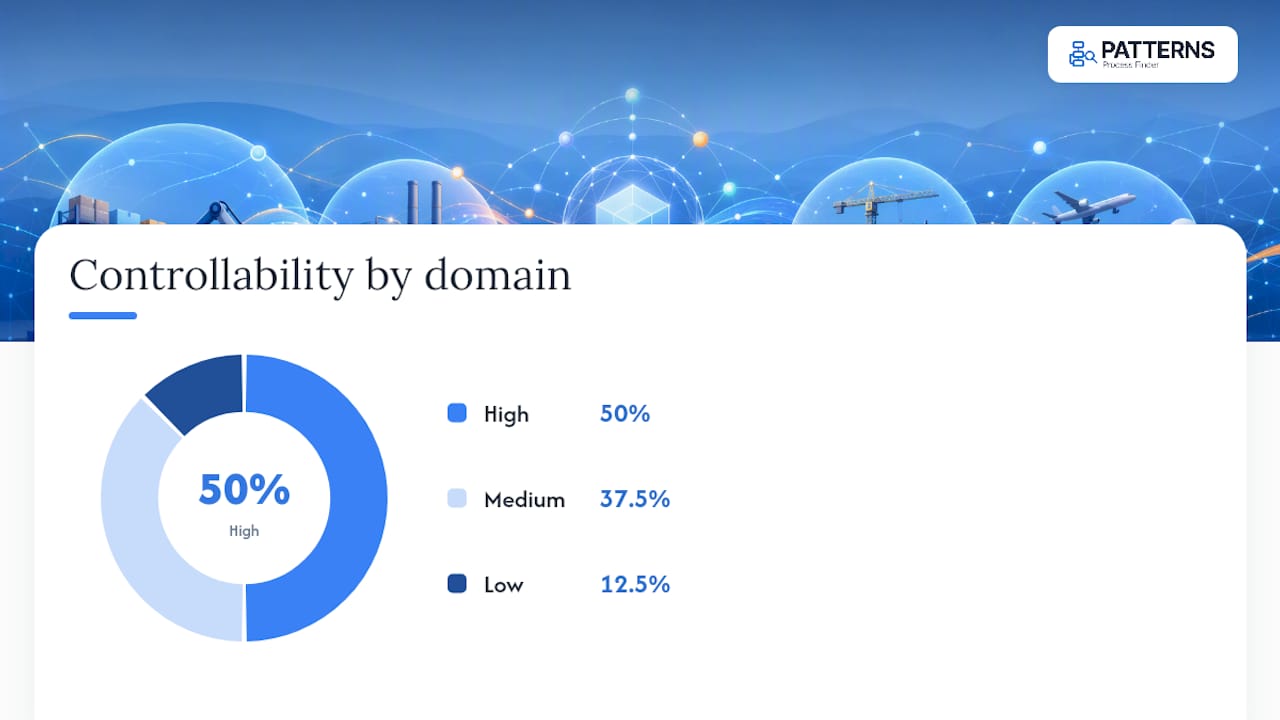
| Risk domain | Key failure signals | Controllability |
|---|---|---|
| Process | Exception rate > 5%, high operator variation | High |
| Data | Unstructured inputs, PII without policy | Medium |
| People | Undocumented knowledge, change resistance | Medium |
| Integration | Legacy UI scraping, 4+ external systems | Low |
| Automation design | Over-scoping, hard-coded rules | High |
| Management/governance | No RPA committee, no change process | High |
| Maintenance/continuity | No rollback plan, no assigned owner | High |
| Security/privacy | Unencrypted credentials, regulated data | Medium |
Readiness metrics and thresholds you can use today
Concrete thresholds turn domain checks into a consistent score across projects and reviewers.
| Metric | How to measure | Recommended threshold |
|---|---|---|
| Exception rate | Exceptions ÷ total runs over 90 days | < 5% |
| Process stability window | Days since last structural change | ≥ 90 days |
| Variation ratio | Distinct subprocess paths ÷ total runs | < 15% |
| Human touchpoints per run | Manual steps counted in process map | ≤ 3 |
| Data sensitivity class | Highest PII/regulated-data tier present | Class 1 or 2 only |
| Integration points count | External systems called per run | ≤ 3 |
| Change frequency | Documented process changes per quarter | ≤ 1 |
Treat these as starting bands, not hard rules. Context always modifies the score.
A repeatable method: discovery through to pilot plan
Follow these stages in order. Each produces a deliverable that feeds the next.
- Mapping: Convert the log into a visual process map showing all branches, exception paths, and decision points. Deliverable: annotated process map with variation count.
- Metric collection: Measure each readiness metric against the thresholds above. Deliverable: completed readiness scorecard.
- Scoring (impact × controllability): Rate each identified risk on impact (1–5) and uncontrollability (1–5). Multiply for a risk score. For risks where expert judgement varies widely, apply DFS-FMEA to capture optimistic and pessimistic estimates and produce a defensible consensus score.
- Decision rule: Sum scores by domain. Domains scoring above 15 require remediation before go-live. Any single risk scoring above 20 is a hard stop.
- Output artefacts: Risk register (ranked by score), remediation list with owners and target dates, and a scoped pilot plan.
Required inputs: Process owner, at least two operators, IT/security representative, and 30+ run recordings.
Required deliverables per stage: process log, subprocess map, scorecard, risk register, pilot plan.
Pro Tip: When calibrating controllability scores, ask the team: “If this risk materialises, can we detect it within one business day and reverse it without data loss?” A “no” to either part moves the controllability score up by at least one point.
Governance controls to require before go-live
Practitioner guidance from ISACA identifies formal governance, environment isolation, and encryption as core controls for any RPA-enabled process. Treat these as non-negotiable before approving production deployment.
Governance structure:
- An RPA committee or centre of excellence with representation from operations, IT security, and compliance
- Formal change-approval workflow for any modification to a bot or its target process
- Defined escalation path and on-call owner for production incidents
Technical safeguards:
- Strict dev/test/prod environment separation with no shared credentials across environments
- Encrypted credential storage (a secrets vault, not hard-coded values)
- SOC 2 Type II report reviewed for any third-party platform the bot touches; see SOC 2 logging requirements for audit checklist guidance
- Version control on all bot scripts with tagged releases
Testing and change management:
- QA sign-off on every release, including regression tests covering known exception paths
- Post-production verification run within 24 hours of deployment
- Documented rollback procedure tested before go-live
Pro Tip: Structure your automation centre of excellence so that the RPA committee reviews the risk register, not just the business case. A committee that only sees ROI projections will approve processes the risk register would have blocked.
Designing a safe pilot
A well-scoped pilot limits blast radius while generating the evidence your risk register needs.
Sampling approach:
- Stratify your test runs by exception type: include at least 10 runs from each identified subprocess branch
- Run a minimum of 50 transactions in the pilot; for high-volume processes, 100 is a more reliable signal
- Include at least five edge-case runs that previously required manual intervention
Test data rules:
- Use anonymised or synthetic data for any run involving PII; never use live customer records in a test environment
- Document the data masking method and retain it as an audit artefact
Acceptance criteria:
- Bot completes ≥ 95% of pilot runs without human intervention
- Exception rate in pilot matches or improves on the pre-automation baseline
- No data integrity errors in output records
- All governance controls verified as active
Timeline and cost drivers: Discovery and mapping typically require one to three weeks depending on process complexity. Developer build and QA cycles add two to six weeks for a scoped pilot. North American market research identifies legacy integration difficulty and data security requirements as the primary cost escalators; budget additional time whenever either factor is present.
Remediations and hard red flags
Most failing candidates can be fixed. A few cannot, and attempting to automate them anyway is where projects go badly wrong.
Repeatable remediations:
- High exception rate: simplify the process first, then automate the simplified version
- Unstructured inputs: digitise and standardise data formats before build
- Missing human validation: add explicit human-in-loop checkpoints at high-risk decision points; work instruction software can formalise these gates
- No version control: implement a git-based workflow for bot scripts before any pilot begins
- Undocumented SOPs: generate living SOPs from real execution data before finalising the process map
Pro Tip: Prioritise remediation items by controllability score, not impact score. A high-impact risk that your team can fix in a week is less dangerous than a medium-impact risk that depends on a vendor’s API roadmap.
Hard red flags — stop automation until resolved:
- System integration uncontrollability score above 4 with no mitigation plan
- Unresolved PII handling issues or active regulatory review of the process
- Manual exception rate above 15% with no documented resolution path
- No assigned process owner willing to accept accountability for bot failures
How Patterns Process Finder reduces unknown variation before you build
The most common source of inflated exception rates and failed pilots is a process map built from interviews and flowcharts rather than real execution. Patterns Process Finder addresses this directly through three mechanisms.
Reality-based process capture: Patterns records actual user actions across desktop and browser applications, producing a process log that reflects what employees do, not what the SOP says they should do. Hidden subprocess branches and client-specific rules surface automatically.

Automated variation detection: The platform identifies distinct execution paths and flags branches that exceed your variation ratio threshold, giving your risk scorecard a defensible, data-driven foundation rather than a best-guess estimate.
Living SOP generation: Patterns converts captured execution into continuously updated SOPs. When the underlying process changes, the SOP updates, keeping your readiness metrics current between assessment cycles.
When a team discovers that a process they assumed was linear actually runs across seven distinct subprocess branches, the pilot scope shrinks from the full process to the two branches that meet readiness thresholds. That is the difference between a six-month remediation cycle and a four-week pilot.
These outputs map directly to assessment stages: captured logs feed the discovery stage, variation reports populate the readiness scorecard, and exported process maps support the impact-controllability scoring workshop. Explore process discovery capabilities to see how the platform fits your assessment workflow.
How to select processes that are genuinely controllable
Process selection is the most frequently cited challenge in RPA literature, and the reason is straightforward: teams optimise for volume and visibility rather than controllability. A high-volume, high-visibility process that is poorly structured will fail faster and more visibly than a smaller, well-bounded one.
The three criteria that most reliably predict a controllable candidate are rule-based logic (every decision in the process can be expressed as an if/then statement without human judgement), digital inputs (all data enters the process in a structured, machine-readable format), and stable interfaces (the applications the bot interacts with change infrequently and have documented APIs or stable UI elements).
Processes that meet all three criteria and fall within the readiness thresholds above are strong candidates regardless of volume. Processes that fail even one criterion need remediation before the exception rate and variation ratio will stabilise enough to support a reliable pilot. Multiple literature reviews consistently recommend targeting mature, rule-based processes for early automation precisely because controllability, not ROI potential, determines whether a first project builds or destroys confidence in the programme.
An assessor’s perspective on what actually matters in practice
The framework above is sound. What the framework cannot tell you is which judgement calls to make when the data is ambiguous, and those calls determine whether a project succeeds.
- Start with the controllability score, not the impact score. A process that scores high on impact but low on controllability will consume three times the remediation budget you projected.
- Require a human-in-loop checkpoint for any process where the exception rate sits between 5% and 15%, even after remediation. The checkpoint is not a failure of automation; it is the control that keeps the bot in production.
- Escalate to architecture or security teams the moment a process touches a legacy system with no documented API. Screen-scraping on an unstable UI is a maintenance liability that compounds with every application update.
- Integrate assessment outputs into your organisation’s broader risk management framework by assigning each risk register item a risk owner from outside the RPA team with expert AI integration strategies for executives. Ownership by the RPA developer alone creates a conflict of interest and a single point of failure.
- The 2026 literature review recommends a “think big, start small” approach: automate a bounded portion of the process first and keep humans in the loop. That is not a compromise. It is the method that produces reliable evidence for the next phase.
- When expert opinions on a risk score diverge significantly, use DFS-FMEA to surface and reconcile the optimistic and pessimistic estimates rather than averaging them away.
Patterns Process Finder accelerates safe process discovery
Teams that complete a rigorous assessment still face one persistent gap: the process map they built from interviews rarely matches what employees actually do. Patterns Process Finder closes that gap by capturing real workflows automatically, so your risk register is built on execution data rather than assumptions.
Three benefits that map directly to the assessment method: automated variation detection that populates your readiness scorecard, living SOPs that stay current as the process evolves, and exportable process maps that feed your impact-controllability scoring workshop. The platform integrates with enterprise security protocols and supports SOC 2 audit requirements. Request a free trial or Processfinder to see how discovery-led assessment reduces pilot scope and remediation cycles.
Sources
- Beyond the hype of Robotic Process Automation (RPA): on conditions needed to implement RPA in organizations | Information Systems and e-Business Management | Springer Nature Link
- Rating Risks in Robotic Process Automation (RPA) Projects: An Expert Assessment Using an Impact-Uncontrollability Matrix
- An introduction to assessing the compliance risk of RPA enabled processes
- Robotic Process Automation (RPA) Implementation Challenges: A Literature Review
FAQ
What is an automation risk assessment?
An automation risk assessment is a structured method for scoring a workflow’s readiness and failure modes before building an RPA solution, producing a go/no-go decision and a prioritised risk register.
What exception rate makes a process unsuitable for automation?
High exception rates necessitate caution; processes with exception rates beyond manageable levels should undergo remediation and include human-in-the-loop checkpoints before pilot approval.
Which risk domain is hardest to control in RPA projects?
System integration. An expert impact-uncontrollability assessment found it significantly harder to control than process management, governance, or automation design risks.
How does FMEA apply to RPA risk assessment?
DFS-FMEA captures optimistic and pessimistic expert estimates for each risk’s severity, occurrence, and detectability, producing a consensus score that is more reliable than a single-point rating, particularly for processes with subjective exception patterns.
How does Patterns Process Finder support risk assessment?
Patterns Process Finder captures real execution paths automatically, surfaces hidden subprocess branches, and generates living SOPs that feed directly into the readiness scorecard and impact-controllability scoring workshop.