
Analysts: Bridge Research and Practice With Process Variant Analysis

Process variant analysis is the practice of splitting an event log into cohorts, defined by a predicate like region or product line, then comparing those cohorts across control-flow, performance, and resource behaviour to explain why they differ. The payoff is immediate: analysts see exactly where a workflow branches, which branch causes delays or rework, and which deviations are worth automating first. The rest of this guide walks through the methods, the data prep, and the step-by-step workflow that gets you there.
TL;DR:
- Variants should be filtered by their impact on key business metrics rather than just their frequency to avoid exploding into meaningless paths.
- Using statistical partitioning helps identify genuine variants objectively, reducing analyst bias and focusing on significant splits.
- Validating detected variants with sample traces ensures that statistical significance reflects operational realities and prevents false positives.
- Automated discovery tools can streamline data collection and mapping, enabling rapid updates to standard operating procedures within weeks.
- Managing variants through a core process with minimal change operations maintains consistency and simplifies ongoing process lifecycle maintenance.
Table of Contents
- What is a process variant and why it matters
- When and which questions to ask before you analyse variants
- Preparing event logs, attributes, and context for variant splits
- Methods for detecting and explaining process variants
- A step-by-step workflow for discovering and validating variants
- Managing variants through the process lifecycle
- Common pitfalls in process variant analysis
- How automated discovery speeds up variant analysis
- Operationalizing variant analysis as an ongoing practice
- Turn variant findings into working automation with Patterns Process Finder
- Sources
- FAQ
What is a process variant and why it matters
A process variant is a subset of process executions distinguishable by a predicate, whether that’s country, organizational unit, order type, or claim value. Analysts extract these subsets, called cohorts, directly from event logs using trace filtering, then compare the resulting groups.
Three perspectives typically matter:
- Control-flow: does the sequence of activities differ between cohorts?
- Performance: do cycle times, wait times, or throughput diverge?
- Resources: do different teams, roles, or systems handle each variant?
The business use cases follow naturally: conformance checking against a reference process, performance diagnosis to find bottlenecks, and automation readiness scoring to decide which variant deserves an RPA bot or workflow rule first.
When and which questions to ask before you analyse variants
Before opening any tool, pin down what you’re actually measuring.
- State the objective. Are you hunting for cycle-time drivers, error rates, or compliance gaps?
- Pick one dependent metric. Cycle time, cost per case, or first-pass yield, not all three at once.
- List candidate predicates. Region, customer tier, order channel, whichever attribute plausibly explains the metric’s spread.
Narrow, measurable questions cut down false positives dramatically. A vague goal like “find inefficiencies” produces dozens of statistically distinct but practically meaningless splits.
Preparing event logs, attributes, and context for variant splits
Reliable cohort splits depend on clean inputs. At minimum, your log needs case ID, activity name, and timestamp, but useful variant analysis also draws on resource, cost, and outcome attributes attached to each event or case.
A critical early decision is separating static context (set once, at case start, like customer segment) from dynamic context (attributes that change mid-case, like escalation status). Treating a dynamic variable as static, according to the Provop lifecycle framework, can invalidate an entire model because the predicate no longer describes a stable cohort.
Before running any detection method, work through this checklist:
- Normalize timestamps to a single time zone and format.
- Map activity labels consistently (systems often log the same step under different names).
- Deduplicate repeated events caused by system retries or logging errors.
- Select your point of interest, the specific activity or decision point where the split should occur.
Skipping this step is the single most common reason variant analysis produces noisy, contradictory results downstream.
Methods for detecting and explaining process variants
No single algorithm answers every question, so start by categorizing what you want to detect: control-flow divergence, performance drift, or resource imbalance. That choice determines which method family fits.
Model-based control-flow comparison. This approach discovers a separate process model per cohort, then compares the models structurally, flagging added, removed, or reordered activities. It produces visual, annotated process maps that stakeholders read easily, but it scales poorly once you have dozens of candidate predicates, since each one demands its own discovered model.
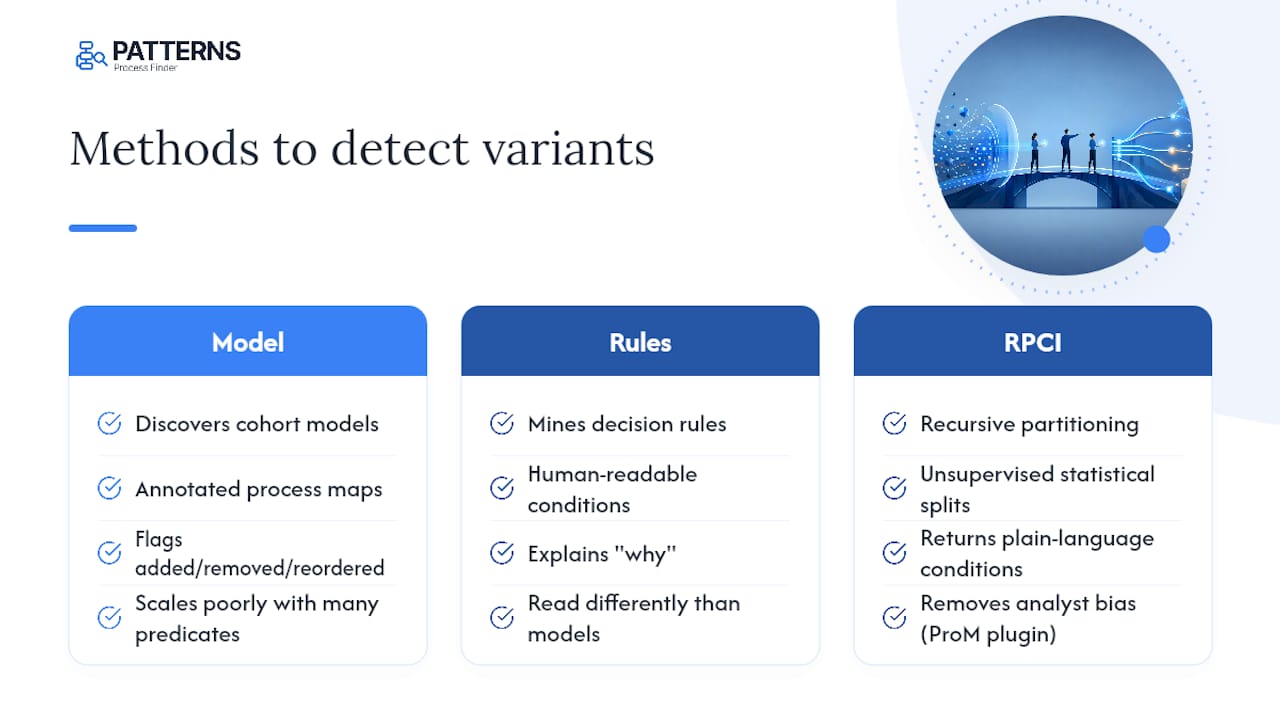
Rule-based and pattern extraction. These methods mine decision rules or causal relations directly from the log, producing human-readable conditions like “if payment method equals wire transfer, approval time exceeds three days in 78% of cases.” Surveyed research classifies these outputs separately from annotated models because analysts read them differently: rules explain “why,” models show “what changed.”
Statistical partitioning. Recursive partitioning with conditional inference, known as RPCI, is an unsupervised technique that tests event attributes for statistically significant splits rather than relying on a predicate an analyst guessed in advance. It has been implemented as a ProM plugin and validated on real logs, returning conditions like “region = APAC AND order value > $5,000” as the boundary of a genuine variant.
Why this matters: RPCI-style partitioning removes analyst bias from the split. Instead of testing the predicates you already suspect, the algorithm searches the attribute space and reports only partitions that clear a statistical significance threshold, then hands you a plain-language condition describing each one.
Most mature practices don’t pick one family and stop. A hybrid pipeline runs statistical partitioning first to find candidate splits objectively, then layers model annotation or rule extraction on top so the output is both statistically sound and interpretable to a non-technical stakeholder.
A step-by-step workflow for discovering and validating variants
Running variant analysis in the right order prevents wasted cycles on splits nobody cares about.
- Define the objective and metric. One sentence, one number you’re trying to explain.
- Prepare the log. Clean timestamps, choose predicates, and set your point of interest.
- Detect variants. Pick a method family (model-based, rule-based, or statistical) matched to your question.
- Compare cohorts statistically. Run significance tests on the metric across cohorts, don’t rely on eyeballed charts.
- Validate with subject-matter experts. Pull five to ten sample traces from each flagged variant and confirm the pattern makes operational sense.
- Prioritise by impact times effort. Rank variants by how much they move the metric against how hard they’d be to fix or automate.
Pro Tip: Step 5 catches more errors than any statistical test. A variant that looks significant in aggregate sometimes turns out to be three exception-handling cases that got miscoded, and only a human glance at the raw traces reveals that.
Managing variants through the process lifecycle
Once you’ve found real variants, the next problem is maintaining them without cloning a full model for every configuration. The Provop approach, described in foundational business process variant literature, solves this by defining a single base or reference process, then deriving each variant through a small set of change operations:
- Insert, delete, move, or modify activities relative to the base.
- Group related change operations into reusable options.
- Attach context rules that automatically select which options apply for a given case.
This keeps maintenance centralised. Update the base process once, and every derived variant inherits the change, rather than requiring updates across dozens of cloned models. Configurable modelling approaches do need governance, though: option constraints must be checked for conflicts, or automated configuration can produce inconsistent or invalid process instances. Dynamic context, attributes that shift mid-case, typically requires runtime reconfiguration support rather than a one-time static derivation.
Common pitfalls in process variant analysis
The biggest trap is model explosion: treating every mathematically distinct path through the log as its own variant. A log with enough attribute combinations can generate thousands of “variants” that are statistically real but operationally meaningless.
- Filter by business-outcome correlation, not raw path frequency.
- Anchor predicates to variables that map to a decision someone can act on, region, product, team, not incidental log noise.
- Confirm whether a context variable is static or dynamic before building the split; a mismatch here invalidates the model.
- Require a statistical significance check before flagging a variant as worth attention, and always spot-check a sample of underlying traces.
Pro Tip: If your detection method surfaces more than twenty “significant” variants on a first pass, that’s usually a sign your predicate set is too fine-grained, not that your process is unusually chaotic.
How automated discovery speeds up variant analysis
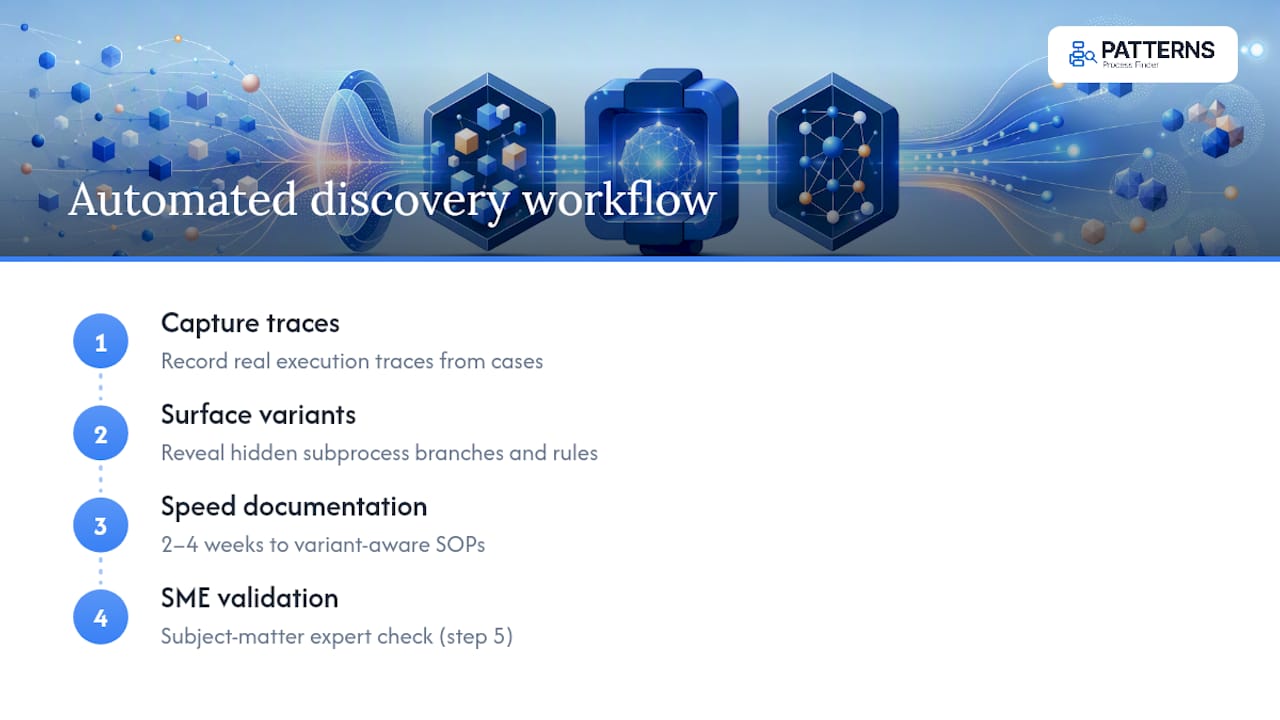
Manually tracing which cohort follows which path across thousands of cases is slow, and traditional documentation rarely reflects what employees actually do. Automated discovery tools capture real execution traces directly, surfacing hidden subprocess branches and client-specific rules that never made it into a process diagram.
That speed compounds when discovery feeds directly into documentation. Teams using SAP Process Discovery for living SOPs have moved from raw process discovery to actionable, variant-aware documentation in two to four weeks, a fraction of the time manual process mapping usually takes. Tooling accelerates the detection and prioritisation stages, but subject-matter expert validation, step 5 in the workflow above, still matters just as much once automation is in the loop.
Operationalizing variant analysis as an ongoing practice
Treat variant analysis as a recurring check, not a one-off study. Set up a small steering group with a shared prioritisation rubric, then embed variant detection directly into your release and automation gates, so high-impact variants automatically trigger a living SOP update or an automation trial.
— Malek
Turn variant findings into working automation with Patterns Process Finder
Some process discovery tools capture real execution traces across desktop and browser applications automatically, so the cohorts and predicates you’d otherwise piece together by hand get surfaced as hidden subprocess branches and client-specific rules from day one.
Instead of exporting a log, cleaning timestamps, and manually filtering traces before you can even start comparing cohorts, the platform’s process mining tool does the discovery and visual mapping for you, then feeds directly into living SOPs that update as the process changes rather than going stale the day they’re published. That matters most for teams running high volumes of exception handling or preparing candidates for automation, where an outdated SOP means a bot automating the wrong version of the process. Teams have used this approach to build living SOPs in two to four weeks instead of months of manual documentation. If your next step is finding out which of your own process variants deserve automation first, request a demo and see what your event data actually shows.
Sources
- Business process variant analysis: Survey and classification
- Lifecycle management for business process variants / Provop concepts
- Finding process variants in event logs (RPCI approach)
- Business process variant analysis: survey and classification (arXiv)
FAQ
What is a process variant?
A process variant is a subset of process executions grouped by a shared predicate, like region, product type, or customer segment, that behaves differently from the rest of the log in control-flow, performance, or resource use.
How is process variant analysis different from process mining?
Process mining discovers a single overall process model from an event log, while process variant analysis splits that log into cohorts first and compares them, revealing differences that a single aggregate model would hide.
Which method should I use to detect variants?
Choose a model-based comparison for control-flow differences you want visualised, rule-based extraction for human-readable causes, or statistical partitioning methods like RPCI when you want the algorithm to find significant splits without a predicate assumed in advance.
How do I avoid model explosion when analyzing variants?
Filter candidate variants by their correlation with a business outcome rather than raw path frequency, and validate every flagged split against a sample of real traces before acting on it.
Can automated tools speed up variant analysis?
Yes. Tools like Patterns Process Finder capture real execution data automatically and surface hidden subprocess branches, cutting the time from raw discovery to actionable, variant-aware documentation to a matter of weeks rather than months.