
Protect Process Mining Data: 5 Controls Security Engineers Need
Process mining is safe when five controls are in place: multi-factor authentication with role-based access, encryption in transit and at rest, strict data minimization, anonymization or differential privacy on sensitive log attributes, and documented retention and deletion policies. Before ingesting a single event log, run a risk scoping exercise. Never share raw logs with resource-level or timestamp detail until those controls and anonymization steps are confirmed.
TL;DR:
- Protect process mining data with multi-factor authentication, role-based access, and encryption, and avoid sharing raw logs until controls and anonymization are confirmed.
- Re-identification risk arises from combining timestamps, case identifiers, and resource attributes, especially in healthcare and sensitive environments.
- Implement core controls like strict access management, API security, encryption, and audit logging before deploying any process mining platform.
- Use a toolkit of privacy techniques such as generalization, differential privacy, and resource-protection methods to balance privacy and analytic utility.
- Federated process mining is suitable when sharing raw data is not allowed, with secure aggregation protocols and local anonymization.
Table of Contents
- What are the main risks unique to process mining?
- How do you build core engineering controls into a deployment?
- What privacy-preserving techniques actually reduce re-identification risk?
- When does federated process mining make sense?
- What governance actions support technical controls?
- How do you check readiness before onboarding process mining securely?
- How does Patterns Process Finder approach privacy in process discovery?
- What do most teams get wrong on their first process-mining pilot?
- Get started with privacy-conscious process discovery
- Sources
- FAQ
What are the main risks unique to process mining?
Process mining pulls timestamps, case identifiers, and resource attributes out of systems that were never designed with analytics in mind. That combination creates a re-identification problem most security teams underestimate: a timestamp plus a case ID plus a named resource can single out an individual employee or patient even after obvious identifiers are stripped. A systematic review of process mining in cybersecurity and reliability analysis notes the same temporal context that makes process mining valuable for forensic and compliance work is exactly what makes event logs risky to expose.
The other major exposure sits in the integration layer. Process-mining platforms connect to ERP, CRM, and ticketing systems through APIs, and industry analysis of process-mining app security flags object-level authorization failures as a recurring, high-risk pattern.
- Re-identification through timestamp, case, and resource attribute combinations
- API misconfiguration and broken object-level authorization
- Cloud storage misconfiguration exposing raw or lightly protected logs
- Insider risk from excessive query privileges on sensitive process data
How do you build core engineering controls into a deployment?
Get the plumbing right before anyone runs a discovery algorithm. Engineering controls are the foundation everything else, including anonymization, depends on.
- Identity and access management. CISA recommends multi-factor authentication using passwordless methods such as biometrics or a hardware keyfob wherever possible, integrated with single sign-on and enforced through role-based access with least-privilege defaults.
- Encryption everywhere data moves or rests. TLS or mutual TLS on every connection, strong encryption at rest, and key management through a cloud provider’s KMS rather than home-grown key handling.
- API hardening. Input validation, object-level authorization checks on every request, rate-limiting, and mutual authentication between the mining platform and source systems. This is where the CMMS software security guidance on IAM and role-based controls offers a useful parallel for any operational analytics platform pulling from line-of-business systems.
- Centralized audit logging. Every access event and query against process data routed into a SIEM, with retention rules on the access logs themselves, not just the underlying event data.
Pro Tip: Test your role-based access model with a dry-run query audit before go-live. If an analyst account can pull resource-level detail across every department, your RBAC scope is too wide, not your analytics platform too smart.
Enterprise security teams already run most of this stack for other systems. The real work is extending it to process mining’s specific ingestion points, covered in more depth in guidance on enterprise security integration.
What privacy-preserving techniques actually reduce re-identification risk?
Anonymization in process mining is not a single technique. It is a toolkit, and picking the wrong tool costs you either privacy or analytic utility.
- Suppression removes sensitive attributes outright, the bluntest option and often the biggest utility loss.
- Generalization, as demonstrated by the PMDG framework for multi-perspective process mining, groups activity and attribute values into equivalence classes large enough to satisfy k-anonymity while preserving the dependencies between control-flow and other perspectives.
- Differential privacy injects calibrated noise into query results or the log itself, giving a mathematical privacy guarantee at the cost of some accuracy. That trade-off is exactly why research on privacy and confidentiality challenges in process mining treats privacy and utility as a dial to tune, not a switch to flip.
- Trace-variant and resource-perspective methods, including the TraVaS approach and the PRETSA algorithm family, protect the sequence of activities and the people who performed them separately, since resource data often carries more re-identification risk than the control-flow itself.
Discovery and conformance checking tolerate more generalization because they care about patterns, not individual traces. Predictive models are less forgiving. If you are building a predictive workflow, local differential privacy or a federated setup will preserve accuracy better than aggressive generalization applied to a centralized log.
Event logs in healthcare settings illustrate the stakes: privacy-preserving process mining research in clinical contexts documents measurable re-identification risk in logs that looked anonymous at a glance, which is exactly why specialized algorithms outperform ad-hoc suppression.

When does federated process mining make sense?
Federated process mining (FPM) lets separate business units, or separate organizations entirely, run analysis without ever centralizing raw event logs. Each party processes its own data locally and only shares aggregated, protected outputs. That architecture is the right call whenever confidentiality agreements or regulatory boundaries make sharing raw logs a non-starter. For example, hospital networks comparing care pathways or supply chain partners benchmarking fulfillment times.
The security work sits in how the aggregation happens.
- Local preprocessing and anonymization before any data leaves its source
- Secure aggregation protocols so no single party sees another’s raw contributions
- Cryptographic primitives, such as secure multiparty computation, for high-sensitivity comparisons
Research on security and privacy in federated process mining identifies two recurring threats: leakage through aggregated statistics that can be reverse-engineered, and poisoning attacks where one participant feeds misleading data to skew shared results. Both require protocol-level defences, not just policy language in a data-sharing agreement.
What governance actions support technical controls?
Technical controls fail quietly when governance is an afterthought. Minimization comes first: collect only the attributes your analytic goal actually requires, and write down the justification for every field you pull. If you cannot explain why an analyst needs a resource’s shift schedule, do not ingest it.
- Scope before you collect. Document which event attributes serve the stated analytic goal, and treat anything outside that list as excluded by default.
- Set retention and deletion timelines for raw logs, derived datasets, and any intermediate anonymized copies, with automatic expiry rather than manual cleanup.
- Put anonymization requirements into contracts. Data-sharing agreements should specify which techniques apply, what queries are permitted, and who is accountable if a re-identification incident occurs.
- Reassess periodically. A goal-oriented evaluation methodology for privacy-preserving process mining frames this as a repeatable cycle: revisit goals, re-check data acquisition scope, and re-measure the privacy-utility balance as source systems and business questions change.
Provenance documentation matters here too. When an audit asks where a dataset came from and what happened to it along the way, “we’re not sure” is not an answer regulators or clients accept.
How do you check readiness before onboarding process mining securely?
Run the risk scoping first. Identify every data source you plan to connect, flag which attributes are sensitive, and note any legal constraints tied to the industry, such as health data rules covered in guidance on HIPAA workflow documentation. Skipping this step is the single most common cause of remediation work later.
- Confirm the platform enforces MFA, SSO, and RBAC before any log leaves its source system
- Verify encryption in transit and at rest, plus API authentication with object-level checks
- Match your privacy technique to the task: lighter generalization for discovery, differential privacy or federation for predictive or cross-organization work
- Run a synthetic or sampled test to measure how much utility you lose at each privacy setting
- Set logging, anonymization SLAs, and a recurring audit or red-team schedule before full rollout
Pro Tip: Run your synthetic utility test with the same questions your business stakeholders will actually ask. A privacy setting that scores well on generic accuracy metrics can still hide the exact bottleneck an operations lead needs to see.
How does Patterns Process Finder approach privacy in process discovery?
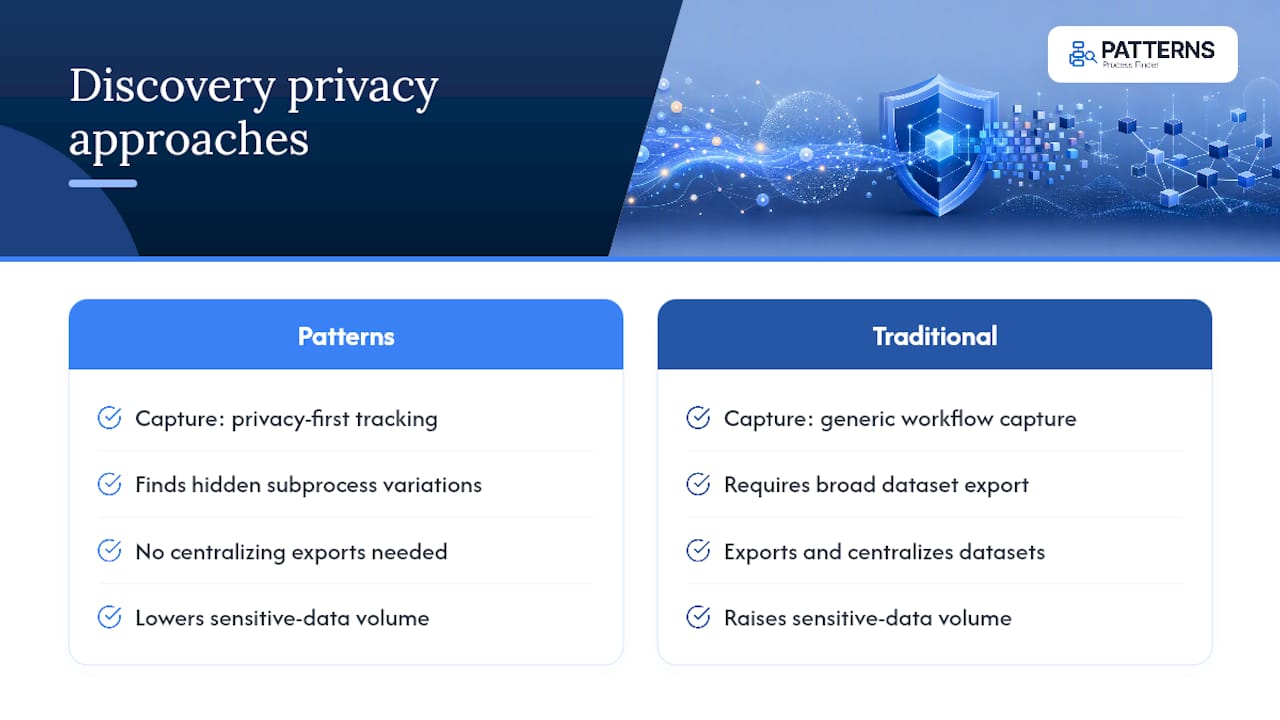
This platform automates the discovery of real workflows across desktop and browser applications, integrating privacy-conscious behaviour tracking into the capture process rather than treating it as an afterthought. Because the platform identifies hidden subprocess variations and client-specific rules directly, teams don’t need to export and centralize broad datasets just to find where a process actually breaks down. That narrower, targeted approach to data capture, detailed in the discussion of business rules discovery, lowers the volume of sensitive information moving through a mining pipeline in the first place.
What do most teams get wrong on their first process-mining pilot?
The pilots that struggle almost always share a pattern: they collect every attribute available “just in case,” skip role-based access because the pilot group is small, and leave retention policy for after launch. Every one of those shortcuts becomes expensive remediation once the pilot scales. Scope your data narrowly, build access controls in from day one, and treat anonymization and governance as one combined discipline, not competing checkboxes.
— Malek
Get started with privacy-conscious process discovery
Traditional process mining tools force a trade-off: capture broad, detailed event logs to get useful analytics, or protect privacy and lose visibility into what’s actually happening. Patterns Process Finder is built to narrow that trade-off from the start. It maps real workflows, including the subprocess variations and exception handling that static documentation never records, while keeping data capture privacy-conscious rather than exhaustive.
That matters for security teams evaluating any process-mining platform: the less raw, sensitive data a tool needs to pull in, the smaller your exposure surface. Patterns turns that captured activity into living SOPs that update automatically as workflows change, instead of static documents that drift out of date and get replaced by broader, riskier data pulls to “figure out what’s really happening.” The platform’s approach to automation readiness is covered in more detail in the guide on deciding when to automate a process.
Plans are available at three tiers, Basic, Pro, and Enterprise, with free trials for teams that want to test the discovery process before expanding deployment. If your next step is evaluating whether your current workflows can be captured and documented without expanding your data footprint, try the process mining tool or request a demo to see it against your own systems.
Sources
- Require multifactor authentication | CISA
- Privacy-preserving process mining in healthcare
- Security and Privacy in Federated Process Mining
- Privacy and confidentiality in process mining: An overview of challenges, methods, and future research directions
FAQ
Is process mining safe to use with sensitive data?
Process mining can be safe when platforms enforce MFA, role-based access, encryption, and anonymization on sensitive attributes before analysis begins. The risk comes from raw, unprotected event logs, not from the analytic technique itself, and research on healthcare process mining shows targeted anonymization can preserve useful patterns while cutting re-identification risk.
What are the four types of data security controls relevant to process mining?
The four core categories are access controls (MFA and RBAC), encryption (in transit and at rest), network and API security (authentication and object-level checks), and data governance (minimization, retention, and deletion policies). Process mining needs all four working together, since a strong encryption setup does little if API authorization is broken.
What are the main stages of a process mining project?
A typical process mining project moves through data extraction, event log preparation, process discovery, conformance checking, and performance or bottleneck analysis, followed by ongoing monitoring. Privacy and security steps, including anonymization and access scoping, need to sit inside the extraction and preparation stages, not bolted on afterward.
How does Patterns Process Finder reduce process mining risk compared to broad data exports?
Patterns Process Finder captures workflow activity directly and identifies hidden subprocess variations without requiring teams to export entire event logs into a separate analytics environment. Pricing for Basic, Pro, and Enterprise plans is listed on the Patterns Process Finder site, and current details are available there for teams comparing deployment options.
Do enterprise platforms like Palantir perform process mining?
Palantir’s platforms focus on data integration and analytics for large organizations, which can support elements of process analysis, but process mining as a discipline centres on algorithms that reconstruct actual workflows from event logs. Purpose-built process mining and discovery tools apply specialized techniques, such as generalization and conformance checking, that general data platforms are not designed around.