
Six Stage Human in the Loop Automation Playbook for Decision Makers
Human in the loop automation is a workflow design where automated systems handle routine decisions and route anything ambiguous, high-risk, or low-confidence to a person before it proceeds. Use it whenever a wrong automated decision carries real cost. If a mistake is cheap to reverse, let the system run unattended; if it’s expensive, non-compliant, or hard to undo, put a qualified reviewer in the loop.
TL;DR:
- Human-in-the-loop automation is most worthwhile when decision ambiguity is high, error costs are significant, or regulators demand human oversight.
- Key components include confidence scoring, review packets, routing queues, audit trails, and feedback mechanisms, which must be carefully calibrated for domain risk profiles.
- Scaling HITL requires limiting review volume through sampling, tiered escalation, and capacity planning, avoiding review bottlenecks and bias.
- Metrics such as exception rate, automation coverage, reviewer accuracy, and resolution time should be monitored weekly or monthly to ensure system health.
- Effective process discovery reveals actual workflows, reducing unexpected exceptions and enabling continuous threshold tuning for better accuracy.
Table of Contents
- What is human in the loop automation and its variants?
- Why does human in the loop automation pay off?
- What are the core components of a HITL system?
- What does the full HITL lifecycle look like?
- How do you scale HITL without creating bottlenecks?
- What metrics and governance controls actually matter?
- How do you run a HITL pilot before scaling it?
- What common pitfalls undermine HITL, and how do you fix them?
- How does process discovery improve HITL outcomes?
- A practitioner’s take on where HITL rollouts actually surprise teams
- Sources
- FAQ
What is human in the loop automation and its variants?
Human-in-the-loop, or HITL, differs from full automation in one structural way: the system pauses at defined checkpoints and waits for a person to confirm, correct, or reject a decision before execution continues. Full automation runs end to end with no checkpoint. IBM’s overview of HITL frames this as inserting oversight specifically where models face ambiguity or high-consequence outcomes, which supports accuracy and gives the process an audit trail regulators and customers can actually inspect.
The taxonomy has three common shapes, and picking the wrong one is a frequent design mistake:
- Human-in-the-loop: a person reviews and approves before the system acts, used when errors are costly (loan approvals, medical claims).
- Human-on-the-loop: a person monitors a running system and intervenes only on exception, used for high-volume, lower-risk streams (fraud scoring, spam filtering).
- Human-along-the-loop: a person and the system work concurrently on the same case, common in complex document review where context builds over time.
Document processing, contact centre triage, and Know Your Customer (KYC) onboarding are the domains where these variants show up most often, largely because each mixes routine cases with a meaningful share of genuinely ambiguous ones. The taxonomy research from PMC notes that loop placement, interaction granularity, and timing all have to match the domain’s actual risk profile, not a generic template.
Why does human in the loop automation pay off?
The business case for HITL rests on four outcomes: accuracy, compliance, auditability, and trust calibration. Full automation optimizes for speed; HITL optimizes for correctness on the cases that matter most, while still automating the bulk of routine volume. That trade-off pays off under specific conditions, not universally.
Three signals tell you HITL is worth the investment: inputs are genuinely ambiguous (scanned documents, inconsistent customer language), the downstream cost of an error is high (financial exposure, safety, regulatory penalty), or a regulator or auditor requires demonstrable human review at some stage. Absent all three, full automation is usually the more efficient choice.
HITL delivers ROI precisely where machines produce frequent low-confidence decisions. Rather than reviewing every transaction, organizations route only the edge cases that fall below a confidence threshold to a human, preserving throughput on the 80 to 90 percent of cases the model handles correctly while still catching the ones it doesn’t. That’s the entire economic argument for HITL in one sentence: pay reviewer time only where it is necessary to improve the outcome.
What are the core components of a HITL system?
Every working HITL system needs five components, and skipping any one of them is usually what turns a pilot into a bottleneck later.
- Confidence scoring and gates: the model outputs a score per decision, and a threshold determines whether it executes automatically or routes to a human. Tune thresholds by testing against a labelled sample and adjusting until false-positive review rates and missed-error rates both sit at acceptable levels.
- Minimum review packet: reviewers need the original input, the model’s reasoning or confidence score, and prior processing history in one view, so they aren’t hunting across systems to make a decision.
- Routing and queues: cases get sorted by urgency, complexity, or reviewer skill, with clear service-level agreements (SLAs) attached to each queue.
- Audit trail and metadata capture: every escalation, decision, and override gets logged with a timestamp and reviewer identity, which is what makes the system defensible to an auditor.
- Feedback capture: every human correction gets written back into the model, ruleset, or threshold logic, not just resolved and forgotten.
PrimeAxiom’s design pattern guide describes these five as the backbone that separates HITL systems that scale from ones that collapse under review volume.
Pro Tip: Set your first confidence threshold deliberately conservative, then loosen it over two or three review cycles as you confirm the model’s error rate on borderline cases. Starting loose and tightening later means live errors you’ll have to explain.

What does the full HITL lifecycle look like?
A production HITL workflow runs through six distinct stages, and each one needs its own tooling and ownership, according to Moxo’s lifecycle framework.
- Detection: the system flags a case using a low-confidence score, an anomaly rule, or a hard business rule (dollar amount over a threshold, missing field).
- Handoff: the case moves to a reviewer with full context preserved, including the original input, the model’s confidence score, and any prior processing steps, so nothing gets re-investigated from scratch.
- Intervention: the reviewer sees a purpose-built decision interface with clear options (approve, reject, escalate, request more information), not a raw data dump.
- Resolution: the system executes the human’s decision automatically, resuming the pipeline rather than requiring manual re-entry into downstream systems, which is where Camunda’s platform guidance notes most workflows lose time through avoidable rework.
- Feedback: the reviewer’s decision and reasoning get logged back into the model’s training data or the ruleset, so the same exception type is less likely to recur.
- Reporting: dashboards track exception volume, resolution time, and reviewer patterns, feeding the next round of threshold tuning.
Treat feedback as a required stage, not an optional add-on. Skipping it means every human correction is a one-off fix that never reduces future exception volume.
How do you scale HITL without creating bottlenecks?
Scaling HITL is really a capacity-management problem disguised as a technical one. Four practices keep review volume proportional to reviewer capacity as case counts grow:
- Sample instead of reviewing everything: for lower-risk decision types, review a statistically meaningful sample rather than 100 percent of cases, and use the sample’s error rate to recalibrate confidence thresholds.
- Build explicit escalation tiers: route straightforward exceptions to first-line reviewers and reserve senior reviewers for cases involving irreversible or high-dollar decisions.
- Govern the feedback loop: audit human overrides periodically for consistency, since a reviewer quietly rubber-stamping every escalation defeats the purpose of the checkpoint.
- Plan reviewer capacity against volume forecasts: SLAs mean nothing if the queue outgrows the team assigned to clear it.
PrimeAxiom’s pattern guide flags a specific anti-pattern here: systems that flag everything for review because nobody classified decisions as reversible versus irreversible up front. That single classification step, done early, is often the difference between a HITL program that scales cleanly and one that drowns its review team within a quarter.
Pro Tip: Review reviewer decisions, not just system decisions. If one person’s approval rate is 15 points higher than their peers on the same case type, that’s a calibration problem worth investigating before it becomes a compliance one.
What metrics and governance controls actually matter?
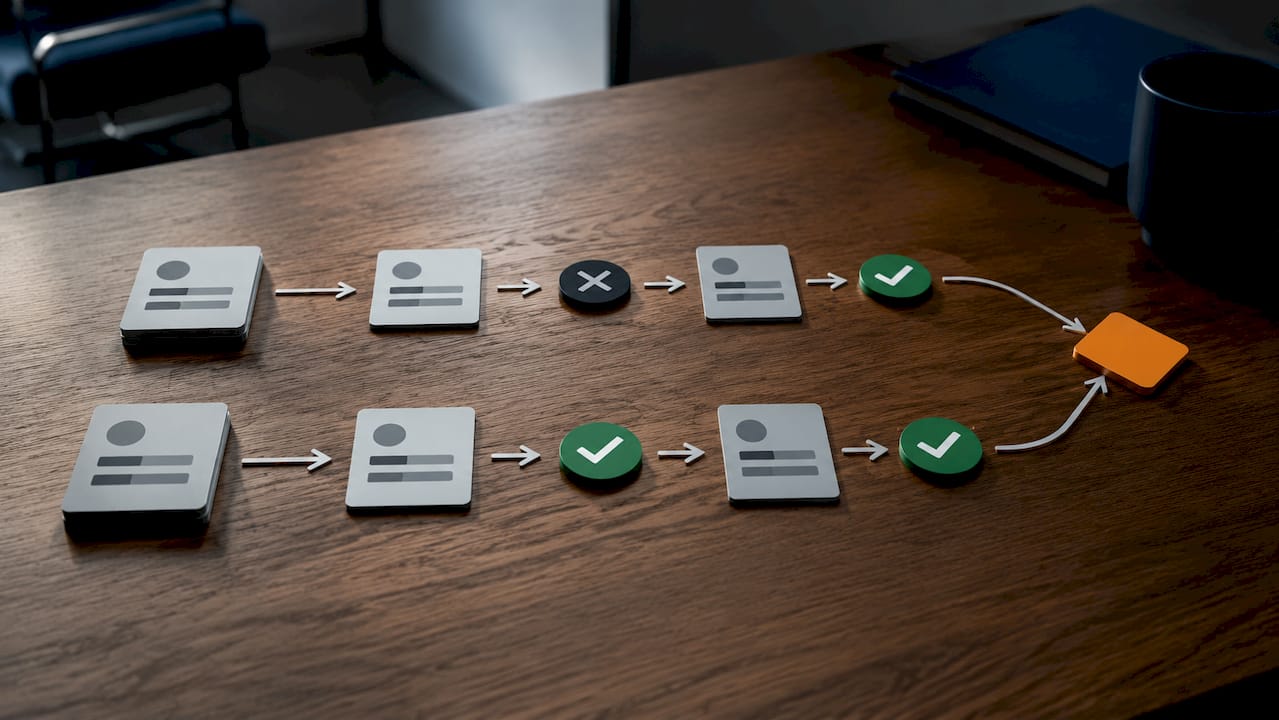
Four KPIs tell you whether a HITL program is working: exception rate (the percentage of cases routed to a human), automation coverage (the percentage resolved without one), reviewer accuracy (measured against a periodic audit sample), and mean resolution time from detection to resolution. Track them weekly during a pilot and monthly once stable.
| Metric | What it tells you | Typical review cadence |
|---|---|---|
| Exception rate | Whether confidence thresholds are too loose or too tight | Weekly |
| Automation coverage | How much volume runs without human intervention | Weekly |
| Reviewer accuracy | Whether human decisions are actually improving outcomes | Monthly audit sample |
| Mean resolution time | Whether SLAs and routing are working | Weekly |
Governance runs alongside metrics: audit logs need to capture who decided what and when, reviewers need documented competency requirements before they can approve certain case types, and any personal data captured during review needs handling that matches your organization’s privacy controls. Rising exception rates usually mean the model has drifted or thresholds need retuning; falling reviewer accuracy usually means it’s time to rotate reviewers or retrain them.
How do you run a HITL pilot before scaling it?
A pragmatic pilot follows four steps, in this order, and skipping the sequence is the most common reason pilots stall.
- Define scope, success metrics, and a timeline. Pick two or three KPIs (exception rate, resolution time, reviewer accuracy) and commit to a review point, typically 60 to 90 days out.
- Choose a moderate-volume use case with clear exception criteria. Avoid your highest-stakes process for a first pilot; pick one with enough volume to generate signal but low enough risk that mistakes are recoverable.
- Design the review packet, routing logic, and SLAs before writing code. Reviewers should never have to hunt for context, and queue rules should already reflect the escalation tiers you plan to use at scale.
- Instrument the feedback loop and set stop/go criteria up front. Decide in advance what exception rate or reviewer accuracy would trigger scaling, pausing, or killing the pilot, so the decision isn’t made emotionally at the 90-day mark.
What common pitfalls undermine HITL, and how do you fix them?
Four failure modes show up repeatedly across HITL rollouts, and each has a straightforward operational fix.
- Automation bias and rubber-stamping: reviewers start approving everything without genuinely evaluating it. Fix it by rotating reviewers across case types and requiring documented evidence for every approval, not just a checkbox.
- Human bottlenecks: review volume outpaces reviewer capacity as the system scales. Fix it with sampling for lower-risk categories and tiered escalation for the rest.
- Privacy leakage: sensitive data sits exposed in review queues longer than necessary. Redact or pseudonymize personal information before it reaches a reviewer wherever the decision doesn’t require seeing it, and pair that with access controls appropriate to AI agents operating with system-level permissions.
- Missing SLAs and incomplete context: cases sit unresolved because nobody owns the queue, or reviewers lack the history to decide quickly. Fix both by defining SLAs per queue and enforcing the minimum review packet standard from day one.
How does process discovery improve HITL outcomes?
Most HITL exception rates stay stubbornly high not because thresholds are wrong, but because the documented process never matched what employees actually do. Patterns Process Finder automates the discovery of real workflows, capturing how a task is actually executed rather than how a policy document says it should be, which is exactly the gap that generates unpredictable exceptions in the first place.
- Hidden branches surface before they cause escalations. Patterns identifies subprocess variations and client-specific rules that standard documentation misses, so routing logic can account for them upfront instead of learning about them from a backlog of confused reviewers.
- Living SOPs cut investigation time. Continuously updated Standard Operating Procedures built from real execution data give reviewers accurate context immediately, instead of a stale document that describes a process nobody follows anymore.
- Execution data sharpens thresholds over time. Patterns’ visibility into how undocumented process variations actually play out gives teams the evidence to retune confidence gates and reduce repeat exception types, rather than guessing.
A practitioner’s take on where HITL rollouts actually surprise teams
Most HITL programs don’t fail on the technology. They fail because nobody mapped what reviewers were actually reviewing against, so the “minimum review packet” ends up incomplete on day one. My honest recommendation: audit your real process before you design the automation, not after the first bad escalation. Pilot small, track exception rate and resolution time from week one, and treat the feedback loop as the whole point, not an afterthought.
— Malek
Sources
- What Is Human In The Loop (HITL)? | IBM
- Survey on human-in-the-loop approaches and taxonomy | PMC
- The complete human-in-the-loop automation lifecycle: 6 essential stages | Moxo
- Primeaxiom
- What is Human in the Loop Automation | Camunda
FAQ
What Is Human-in-the-Loop Automation?
It’s a workflow design where an automated system handles routine cases and routes ambiguous or high-risk ones to a human reviewer before execution, which IBM defines as inserting oversight specifically to preserve accuracy and accountability.
What Is the Human-in-the-Loop Mechanism?
The mechanism is a confidence gate: the system scores each decision, and anything below a set threshold pauses for human review, then resumes automated execution once a person resolves it, as Camunda’s HITL model describes.
What Is the Human-in-the-Loop Strategy?
The strategy is selective intervention: reserve human review for cases where errors are costly, inputs are ambiguous, or regulators require demonstrable oversight, and let automation run unattended everywhere else.
What Is Human-in-the-Loop Simulation?
It refers to testing or training environments where a human interacts with a simulated system in real time, evaluating or correcting its decisions, a technique closely related to the same trust-calibration principles used in production HITL systems, as outlined in the HITL taxonomy research.