
SOP vs work instructions: clarity for compliance teams
TL;DR:
- An SOP controls processes at a high level, while work instructions detail specific tasks for execution. Keeping them separate but linked ensures operational consistency and audit readiness; automation tools like Patterns Process Finder capture actual workflows to improve documentation accuracy. Properly managing both document types reduces deviations, enhances compliance, and supports effective training.
An SOP controls the process; a work instruction controls the task. Keep both distinct but linked: use SOPs for governance and accountability, and work instructions for reproducible execution at the point of use. Standards like ISO 9001:2015 and FDA 21 CFR 211 treat these as separate document types for good reason, and Patterns Process Finder is built around the same principle: capture how work actually happens, then document it at the right level.
The confusion between the two is more common than most quality teams admit. When an SOP absorbs task-level steps, it becomes bloated and hard to maintain. When a work instruction tries to govern an entire process, it loses traceability. Both errors increase deviations and audit findings in ways that are entirely preventable.

Table of Contents
- What is a standard operating procedure (SOP)?
- What is a work instruction, and what formats work best?
- How do SOPs and work instructions compare across key dimensions?
- When should you write an SOP, a work instruction, or both?
- How do SOPs and work instructions fit in a document hierarchy?
- Why the SOP vs work instruction distinction matters for audits and compliance
- How to author, review, and maintain SOPs and work instructions
- Common documentation mistakes and how to fix them fast
- How automated process discovery changes SOP and WI accuracy
- Key takeaways
- The gap nobody talks about
- Patterns Process Finder keeps your SOPs and WIs audit-ready
- Useful sources
- FAQ
What is a standard operating procedure (SOP)?
An SOP is a governance-level document that controls an entire process or a defined segment of one. It maps responsibilities, approvals, inputs, outputs, and the sequence of major steps, but it does not tell an operator exactly how to turn a dial or click through a software screen. That level of detail belongs elsewhere.
Standard SOP components include:
- Purpose and scope: what the document governs and what it excludes
- Roles and responsibilities: who owns each step and who approves outputs
- Main process steps: high-level sequence, not granular task instructions
- Inputs and outputs: what triggers the process and what it produces
- Records and references: forms to complete and documents to consult
- Approval and change control: sign-off authority and revision history
The primary audience for an SOP is supervisors, quality assurance staff, and process owners. A frontline operator performing a single task rarely needs the full SOP; they need the work instruction that the SOP references. A document qualifies as an SOP rather than a policy when it describes a repeatable process with defined steps, owners, and records. It qualifies as an SOP rather than a procedure when it carries formal approval authority and change-control requirements.
Three short examples of SOP headings that reflect the right scope:
- Deviation management and CAPA initiation
- Batch release and quality sign-off process
- New supplier qualification and approval
Pro Tip: Write your SOP steps as outcomes, not instructions. “Operator verifies calibration status” is an SOP step. “Open the calibration log, locate the instrument ID, and confirm the expiry date has not passed” is a work instruction step. Keeping that boundary sharp prevents SOPs from ballooning into 40-page documents that nobody reads.
What is a work instruction, and what formats work best?
A work instruction is task-focused, step-by-step guidance that converts a single procedural step from an SOP into a set of reproducible actions. Where an SOP says “operator verifies equipment calibration,” the work instruction says exactly how to do that, in the order it must happen, with the specific settings or acceptance criteria required.
Typical work instruction contents:
- Numbered steps in execution order
- Exact parameters, settings, or tolerances (e.g., temperature range, torque value, field name in a software form)
- Photos, screenshots, or annotated diagrams at critical steps
- Safety notes and personal protective equipment requirements
- Acceptance criteria and pass/fail thresholds
- Forms or records to complete at each step
A micro-example for a single equipment verification task:
- Log in to the calibration management system using your employee ID.
- Navigate to Equipment Register and search by instrument serial number.
- Confirm the calibration expiry date is at least 30 days in the future.
- If expired or within 30 days, place the instrument on hold and notify the lab supervisor.
- Record the verification result in Form QC-14 and initial the log.
That level of granularity is what separates a work instruction from an SOP step. The SOP references this task; the work instruction executes it.
Format options vary by context:
- Checklist: fast to complete, ideal for routine tasks with binary pass/fail criteria
- Annotated images or screenshots: effective for software UI tasks and equipment setup
- Screen-by-screen instructions: standard for ERP, LIMS, or MES workflows
- MES/LMS-embedded pages: work instructions built directly into manufacturing execution or learning management systems for point-of-use access
Work instructions are typically authored by area subject-matter experts (SMEs) or supervisors who perform the task. They update more frequently than SOPs because they are tied to specific equipment, software versions, or supplier materials. Practical guidance consistently shows that work instructions perform best for onboarding, software UI navigation, and equipment-specific steps where step-level detail reduces errors.
A work instruction that lives in a binder on a shelf two rooms away from where the task happens is not a work instruction. It is a compliance artefact. Placement at the point of use is not optional.
How do SOPs and work instructions compare across key dimensions?
The core distinction is governance versus execution: SOPs set the “what” and “who”; work instructions set the “how.” The table below makes that concrete across seven dimensions.

| Dimension | SOP | Work Instruction |
|---|---|---|
| Level of detail | Process-level: major steps, responsibilities, inputs/outputs | Task-level: exact actions, settings, parameters, acceptance criteria |
| Primary audience | Supervisors, QA, process owners, auditors | Frontline operators, technicians, new hires |
| Purpose / goal | Governance, accountability, compliance traceability | Reproducible task execution, error reduction |
| Typical format and length | Numbered sections with narrative; 2–3 pages | Numbered steps with visuals; 1–4 pages per task |
| Author / owner | Process owner or QA manager | Area SME or supervisor |
| When to create / maintain | At process design; review annually or on process change | At task design; update on equipment, UI, or supplier change |
| Compliance and audit support | Provides the governance framework auditors trace from policy | Provides the execution evidence auditors sample for consistency |
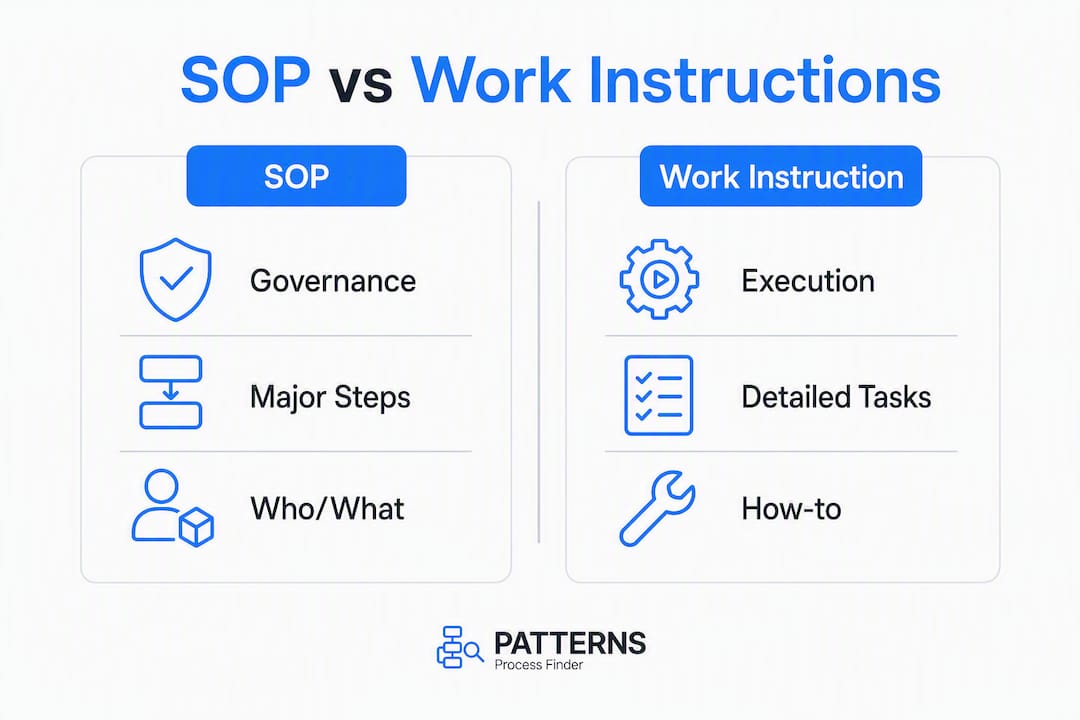
Example for each row: an SOP for “incoming material inspection” lists who approves lots and what records are retained; the corresponding work instruction shows the operator exactly how to measure a dimension and where to record the result.
When to combine versus split: combine SOP and work instruction content in a single document only when the process is simple (three or fewer operators, low compliance risk, stable task steps). Split them as soon as the task requires mechanical precision, involves many operators, or changes at a different cadence than the process it belongs to. In GMP environments, regulators assess alignment between controlled procedures and operational instructions as a governance signal, so the split is rarely optional.
When should you write an SOP, a work instruction, or both?
The decision is not about preference; it follows the nature of the work.
Write an SOP when:
- The scope spans multiple roles or departments.
- The output requires formal approval or sign-off.
- Regulatory or quality standards require a controlled procedure.
- The document needs to survive personnel changes without retraining from scratch.
- Audit traceability from policy to execution is required.
Write a work instruction when:
- A single SOP step requires more than two or three sub-actions to execute correctly.
- The task involves specific equipment, software screens, or measured parameters.
- Operator turnover is high and onboarding speed matters.
- Repeated deviations trace back to inconsistent task execution.
- A software UI, equipment model, or supplier specification has changed.
Create both when:
- The process is compliance-critical and involves multiple operators performing the same task differently.
- You are onboarding a new production line, laboratory method, or shared-services workflow.
- An audit finding or deviation investigation has identified missing task-level documentation.
Industry examples by context:
- Manufacturing: SOP for the batch manufacturing process; work instructions for each equipment setup, cleaning step, and in-process check.
- Laboratory: SOP for the analytical testing process; work instructions for each instrument method, reagent preparation, and system suitability check.
- IT / desktop operations: SOP for the incident management process; work instructions for each software tool used to log, triage, and close tickets.
- Shared services: SOP for the accounts payable process; work instructions for each ERP transaction screen and exception-handling path.
Quick decision prompts: if the question is “who is responsible and what must happen,” write an SOP. If the question is “exactly how does the operator do this step,” write a work instruction. If both questions apply, you need both documents.
How do SOPs and work instructions fit in a document hierarchy?
A well-governed documentation system flows in one direction: from intent to execution, with every level traceable to the one above it.
The standard hierarchy:
Each level references the one above it and is referenced by the one below. A policy states the organisation’s commitment. An SOP describes how the organisation fulfils that commitment through a controlled process. A work instruction describes how an operator executes a specific step in that process. Forms and records capture the evidence that execution occurred.
Version control and change-control checklist:
- Assign a unique document ID and version number to every SOP and work instruction.
- Define approval authority by document type (e.g., QA manager approves SOPs; area supervisor approves work instructions).
- Set an effective date and a scheduled review date on every document.
- Cross-reference: every work instruction must cite the SOP it supports; every SOP must list the work instructions it references.
- Record all changes in a revision history table within the document.
- Notify affected operators and require re-training sign-off when a work instruction changes.
ISO 9001:2015 does not mandate work instructions explicitly, but it does require that organisations retain documented information sufficient to demonstrate consistent execution of quality-critical tasks. That standard effectively creates the need for work instructions wherever task variability poses a quality risk.
| Document type | Review trigger | Minimum review cadence | Approval level |
|---|---|---|---|
| Policy | Regulatory change, strategic shift | Every 3 years | Executive / senior leadership |
| SOP | Process change, audit finding, annual review | Annually | Process owner + QA |
| Work instruction | Equipment change, UI update, deviation, supplier change | As triggered; at least every 2 years | Area supervisor + SME |
| Form / record | SOP or WI revision | With parent document | Same as parent |
Audit traceability tip: when an auditor asks for evidence that a process step was executed correctly, the chain runs from the record (completed form) back to the work instruction, then to the SOP, then to the policy. If any link in that chain is missing or out of sync, the finding is yours.
Why the SOP vs work instruction distinction matters for audits and compliance
Blurring the line between SOPs and work instructions is not just a documentation preference issue. It creates measurable inspection risk.
Under FDA 21 CFR 211, written procedures are required for production and process controls, and those procedures must be followed. When task-level execution detail is missing from the document system, inspectors interpret that as a failure of process control, not just a paperwork gap. In GMP contexts, regulators assess alignment between policy, controlled procedures, operational instructions, and retained records; misalignment is treated as a governance weakness, not an administrative oversight.
Common audit failure patterns tied to document confusion:
- An SOP references a task step but no work instruction exists; the operator performs the step from memory.
- Two work instructions for the same task exist in different versions, and operators use both.
- A work instruction was updated after an equipment change but the SOP still references the old method.
- Training records reference an SOP but operators were never trained on the corresponding work instructions.
A risk-based approach to document layering reduces inspection exposure: classify which process steps need work instructions based on variability, compliance impact, and operator count. High variability plus high compliance impact plus multiple operators equals a mandatory work instruction.
Pro Tip: Map every critical SOP step to a corresponding work instruction and a specific form or record. Present that map to auditors as a traceability matrix. It demonstrates that your document system is designed, not assembled.
How to author, review, and maintain SOPs and work instructions
Good documentation does not start with a blank template. It starts with a clear scope decision and a named owner.
Drafting checklist (applies to both document types):
- Define the scope: what does this document cover, and what does it explicitly exclude?
- Identify the audience: who will use this document, and what do they already know?
- Assess compliance risk: does this step appear in a regulatory requirement, quality standard, or audit finding?
- Assign an owner: one named role is responsible for accuracy and updates.
- Set minimum metadata: document ID, version, effective date, review date, approval signatures.
- Add change control fields: revision history table with date, change description, and approver.
Mini-template: SOP structure
- 1.0 Purpose — one sentence stating what the process achieves
- 2.0 Scope — what is included and excluded
- 3.0 Roles and responsibilities — table of roles and their accountabilities
- 4.0 Procedure — numbered major steps (reference work instructions by ID for task detail)
- 5.0 Records — list of forms and retention requirements
- 6.0 References — related SOPs, work instructions, standards
- 7.0 Revision history — table of version, date, change, and approver
Mini-template: work instruction structure
- Header: document ID, version, effective date, equipment or system name, related SOP ID
- Safety notes: PPE, hazards, prerequisites
- Step-by-step instructions: numbered, one action per step, with parameters and acceptance criteria
- Visuals: screenshots or photos at critical steps
- Completion record: form reference or sign-off field
Training and sign-off checklist:
- Conduct initial training before the document’s effective date.
- Require observed competency demonstration for high-risk work instructions.
- Set requalification frequency (typically annual for routine tasks, immediate on document revision).
- Retain training records linked to the specific document version the operator was trained on.
Pro Tip: When a software UI or equipment model changes, update the work instruction before the change goes live, not after the first deviation. Attach a “change reason” note to the revision history so auditors can see the update was proactive, not reactive.
Common documentation mistakes and how to fix them fast
Most documentation failures are predictable. The fixes are straightforward once the root cause is named.
- Overloaded SOPs: the SOP contains step-by-step task instructions instead of referencing work instructions. Fix: extract task steps into standalone work instructions, replace them in the SOP with a reference line, and update training records.
- Missing work instructions at the point of use: operators perform tasks from memory because no work instruction exists or it is stored somewhere inaccessible. Fix: audit each critical SOP step, identify gaps, and create or relocate work instructions within one sprint.
- Out-of-sync versions: the SOP and its work instructions are on different revision cycles. Fix: add a cross-reference table to the SOP listing each work instruction ID and its current version; review both together on the same schedule.
- Undefined ownership: no named role is responsible for keeping a document current. Fix: assign one owner per document in the document management system; tie ownership to the role, not the person.
- Training gaps: operators are trained on the SOP but not on the work instructions it references. Fix: update the training curriculum to include all referenced work instructions, and require sign-off at the work instruction level.
- Inconsistent records: forms are completed inconsistently because the work instruction does not specify exactly what to record. Fix: add a “records” row to each work instruction step that requires documentation.
Remediation steps for the most common scenario (overloaded SOP):
- Print the current SOP and highlight every step that contains more than two sub-actions.
- Extract each highlighted block into a new work instruction document.
- Replace the extracted content in the SOP with a single reference line: “Perform [task name] per WI-[ID].”
- Assign an owner and effective date to each new work instruction.
- Update the training matrix to include the new work instructions.
- Notify affected operators and require acknowledgement sign-off.
Pro Tip: Attach a lightweight evidence checklist to every work instruction: what record to complete, where to file it, and who to notify if a step cannot be completed as written. That single addition converts a work instruction from a training aid into an audit-ready document.
How automated process discovery changes SOP and WI accuracy
Traditional SOP and work instruction authoring relies on interviews, observation sessions, and SME workshops. The result is documentation that reflects how work is supposed to happen, not how it actually happens. Subprocess branches, client-specific exceptions, and workarounds developed over years rarely make it into the official document.
Automated process discovery addresses this directly. By recording real desktop and browser actions across a team, it surfaces the actual execution paths, including the undocumented branches that cause deviations when they are missing from work instructions.
Consider a shared-services team processing supplier invoices. A discovery run might reveal that 30% of invoices follow a non-standard path through a secondary approval queue that no SOP or work instruction documents. That branch exists because of a specific supplier category rule that was never formalised. Without discovery, the next person trained on the process learns the standard path and creates a deviation the first time they encounter that supplier.
Benefits of automated capture for documentation teams:
- Faster authoring: real execution recordings become draft work instructions with minimal manual transcription.
- Fewer rework cycles: documented steps match actual execution, reducing the gap between the document and the work.
- Traceable versioning: capture timestamps provide evidence of when a process changed, supporting change-control documentation.
- Improved training conversion: operators trained on discovery-based work instructions encounter fewer surprises on the job.
- Automation readiness: accurate work instructions are a prerequisite for RPA and process automation; discovery-based documentation reduces automation failure rates.
Patterns Process Finder records actual desktop and browser actions and extracts repeatable subprocesses suitable for documentation or automation. The output is a draft that SMEs validate, not a finished document that bypasses human review.
Security and privacy are core to any workflow capture deployment. Patterns Process Finder’s approach includes consent-based capture, data minimisation, and enterprise security protocols. Full details are available on the security and privacy page.
Pro Tip: Use discovery captures as draft sources, not final documents. Require SME validation of every captured path before it enters version control. The capture proves what happens; the SME confirms what should happen.
Key takeaways
SOPs govern the process; work instructions execute the task. Keeping them distinct, linked, and current is the foundation of both operational consistency and audit readiness.
| Point | Details |
|---|---|
| Separate governance from execution | SOPs define who is responsible and what must happen; work instructions define exactly how each task is performed. |
| Link every critical SOP step to a WI | Each high-risk or multi-operator task step in an SOP should reference a specific work instruction by document ID. |
| Apply version control at both levels | Assign unique IDs, review dates, and approval authority to SOPs and work instructions independently. |
| Use a risk-based approach to WI creation | Classify which steps need work instructions based on variability, compliance impact, and operator count. |
| Patterns Process Finder accelerates accuracy | Automated process discovery captures real execution paths, reducing the gap between documented and actual workflows for both SOPs and WIs. |
The gap nobody talks about
Most organisations know they need SOPs. Fewer understand that an SOP without corresponding work instructions is a governance document with no execution backbone. You can have a perfectly structured, ISO-aligned SOP library and still have operators performing the same task five different ways, because the task-level detail was never written down.
The deeper problem is that even when work instructions exist, they often document the ideal path, not the real one. SME workshops and observation sessions capture what people say they do. Discovery-based documentation captures what they actually do, including the exception paths, the workarounds, and the client-specific rules that live only in the heads of your most experienced operators.
Organisations that treat SOPs and work instructions as interchangeable tend to end up with one of two failure modes: governance documents so detailed they are never read, or task guides so high-level they provide no real guidance. Neither survives an audit. Neither supports consistent training. The fix is not more documentation. It is the right documentation at the right level, kept current by a process that does not depend entirely on someone finding time to run a workshop.
Patterns Process Finder keeps your SOPs and WIs audit-ready
Accurate documentation is only as good as the process that creates and maintains it. Most teams spend weeks in workshops trying to reconstruct how work actually happens, then produce SOPs and work instructions that are already out of date by the time they are approved.
Patterns Process Finder captures real user workflows across desktop and browser applications, identifying the subprocess branches, exception rules, and client-specific paths that never make it into manually authored documents. The result is documentation grounded in actual execution, not assumptions.
Use cases that match this audience directly:
- Process clarity: surface undocumented paths before they become deviations or audit findings.
- Handoff documentation: capture how experienced operators actually perform tasks before they leave.
- Training conversion: build work instructions from real execution recordings, not workshop notes.
- Automation readiness: accurate work instructions are the prerequisite for RPA; discovery removes the guesswork.
- Audit evidence: traceable capture timestamps support change-control documentation and inspection readiness.
Privacy and security are built into the platform from the ground up, with consent-based capture, data minimisation, and enterprise security protocols. See the security overview for full details.
Sign up for free to see how automated discovery changes the way your team authors and maintains process documentation.
Useful sources
The following references support the guidance in this article. Consult standards for governance requirements, and the Patterns Process Finder resources for automated capture and documentation workflows.
| Source | When to consult |
|---|---|
| FDA 21 CFR 211 — ecfr.gov | Pharmaceutical and life sciences teams establishing written procedure requirements |
| ISO 9001 work instructions — SafetyCulture | Quality managers applying ISO 9001:2015 to work instruction design |
| SOP vs WI: GMP analysis — Zamann Pharma | GMP compliance teams preparing for regulatory inspections |
| SOP vs WI: GMP compliance — PharmUni | Teams diagnosing deviation patterns linked to document confusion |
| Work instructions vs SOP — Hurley Write | Operations teams deciding when to split SOP and WI content |
| SOP vs work instructions — Anark | Process owners needing a plain-language distinction for stakeholder communication |
| Automated documentation capture — Patterns Process Finder | Teams using discovery outputs to draft or update work instructions |
FAQ
What is the difference between an SOP and a work instruction?
An SOP is a governance document that defines the process, roles, and responsibilities at a high level. A work instruction provides the step-by-step task detail an operator needs to execute a specific step within that process.
What is the difference between a procedure and a work instruction?
A procedure (or SOP) describes what must happen and who is responsible; a work instruction describes exactly how to perform a specific task, often with parameters, screenshots, or acceptance criteria.
What is the difference between a work process and an SOP?
A work process is the actual sequence of activities that produces an outcome; an SOP is the controlled document that governs that process, assigns ownership, and provides the compliance record required by standards like ISO 9001 or FDA 21 CFR 211.
What is the difference between standard work and a work instruction?
Standard work (a lean manufacturing concept) defines the optimal sequence, timing, and resource use for a task at a given point in time. A work instruction is the documented form of that standard, written for operator use and subject to formal version control and approval.
How does Patterns Process Finder help with SOP and work instruction accuracy?
Patterns Process Finder captures real user workflows across desktop and browser applications, surfacing undocumented subprocess branches and exception paths that manual authoring typically misses, so your SOPs and work instructions reflect actual execution rather than assumed best practice.