
Map Threats to 4 Methods for Process Mining Researchers
Process mining privacy means applying an anonymization strategy that matches your attack model while preserving the analytical utility your team actually needs. Choose group-based methods for straightforward re-identification risk, semantic sanitization (PRETSA, SaCoFa, PRIPEL) when control-flow accuracy matters, or differential privacy when you need formal, mathematically bounded guarantees. Whatever family you pick, define the threat model first, pilot on a sampled log, and record the transformation in privacy metadata before you scale.
TL;DR:
- Group-based methods like microaggregation and TLKC can reduce re-identification risk but may still lose some timing and control-flow detail.
- Semantic sanitization algorithms such as PRETSA and PRIPEL preserve process structure better than generic tools by focusing on the actual activity sequences and contextual attributes.
- Differential privacy guarantees strongest formal privacy but can significantly distort control-flow accuracy if not carefully tuned, especially on sequential process data.
- The NP-hardness of optimal k-anonymization means all practical approaches rely on heuristics, which require careful utility and privacy monitoring during deployment.
- Capturing process data through behavior-driven tools like Patterns Process Finder minimizes raw data exposure before anonymization, supporting privacy and compliance.
Table of Contents
- Why event logs are a privacy minefield most teams underestimate
- A working taxonomy of anonymization approaches for process mining
- PRETSA, SaCoFa, and PRIPEL: the algorithms built specifically for traces
- Setting differential privacy budgets without wrecking your analysis
- Why some anonymization problems can’t be solved, only managed
- Documenting your privacy transformations with metadata and the XES extension
- Measuring privacy and utility with a repeatable evaluation method
- A step-by-step checklist for deploying privacy-preserving process mining
- How Patterns Process Finder supports privacy-aware process discovery
- What the field still gets wrong about process mining privacy
- A privacy-conscious way to capture process data in the first place
- Sources
- FAQ
Why event logs are a privacy minefield most teams underestimate
An event log looks like plumbing data. It is not. Each trace, the sequence of activities tied to a single case, functions as a quasi-identifier in almost the same way a birthdate or postal code does in tabular data. Combine a timestamp, a resource name, and a handful of activity labels, and you often have enough to single out one employee or one patient case even after obvious identifiers are stripped out.

Timestamps do the most damage. A case that starts at 2:14 AM on a Tuesday and touches three specific resources is frequently unique in the whole log, which means removing the case ID accomplishes almost nothing. Resource attributes compound the problem: if only two people in a department handle a given exception type, tagging that resource re-identifies them regardless of what you did to the case ID column.
Formal threat modelling treats these risks as distinct attack categories rather than one vague “privacy risk” bucket:
- Re-identification attacks, where an adversary with partial background knowledge (a known timestamp, a known resource) matches a target individual to a specific trace in the released log.
- Membership disclosure, where the adversary determines whether a specific person’s data appears in the log at all, which matters even without learning the trace content, especially in healthcare or HR contexts.
- Reconstruction attacks, where an adversary rebuilds sensitive attribute values from released process models, aggregate statistics, or social network graphs rather than from the raw log itself. Reconstruction from released models is a documented, practical threat, not a theoretical edge case.
- Linkage attacks, where the adversary joins the anonymized log against an external dataset (a public roster, a hospital admission list) to strip away the anonymization entirely.
Writing an attack model does not require a security certification. It requires three honest answers: what does the adversary already know (a partial trace, a resource list, an external database), what do they want to learn (identity, membership, an attribute value), and what would count as a successful attack against your specific release. A hospital publishing a treatment-pathway log for academic research faces a very different adversary than an insurer sharing claims-handling data with an internal audit team, and the anonymization strategy should differ accordingly. Skip this step and you end up picking a technique because it is popular, not because it fits.
A working taxonomy of anonymization approaches for process mining
Four families dominate the literature, and each trades off differently between privacy strength, implementation complexity, and how much analytical value survives the transformation.
Group-based approaches extend the classic k-anonymity idea, guaranteeing that every released record is indistinguishable from at least k-1 others on the quasi-identifying attributes. The trouble is that k-anonymity was built for flat tables, and a trace is a sequence, not a row. Microaggregation-based methods adapted for event logs group similar cases before generalizing shared attributes, which reduces re-identification risk while keeping aggregate statistics reasonably intact. Extensions like TLKC add a length and confidence bound so the model accounts for how much of a trace an adversary might already know, rather than assuming they know everything or nothing.
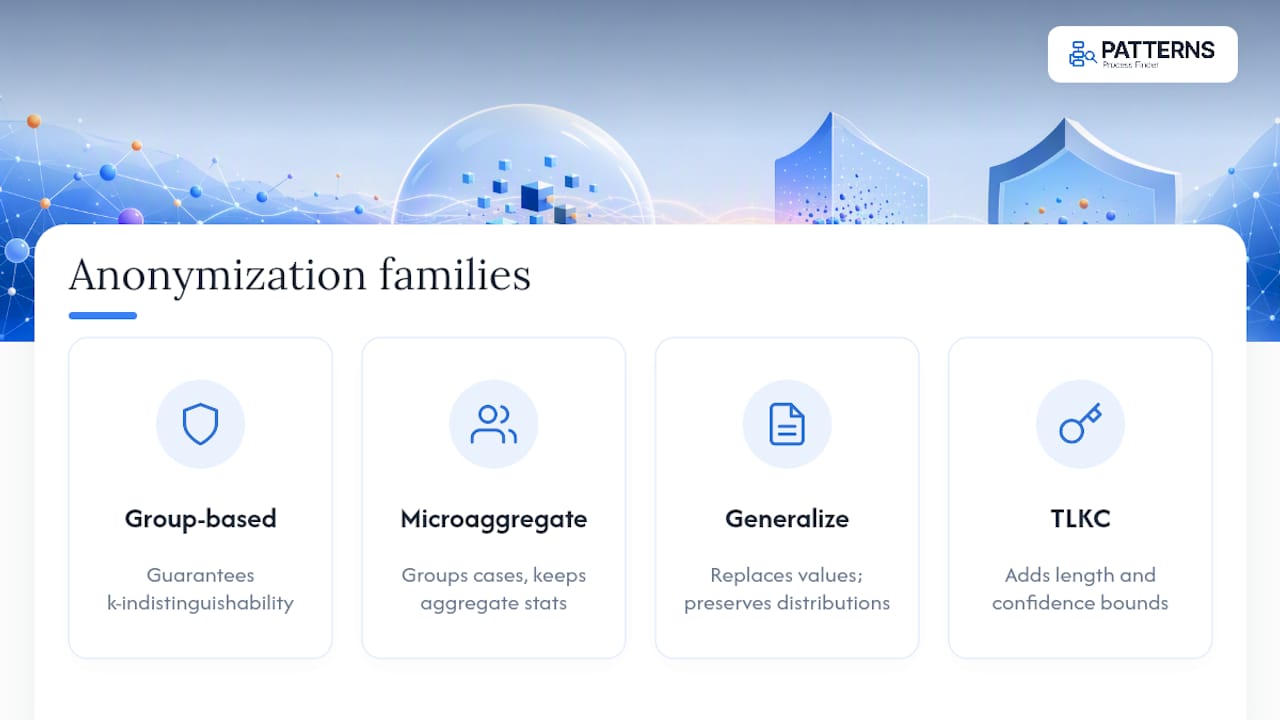
Microaggregation and generalization variants cluster similar traces and replace individual values with cluster representatives, such as substituting an exact timestamp with a time band or an exact resource with a role category. This preserves distributional properties well but degrades fine-grained timing analysis, which matters if your downstream goal is bottleneck detection.
Pseudonymization, suppression, and cryptographic masking are the blunt instruments: replace identifiers with tokens, drop rare attribute combinations outright, or hash sensitive fields. They are cheap and fast, and they are also the weakest against a determined adversary with external data, since token consistency across a log often re-creates the linkage the pseudonym was supposed to prevent.
Differential privacy adds calibrated statistical noise so that the presence or absence of any single case has a bounded, quantifiable effect on the output. It offers the strongest formal guarantee of the four families, but naive noise insertion on sequential data can wreck control-flow accuracy, turning a clean process model into statistical noise dressed up as a discovery result.
Where the field actually stands: optimal k-anonymization of event logs is NP-hard, meaning no algorithm can guarantee both perfect privacy and perfect efficiency on realistic, high-dimensional logs, leading to heuristic trade-offs. Every production method you will encounter is a heuristic trade-off, not a solved problem.
That NP-hardness result is worth sitting with, because it explains why the rest of this article is a catalogue of trade-offs rather than a single recommended default.
PRETSA, SaCoFa, and PRIPEL: the algorithms built specifically for traces
Generic anonymization tools were not designed for sequential, timestamped case data, and it shows the moment you try to apply them directly to an event log. The following algorithms exist because the process mining research community concluded that traces need purpose-built treatment.

PRETSA and the prefix-tree family. PRETSA builds a prefix tree from the event log, where each path from the root represents a shared activity sequence across multiple cases. It then merges tree branches that fall below a chosen anonymity threshold, generalizing timestamps and suppressing rare paths until every remaining branch satisfies k-anonymity, and optionally t-closeness for sensitive attribute distributions. Empirical testing on real event logs shows this prefix-tree merging preserves discovered process models well under realistic adversary assumptions, though the fully optimal variant, PRETSA*, carries exponential worst-case complexity that makes it impractical past a few thousand distinct trace variants. Practical deployments almost always run a heuristic, best-first version instead of the exact optimum.
SaCoFa and SaPa: keeping control-flow semantics intact. Both algorithms start from the observation that a differentially private release which distorts the order of activities is often useless for discovery, even if the privacy math is flawless. SaCoFa and SaPa build semantics-aware noise mechanisms that respect the underlying control-flow structure, adding noise in ways that avoid manufacturing impossible activity sequences or destroying the loops and branches a process model depends on. That semantic awareness is the difference between a differentially private log that a discovery algorithm can still work with and one that produces a spaghetti model no analyst would trust.
PRIPEL: combining approaches instead of picking one. PRIPEL sanitizes the control-flow skeleton of each trace first, then applies local differential privacy to the remaining contextual attributes, resource names, case attributes, and event data payloads, individually. This two-stage design lets teams tune privacy strength on the sensitive contextual fields without over-distorting the sequence structure that process discovery and conformance checking depend on.
- Prefix-tree sanitization suits teams whose primary output is a discovered process model and who need an interpretable, tunable k-anonymity or t-closeness guarantee.
- Semantics-aware DP (SaCoFa/SaPa) suits teams that need a formal differential privacy guarantee but cannot tolerate control-flow corruption.
- PRIPEL suits mixed workloads where both the flow and the contextual attributes carry sensitive information.
Pro Tip: Run PRETSA-style sanitization on a copy of your log first and compare the discovered process model, side by side, against the original in a tool with visual process mapping. If the two models diverge on your core happy-path sequence, your anonymity threshold is set too aggressively for that dataset.
Setting differential privacy budgets without wrecking your analysis
Differential privacy protects an event log by injecting calibrated noise, and the parameter ε (epsilon) controls how much. A smaller ε means stronger privacy and more noise; a larger ε means weaker privacy and cleaner data. There is no universal “correct” ε for process mining, because the right value depends entirely on what analysis the log needs to support downstream.
Discovery-oriented releases, where the goal is recovering an accurate process model, tolerate somewhat looser budgets than releases meant for precise aggregate reporting, such as case-duration statistics used in a compliance dashboard. Aggregate queries amplify small per-record errors into visible distortions at the summary level, while discovery algorithms can sometimes average out modest per-trace noise across many similar cases.
Two implementation patterns show up repeatedly in the literature:
- Local differential privacy adds noise on each individual’s device or record before it ever reaches a central log, which suits contextual attributes like resource identity or case data fields where you cannot trust a central aggregator.
- Global differential privacy adds noise centrally after collecting the raw log, which generally preserves more utility per unit of privacy budget but requires trusting whoever runs the sanitization step with the unmodified data first.
The practical failure mode is applying naive, uniform noise across an entire trace without regard to structure. Semantics-aware noise shaping, as demonstrated in SaCoFa and SaPa, constrains where and how noise gets applied so that it does not manufacture activity transitions that never happened in the real process. Skipping semantic noise constraints can result in differentially private logs that meet mathematical criteria but produce unusable analysis results.
Before committing to a budget for a production release, pilot the same ε value against your actual downstream metrics, discovered model fitness, conformance checking accuracy, or social network centrality scores, rather than trusting a value pulled from an unrelated paper’s use case. What works for a retail claims log will not necessarily hold for a hospital treatment pathway with far fewer distinct trace variants.
Why some anonymization problems can’t be solved, only managed
Optimal k-anonymization of an event log is NP-hard, and that is not a minor technical footnote. It means that as your log grows in case volume or attribute dimensionality, no algorithm can guarantee the mathematically best possible anonymization within a reasonable runtime. This computational ceiling is well established, and it shapes every practical tool built for this space.
The engineering response has been heuristics, not brute force:
- Greedy merging and BF-PRETSA (best-first variants of the prefix-tree algorithm) trade a small amount of theoretical optimality for runtime that scales to logs with tens of thousands of cases.
- Sampling and partitioning reduce the working dataset before anonymization, then extrapolate or reassemble results, which cuts computation time at the cost of some statistical precision on rare trace variants.
- Federated and secure multi-party patterns avoid pooling raw event data across organizational boundaries entirely, letting each party compute local statistics or apply local sanitization before any cross-organization aggregation happens, a pattern that matters for multi-hospital or multi-branch process mining.
Runtime and utility both need active monitoring during sanitization, not just at the end. Build a utility check into the pipeline itself: compare discovered model fitness before and after sanitization on every run, not just during initial validation.
Documenting your privacy transformations with metadata and the XES extension
A sanitized event log with no record of what was done to it is close to useless for anyone auditing it later, including your own team six months from now. A proposed privacy extension for XES, the standard event log format used across process mining tools, defines a structured way to attach transformation metadata directly to the log without exposing the sensitive values that were transformed.
Useful metadata fields include the operation type applied (suppression, generalization, DP noise injection), the privacy level or parameter used (a k value, a t-closeness bound, an ε), and a utility indicator summarizing how much the transformation affected downstream discovery accuracy.
- Operation type and level: which algorithm ran (PRETSA, SaCoFa, PRIPEL, or a simpler suppression pass) and at what parameter setting.
- Privacy budget consumed: the cumulative ε spent if differential privacy was involved, since budgets deplete across repeated queries on the same underlying data.
- Utility indicators: model fitness or precision scores measured before and after sanitization, so a downstream analyst knows how much to trust the result.
- Granularity level: whether the transformation was applied at the log, trace, or event level, since a log-wide k value tells you far less than a per-trace record of which cases were merged or suppressed.
Granularity is the trade-off most teams underestimate. Log-level metadata is cheap to produce but tells an auditor almost nothing about which specific traces were altered. Event-level metadata is exhaustive and supports genuine reproducibility, but it can balloon storage and, if handled carelessly, leak information about which records were considered rare or high-risk in the first place.
Pro Tip: Store privacy metadata separately from the sanitized log itself, with restricted access. A metadata file that says “case 4,417 was in a suppressed cluster of size 2” is itself a disclosure risk if anyone outside the data governance team can read it.
This kind of record also does real work for regulatory compliance. When a data subject exercises an access or deletion right under a framework like GDPR, metadata showing exactly which transformation touched their case, and whether their data was merged, suppressed, or noised, lets a team respond accurately instead of guessing.
Measuring privacy and utility with a repeatable evaluation method
Every privacy-preserving process mining project needs two numbers before it can claim success: a privacy risk estimate and a utility loss estimate. Reporting only one of them is how vendors and papers alike oversell weak techniques.
Privacy risk estimators typically measure the probability that an adversary with a defined background knowledge level can correctly re-identify a case or infer a sensitive attribute. These estimates should be tied directly to the attack model you wrote earlier, not computed against a generic worst-case adversary that does not reflect your actual release scenario.
Utility metrics need to match what the log is actually for:
- Process discovery: model fitness and precision, comparing the process model mined from the sanitized log against the model from the original.
- Conformance checking: how much the fitness and precision of conformance results shift when checked against the sanitized versus original log.
- Social network analysis: whether handoff patterns and resource collaboration structures survive the anonymization, since generalizing resource identities can flatten organizational network insights entirely.
A goal-oriented evaluation methodology (GQM), goals, questions, metrics, gives this process structure instead of ad hoc testing. The cycle runs in stages:
- Define the goal: state explicitly what the privacy-utility balance needs to achieve for this specific release (for example, “preserve discovery accuracy within 5% of baseline while guaranteeing k ≥ 10”).
- Formulate questions: what would confirm or deny that the goal was met (does the discovered model’s fitness score stay above a defined threshold?).
- Select metrics: pick the specific privacy and utility measures that answer those questions.
- Run targeted acquisition and refinement: apply the candidate technique, measure, and adjust parameters iteratively rather than accepting the first output.
- Report and compare: document the final parameter choices, metric results, and the attack model assumptions, so another team could reproduce the comparison.
A minimal reporting checklist for any PPPM experiment should include the attack model assumptions, the algorithm and parameters used, the privacy risk estimate under that attack model, the utility metrics before and after sanitization, and the runtime on a stated log size. Skipping any one of these turns a rigorous evaluation into a marketing claim.
A step-by-step checklist for deploying privacy-preserving process mining
Moving from technique selection to a production pipeline goes smoother with a defined sequence rather than picking an algorithm and hoping the rest sorts itself out.
- Scope the release. Decide who receives the sanitized log, an internal analytics team, an external research partner, a regulator, and what they are contractually or ethically permitted to attempt with it.
- Map the attack model. Write down adversary knowledge, goals, and available external datasets for this specific scope, not a generic worst case.
- Pick the technique family. Match group-based, semantic sanitization, or differential privacy to the attack model and the analyses that must remain accurate.
- Pilot on a sampled log. Run the chosen algorithm on a representative subset before touching the full dataset, and measure both privacy risk and utility loss against your GQM plan.
- Evaluate against stakeholder thresholds. Confirm the acceptable utility loss and required privacy guarantee with whoever owns the downstream analysis, not just with the technical team.
- Operationalize with metadata. Attach the privacy metadata to every released log, using the XES extension fields described earlier, before it leaves your controlled environment.
Before signing off on a pilot, put these questions to stakeholders directly: which specific analyses must remain accurate (bottleneck detection, compliance checks, resource workload)? What is the maximum tolerable utility loss, expressed as a percentage drop in model fitness or precision? Is there a defined deletion window for raw, unsanitized logs once the sanitized version is validated?
Certain signals should trigger an immediate escalation to legal or compliance rather than a purely technical fix. A log containing healthcare treatment pathways, financial transaction sequences tied to individual accounts, or any dataset falling under HIPAA or GDPR scope needs sign-off before release, not after. If your attack model assumes an adversary with access to an external roster (a patient list, an employee directory), treat linkage risk as a compliance-relevant finding, since a successful linkage attack on health data is a reportable incident in many jurisdictions.
Pro Tip: Build periodic re-assessment into the pipeline, not just a one-time sign-off. External datasets an adversary might use for linkage attacks change over time, so a log that was safely anonymized last year against a specific background-knowledge assumption may not be safe against this year’s newly available public data.
Minimum instrumentation for any production deployment includes logging of who accessed the sanitized log and when, periodic audits comparing current utility metrics against the original pilot baseline, and a documented schedule for re-running the attack model assessment as external data availability shifts.
How Patterns Process Finder supports privacy-aware process discovery
Most privacy failures in process mining start before anonymization ever enters the picture, at the data capture stage, when raw screen recordings, click logs, or unfiltered event streams get exported wholesale and passed around teams with no structure. Automated process discovery built with privacy-conscious behaviour tracking changes that starting point by capturing how work actually happens without exporting raw, unfiltered activity data by default.
Patterns Process Finder generates living, continuously updated SOPs directly from observed workflows, which means the analytical output your team needs, the actual sequence of steps, the exception patterns, the subprocess variations, gets produced without every downstream analyst needing raw access to the underlying event stream. That structural separation between “what gets analyzed” and “who touches raw data” is itself a privacy control, independent of which anonymization algorithm you later apply to any exported log.
- Execution metadata capture: Patterns records how a process was actually run alongside the discovered workflow, giving teams a documented basis for the kind of transformation metadata this article recommends.
- Reduced raw-data exposure: because SOPs and process maps are generated from captured behaviour rather than requiring every stakeholder to query the raw log directly, fewer people need direct access to sensitive event-level detail.
- Audit-ready logging: security and data privacy controls built into the platform support the traceability that privacy metadata and compliance audits both depend on.
A practical pilot pattern looks like this: use Patterns to capture traces from a defined process area, export a sampled subset of the resulting log, apply a sanitization algorithm like PRETSA or PRIPEL to that sample, and store the resulting privacy metadata alongside the SOP output for future audits. That gives a research or compliance team a defensible, documented pipeline instead of an ad hoc export sitting in someone’s downloads folder.
What the field still gets wrong about process mining privacy
Most organizations treat privacy as a step bolted onto the end of a process mining project, something you do to a log right before it leaves the building. That sequencing is backwards, and it is the single biggest reason privacy-preserving techniques underperform in practice. By the time someone reaches for PRETSA or a differential privacy library, the attack model has often never been written down, which means the parameters chosen are guesses dressed up as engineering decisions.
The research community has done real work here. Semantics-aware sanitization is a genuine advance over naive noise insertion, and the shift toward documenting transformations through metadata rather than treating anonymization as an invisible black box deserves more attention than it gets. But there is a gap between what the algorithms can guarantee mathematically and what most teams can actually verify operationally, because interpretable, standardized disclosure metrics are still immature. A k value or an ε tells a specialist something concrete; it tells most stakeholders almost nothing about real-world risk.
The open problems worth watching are scalable differential privacy for long, high-variability sequences, federated approaches that let multiple organizations mine shared processes without pooling raw logs, and disclosure metrics an operations leader could actually interpret without a statistics background. None of that gets solved by a single vendor or a single paper. It needs researchers and practitioners comparing results on shared, public benchmark logs, the same way other data privacy subfields matured once common evaluation datasets existed.
— Malek
A privacy-conscious way to capture process data in the first place
Group-based anonymization, semantic sanitization, and differential privacy all assume you are starting from a raw event log that already needs fixing. Patterns Process Finder takes a different starting point: it captures real workflow execution and turns it into living SOPs and process maps without requiring every team member to export or handle raw event data directly.
That matters most for operations leaders and automation teams who need accurate process intelligence but cannot justify the compliance overhead of managing raw, unsanitized logs across every department. Because Patterns generates documentation from observed behaviour rather than requiring broad raw-log access, fewer people in your organization ever need to touch sensitive event-level detail in the first place, which shrinks your attack surface before any anonymization algorithm even enters the conversation. The platform’s security and data privacy controls support the audit logging and traceability that a formal privacy assessment expects to see.
If your team is evaluating how to combine automated process discovery with a defensible privacy posture, request a demo of the process mining tool and walk through how a captured workflow, a sampled export, and a sanitization pass fit together for your specific data environment.
Sources
The papers behind this guide cover the proofs and algorithms in full technical depth. The microaggregation-based approach to privacy-preserving process mining lays out the foundational case for group-based techniques applied to logs. The NP-hardness analysis of optimal k-anonymization explains why heuristics dominate practical deployments. Group-based techniques adapted for traces cover TLKC and PRETSA in detail, while the SaCoFa, SaPa, and PRIPEL methods overview details semantics-aware differential privacy. The goal-oriented evaluation methodology offers a reproducible framework for comparing any of these techniques head to head.
- Privacy-preserving process mining: A microaggregation-based approach
- Privacy-preserving data publishing in process mining (arXiv)
- Thesis / methods overview including SaCoFa, SaPa, PRIPEL
FAQ
How do you protect data from re-identification in process mining?
Map your attack model first, then choose group-based anonymization (k-anonymity, TLKC, PRETSA), semantic sanitization, or differential privacy based on what an adversary could realistically know and what analyses must stay accurate, and always pilot the chosen method on a sampled log before full deployment.
What are the limitations of process mining?
Beyond privacy risk, process mining is limited by event log quality issues, incomplete or noisy timestamps, missing case attributes, and by the computational cost of anonymizing large, high-dimensional logs, since optimal k-anonymization is NP-hard and forces reliance on heuristic trade-offs.
What are the main categories of privacy at stake in process mining?
Process mining data commonly implicates identity privacy (who performed a case), attribute privacy (sensitive case data), behavioural privacy (the sequence of actions someone took), and organizational privacy (internal handoff and resource patterns), all of which need separate consideration in an attack model rather than one blanket policy.
What does process mining actually do?
Process mining analyzes event logs, timestamped records of activities and resources, to discover how a process really runs, check whether real execution conforms to an intended model, and surface bottlenecks or exception patterns; tools built for automated process discovery generate this insight directly from observed workflow behaviour.
Which anonymization technique preserves the most analytical accuracy?
Semantics-aware algorithms like SaCoFa, SaPa, and PRIPEL generally preserve control-flow accuracy better than naive noise insertion or blunt suppression, because they constrain transformations to respect the underlying process structure rather than treating the log as an unordered table.