
Automated Process Discovery: A Buyer’s Guide for Analysts

Automated process discovery (APD) uses event logs, desktop activity captures, and AI-driven algorithms to map how work actually executes inside your organization and surface high-value automation opportunities. If you are evaluating solutions now, the most effective first step is to run a scoped pilot using two or three processes with clean event log data, then validate findings against your baseline KPIs before committing to a full deployment.
The core claim: APD replaces subjective, interview-based process mapping with data-driven process models that reflect real execution, not the idealized version documented in a policy manual. The result is faster identification of automation candidates, compliance gaps, and cycle-time bottlenecks.
Two signals that separate credible APD deployments from expensive experiments:
- APD tools can analyze high volumes of event traces far faster than manual mapping approaches, giving operations teams coverage that workshops simply cannot match.
- BPMN 2.0 and Petri net outputs from discovery runs are directly consumable by RPA and BPM platforms, shortening the discovery-to-automation handoff considerably.
Table of Contents
- What is automated process discovery, exactly?
- Process mining vs. task mining: which one do you need?
- How automated process discovery works in practice
- Why organizations invest in automated process discovery
- How to evaluate automated process discovery solutions
- Common enterprise use cases and what APD reveals
- How to run a pilot and scale: a practical roadmap
- The biggest failure mode: bad input data and governance gaps
- Key Takeaways
- The gap between what APD promises and what actually matters
- Patterns by Processfinder: built for analysts who need real process intelligence
- Useful sources and further reading
What is automated process discovery, exactly?
Automated process discovery is the combination of process mining, task (desktop) mining, and AI analytics applied to recorded organizational data to construct an objective model of how a process actually runs. It is distinct from manual discovery, which relies on interviews, workshops, and document reviews that capture how people believe work happens rather than how it does.
The three core components work together:
- Process mining extracts structured event logs from enterprise systems (ERP, CRM, ITSM) and applies algorithms to build a process model.
- Task mining records desktop and browser activity at the user level, capturing the manual steps that never appear in system logs.
- AI analytics layers on top to identify variants, bottlenecks, conformance deviations, and automation candidates automatically.
Core data inputs
Every APD run depends on an event log containing at minimum three attributes: a case ID (unique identifier grouping all activities for one instance), an activity name (what happened), and a timestamp (when it happened). Additional attributes such as resource names, cost centers, and outcome flags enrich the model but are optional.

Visual outputs and notations

| Notation | What it communicates best |
|---|---|
| Directly-Follows Graph (DFG) | Frequency and sequence of activities; fast baseline view |
| Petri net | Formal, unambiguous concurrency and branching logic |
| Process tree | Hierarchical, sound model; basis for BPMN conversion |
| BPMN 2.0 | Human-readable; directly usable by RPA and BPM tools |
Glossary analysts need
- Event log: The structured dataset of case ID, activity, and timestamp records extracted from source systems.
- Case ID: The unique key that groups all events belonging to one process instance (e.g., one invoice, one ticket).
- Variant: A distinct sequence of activities observed across cases; high variant counts signal process fragmentation.
- Conformance checking: Comparing a discovered model against a normative model to quantify deviations.
- Task mining: Desktop-level capture of user actions to supplement system event logs.
- Process model: The graphical output of a discovery algorithm representing observed behavior.
Why terminology matters: Teams that conflate “process mining” and “process discovery” often scope pilots incorrectly. Process discovery is one of three main types of process mining; the other two are conformance checking and model enhancement. Getting this right before vendor conversations saves significant scoping time.
Process mining vs. task mining: which one do you need?
The choice between process mining and task mining is not either/or for most enterprise processes. It depends on where the work actually lives.
| Dimension | Process mining | Task (desktop) mining |
|---|---|---|
| Primary input | System event logs (ERP, CRM, ITSM) | Desktop/browser activity captures |
| Visibility level | End-to-end process flow across systems | Step-level user actions within applications |
| Strengths | High-volume, system-driven processes; conformance checking | Manual steps, copy-paste actions, UI navigation |
| Limitations | Blind to work done outside system logs | Requires agent deployment; privacy considerations |
| Best for | Order-to-cash, invoice processing, IT service management | Claims handling, KYC, any heavily manual workflow |
When to run both together: mixed human/system processes are the norm in most enterprises. An accounts payable process, for example, may have clean SAP event logs for the invoice receipt and posting steps, but the exception-handling steps (manual email lookups, spreadsheet corrections, copy-paste between screens) are invisible to process mining alone. Task mining fills that gap.
Practical rule of thumb: Start with process mining on system-driven processes to establish the end-to-end flow and identify where the model breaks down. Add task mining precisely where the DFG shows unexplained gaps or high variant counts that system data cannot explain.
Pro Tip: Run process mining first. It is the least invasive method and requires no agent deployment. Use the resulting model to identify which specific steps need desktop-level investigation before deploying task mining agents.
How automated process discovery works in practice
The APD pipeline moves through five stages, each with distinct data engineering and analytical requirements.
- Data extraction: Pull event logs from source systems via API, database query, or connector. Map case IDs across systems (e.g., linking an ERP order number to a CRM case ID) to build a unified log.
- Preprocessing and cleaning: Normalize timestamps across time zones, handle missing events, remove noise (duplicate events, test cases, outlier traces), and group repetitive user actions into meaningful higher-level events.
- Algorithmic discovery: Apply a discovery algorithm to the cleaned log to produce an initial process model.
- Visualization and filtering: Apply staged filtering (activity-based, variant-based, arc pruning) to simplify the model without losing fidelity. A DFG is the standard starting point; higher-level notations (Petri nets, process trees, BPMN) are generated for human review and downstream use.
- Conformance checking and output: Compare the discovered model against normative models, generate variant lists, throughput metrics, bottleneck heatmaps, and root-cause leads.
Algorithm types and their trade-offs
Over 100 process mining algorithms exist. Four families matter most in practice:
- α-algorithm: The foundational algorithm; good for learning the mechanics but not production-grade due to sensitivity to noise.
- Heuristic mining: Uses event frequency to suppress infrequent paths; practical for noisy real-world logs.
- Inductive miner: The leading choice for enterprise deployments. It guarantees sound models (no deadlocks, no livelocks) and scales well. Process trees produced by inductive mining convert cleanly to BPMN.
- Genetic approaches: Non-deterministic; useful for complex processes where deterministic algorithms produce spaghetti models, but computationally expensive.
Statistic callout: Discovery algorithms trade off four properties: fitness (how well the model explains observed behavior), precision (how tightly it constrains behavior), generalization (how well it handles unseen cases), and simplicity (human interpretability). Noisy input data forces a model toward either overfitting (spaghetti) or underfitting (too abstract to be useful). Neither is acceptable for an automation handoff.
Typical outputs from a completed discovery run include: a visual process map with frequency and time annotations, a ranked variant list showing the top paths by case volume, throughput and lead-time distributions by variant, and bottleneck heatmaps that highlight where cases queue.
Why organizations invest in automated process discovery
The primary business case for APD rests on four concrete advantages over manual methods.
- Objectivity: Discovered models reflect actual execution data, not what a subject-matter expert remembers or prefers to describe. This removes the political bias that often distorts workshop-based documentation.
- Speed: APD tools can analyze large volumes of event traces faster than any manual mapping approach, compressing weeks of workshop cycles into days of analysis.
- Automation candidate identification: APD surfaces deviations and exception patterns that represent both automation opportunities and compliance risks simultaneously.
- Governance and auditability: Discovered models provide a timestamped, evidence-based record of how processes ran, which is directly useful for audit, regulatory review, and SLA tracking.
Secondary impacts compound over time. Cycle time reductions come from eliminating unnecessary handoffs identified in variant analysis. Exception rates drop when discovered root causes are addressed before automation is deployed. Auditability improves because the process model is generated from system data, not from human recollection.
Statistic callout: Practitioner sources report that APD dramatically reduces the time and cost of process mapping compared with manual methods, and scales to analyze millions of process variants when input data quality is sufficient. The key qualifier is data quality: the same tools that accelerate discovery will accelerate the production of misleading models if the underlying logs are noisy.
A concrete example: in an order-to-cash process, APD typically reveals that a significant share of orders follow exception paths (credit holds, manual overrides, duplicate entries) that were never documented. Addressing those paths before deploying RPA prevents the automation from failing on the cases that matter most.
How to evaluate automated process discovery solutions
Selecting an APD solution requires scoring vendors across four dimensions: technical capability, security and privacy, operational fit, and commercial model.
Technical capability checklist
- Supports both process mining (event log ingestion) and task mining (desktop capture) in a single platform
- Handles variant analysis and conformance checking natively
- Offers drill-down from process map to individual case trace
- Produces BPMN 2.0 or equivalent output consumable by your RPA/BPM platform
- Provides API access for integration with your data pipeline
Security and privacy checklist
- Data minimization controls: ability to exclude sensitive fields before ingestion
- Masking and anonymization for PII in event logs and desktop captures
- Encryption in transit and at rest
- Support for enterprise SSO (SAML, OIDC)
- On-premises or private cloud deployment option for regulated industries
Operational and procurement criteria
| Criterion | What to ask |
|---|---|
| Deployment model | SaaS, on-prem, or hybrid? What are the data residency options? |
| Scalability | How many cases/events per month does the license cover? |
| Explainability | Can non-technical stakeholders read and validate the output? |
| Pilot scope | Is there a fixed-fee pilot option, or is pricing per seat/per automation? |
| Audit trail | Does the platform log who accessed which process model and when? |
| Reporting | Can outputs be exported to PowerPoint, PDF, or BI tools? |
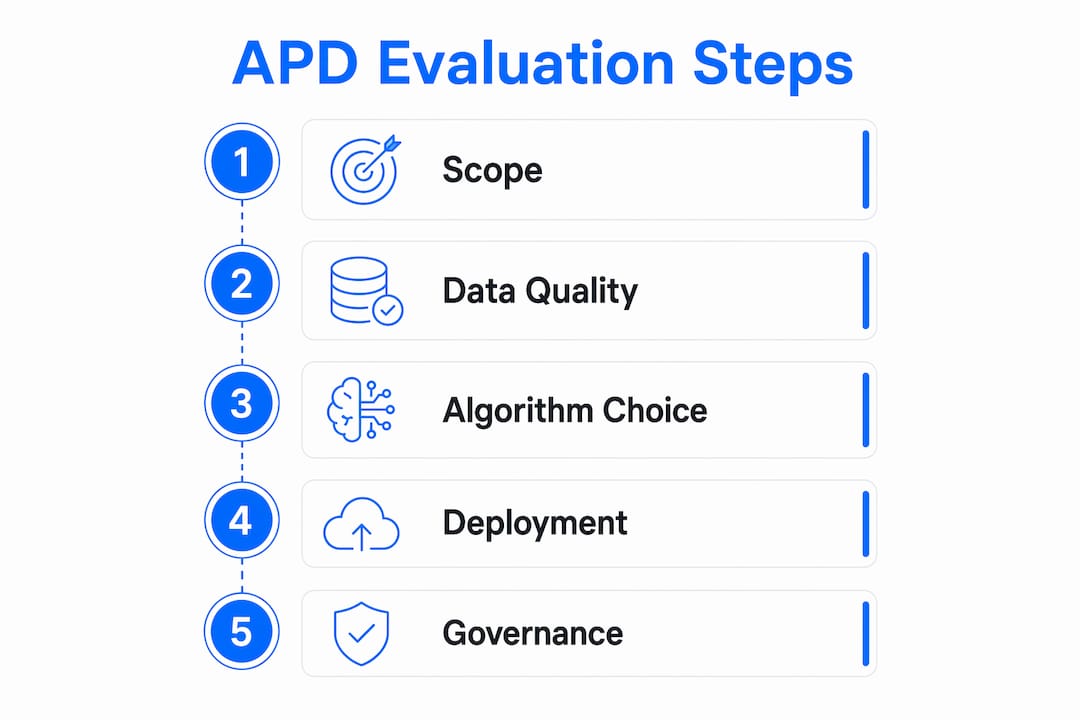
Pro Tip: Ask every vendor for their pricing page or a written pilot scope before the technical demo. Vendors who cannot define a fixed pilot deliverable and timeline are a procurement risk regardless of their technology.
Common enterprise use cases and what APD reveals
Five process families consistently deliver the highest ROI from discovery investments.
- Order-to-cash (O2C): Data sources: ERP order management, credit management, AR modules. APD reveals: exception path frequency, credit hold loops, manual override rates. KPIs: order cycle time, touchless order rate, days sales outstanding.
- Procure-to-pay / invoice-to-pay (P2P): Data sources: ERP procurement and AP modules, email systems. APD reveals: three-way match failure rates, manual approval bypasses, duplicate invoice patterns. KPIs: invoice processing time, exception rate, early payment discount capture.
- IT service management (ITSM): Data sources: ServiceNow, Jira, or equivalent ITSM platform. APD reveals: ticket reassignment loops, SLA breach patterns, resolution path variants. KPIs: mean time to resolution, first-contact resolution rate, SLA compliance.
- Claims processing: Data sources: claims management system, document management. APD reveals: manual review triggers, rework loops, adjudication variant counts. KPIs: claims cycle time, straight-through processing rate, error rate.
- Onboarding and KYC: Data sources: CRM, identity verification systems, document management. APD reveals: manual verification steps, exception escalation paths, duplicate data entry. KPIs: onboarding cycle time, touchless completion rate, compliance deviation rate.
On pilot process selection: Choose two or three processes that combine high data availability (clean, accessible event logs) with meaningful ROI potential. A process with perfect data but low business impact wastes pilot budget. A high-impact process with fragmented or inaccessible logs will produce unreliable models. The intersection of those two criteria is where pilots succeed.
How to run a pilot and scale: a practical roadmap
A well-structured pilot moves through six phases. Budget four to eight weeks for a scoped engagement covering two processes.
- Scoping (Week 1): Define the two pilot processes, identify data owners, confirm event log accessibility, and set baseline KPIs. Deliverable: a signed pilot scope document with success criteria.
- Data collection and preparation (Weeks 1–2): Extract event logs, map case IDs across systems, normalize timestamps, and remove test/noise records. This phase typically consumes 30–40% of total pilot effort.
- Discovery run (Week 2–3): Ingest cleaned logs, run the discovery algorithm, generate the initial DFG, and apply staged filtering to produce a readable process model.
- Analysis and validation (Week 3–4): Review the discovered model with process owners. Validate that the model matches known process behavior. Identify the top three to five automation candidates and compliance deviations.
- Quick wins and measurement (Week 4–6): Implement one or two low-complexity fixes (e.g., eliminating a documented rework loop) and measure the KPI delta against baseline.
- Scale plan (Week 6–8): Document findings, present ROI evidence, and define the roadmap for expanding to additional processes.
| Phase | Key deliverable | Primary owner |
|---|---|---|
| Scoping | Pilot scope + baseline KPIs | Business sponsor + process analyst |
| Data preparation | Cleaned, unified event log | Data engineer + security/privacy owner |
| Discovery run | Process model + variant list | Process analyst |
| Validation | Validated model + deviation report | Process analyst + business sponsor |
| Quick wins | Measured KPI delta | Transformation lead |
| Scale plan | Business case for expansion | Business sponsor |
Roles that must be named before the pilot starts: business sponsor (accountable for ROI), process analyst (runs the discovery and interprets outputs), data engineer (owns log extraction and cleaning), security/privacy owner (approves data handling), and transformation lead (manages change and stakeholder communication).
The biggest failure mode: bad input data and governance gaps
The single most common reason APD pilots fail is not algorithm selection or tool capability. It is input data quality.
Real-world event logs typically require significant upfront work: mapping case IDs across systems that use different identifiers, cleaning inconsistent or missing timestamps, removing test records, and grouping low-level user actions into meaningful process events. Skip this work and the discovery algorithm will faithfully model the noise, producing either a spaghetti diagram that no one can interpret or an oversimplified model that misses critical variants.
Four specific data problems to audit before any discovery run:
- Missing timestamps: Events with null or implausible timestamps break sequence reconstruction and distort lead-time calculations.
- Inconsistent case IDs: When the same process instance carries different identifiers across systems, the algorithm treats them as separate cases, inflating variant counts.
- Fragmented logs: Processes that span multiple systems with no shared key require manual ID mapping before ingestion.
- Noisy user traces: Desktop captures often include irrelevant application switches and repeated micro-actions that must be grouped into meaningful events before analysis.
Pro Tip: Budget at least 30–40% of total pilot effort for data preparation. Teams that underestimate this consistently overshoot timelines and underdeliver on model quality.
Governance controls are equally non-negotiable. Desktop capture in particular requires a clear policy covering: employee consent and notification, what data is captured and what is excluded, retention periods, and who can access raw traces. Encryption in transit and at rest is a baseline requirement, not a differentiator.
Statistic callout: Discovery algorithms balance fitness, precision, generalization, and simplicity. When input data is noisy, no algorithm can compensate: the trade-off collapses toward either an uninterpretable spaghetti model or a model so simplified it misrepresents the actual process. Data quality is not a preprocessing detail; it determines the ceiling on model accuracy.
Filtering and variant thresholds also affect what the model shows. Setting the activity filter too aggressively removes rare but important exception paths. Setting it too loosely produces a model too complex for stakeholders to validate. The right threshold is process-specific and requires iteration with the process owner.
Key Takeaways
Automated process discovery delivers accurate, evidence-based process models only when event log quality, governance controls, and a structured pilot approach are in place before algorithms run.
| Point | Details |
|---|---|
| APD combines two methods | Process mining handles system logs; task mining captures manual desktop steps invisible to system data. |
| Data prep drives model quality | Budget 30–40% of pilot effort for case ID mapping, timestamp cleaning, and noise removal. |
| Pilot selection matters | Choose processes with both clean data availability and meaningful ROI potential for the highest pilot success rate. |
| Governance is non-negotiable | Desktop capture requires consent policies, data minimization, encryption, and defined retention periods before deployment. |
| Processfinder as starting point | Patterns combines process mining, desktop capture, and living SOP generation in one platform built for enterprise pilots. |
The gap between what APD promises and what actually matters
Most APD conversations start in the wrong place. Vendors lead with algorithm sophistication and process map aesthetics. Buyers get excited about the visualization. Then the pilot stalls in week two because no one mapped the case IDs across the three systems the process touches.
The technology is genuinely capable. Inductive mining produces sound, scalable models. Task mining fills the gaps that system logs miss. The combination, when fed clean data, delivers process intelligence that workshops simply cannot replicate at scale. That part of the vendor pitch is accurate.
What gets undersold is the organizational readiness requirement. APD is not a plug-in. It is a data engineering project with a process intelligence output. The teams that get the most from it treat data preparation as a first-class deliverable, not a prerequisite to skip. They also treat discovery as continuous, not a one-time audit. Processes change. Variants evolve. A model built on last year’s logs is already partially wrong.
The governance dimension is also consistently underestimated, particularly for task mining. Capturing desktop activity at the user level is powerful and legally and ethically sensitive. Organizations that deploy desktop capture without a clear consent framework and data minimization policy create compliance exposure that can halt the entire program. Get the governance right before the first agent is deployed, not after.
The practical implication: treat your first APD pilot as a data readiness assessment as much as a process discovery exercise. The model you produce is valuable. The data infrastructure and governance framework you build to produce it are what make the second and third pilots faster and more reliable.
Patterns by Processfinder: built for analysts who need real process intelligence
Most process discovery tools ask you to choose between system-level process mining and desktop-level task capture. Patterns, by Processfinder, combines both in a single platform designed specifically for business analysts and operations leaders who need accurate, audit-ready process models without a six-month implementation.
Patterns records real user actions across desktop and browser applications, identifies hidden subprocess branches and exception patterns, and converts discovered workflows into continuously updated SOPs that reflect how work actually runs. Privacy-conscious capture, enterprise SSO support, and encryption controls are built in, not bolted on. The result is a discovery pipeline that satisfies both the analyst who needs model accuracy and the security team that needs data governance.
For teams ready to run a scoped pilot, Patterns delivers a process discovery dashboard, variant analysis, and pilot KPIs within a defined engagement. Sign up for a free trial or request a demo directly on the process mining tool page to scope your first two processes and see what your data actually shows.
Useful sources and further reading
- Gartner: Automated Business Process Discovery (ABPD) — Gartner’s definition and market framing of ABPD; useful for executive briefings and vendor evaluation context.
- Business Process Discovery (Wikipedia) — Comprehensive technical overview of discovery algorithms (α-algorithm, heuristic mining, inductive miner, genetic approaches) and event log requirements.
- Process Discovery (processmining.org) — Practitioner-oriented explanation of algorithm trade-offs (fitness, precision, generalization, simplicity) and data quality dependencies.
- Foundations of Process Discovery (RWTH Aachen) — Academic foundation covering DFG-based discovery and staged filtering techniques; the authoritative reference for algorithm selection.
- What Is Business Process Discovery? (Appian) — Practitioner explainer covering the APD pipeline and event log data requirements.
- Automated Process Discovery Explained (Decisions.com) — Covers APD as both an automation enabler and a governance tool; useful for compliance and audit use cases.
- Processfinder: Process Mining Tool for Business Analysts — Product page for Patterns’ process mining tool; trial and demo options for pilot scoping.
- Processfinder: Automated Documentation and Living SOPs — Feature page explaining how Patterns converts discovered workflows into continuously updated SOPs.
- Processfinder: Security and Data Privacy — Governance and security controls documentation for enterprise procurement and compliance review.