
Process discovery cost: what to budget in 2026
A small pilot typically runs €7,000 to €20,000 for scoping and a first analysis, mid-market programs land between roughly €15,000 and €45,000+ depending on integrations, and enterprise deployments spanning multiple process domains commonly reach US$150,000 to US$800,000 or more. The range swings on three things:
- Scope: how many processes and business units you’re mapping at once.
- Data quality: clean, structured system logs cost far less to prepare than fragmented spreadsheets and manual approvals.
- Connectors: each additional enterprise system (SAP, Salesforce, a legacy ERP) usually adds a separate licence or integration fee.
No vendor can hand you a fixed number without first seeing your data and systems. The right first move is a scoped audit or diagnostic, not a proposal request. That single step turns a guess into a number you can actually take to finance.
Key Takeaways
Process discovery cost scales primarily with data preparation effort and connector count, not with the base licence fee vendors quote first.
| Point | Details |
|---|---|
| Get a real audit first | No fixed quote is trustworthy until a vendor has reviewed a sample of your actual system data. |
| Budget for data prep | Expect roughly 30% of total spend on data preparation, often the line item most likely to run over. |
| Build in contingency | Set aside 15% to 25% of total project cost for data quality surprises and legal review time. |
| Tie discovery to action | ROI reaches 300 to 800% in year one only when findings connect to a funded automation plan. |
| Consider automated capture | Patterns Process Finder reduces manual data prep by capturing real workflows directly, lowering follow-on documentation cost. |
Table of Contents
- What does process discovery cost across pricing tiers?
- Where does the money actually go? A line-item budget split
- How long does a process discovery project actually take?
- Negotiating vendor contracts and procurement questions to ask
- Calculating ROI: a worked example
- Three scenarios: small, mid-market, and enterprise
- How company size and industry shape the price tag
- Why you need a contingency line, and how big to make it
- Scaling process discovery without scaling cost linearly
- What experienced buyers wish they’d known earlier
- Reducing your process discovery cost with the right tool
- Sources
- FAQ
What does process discovery cost across pricing tiers?
Vendors rarely publish a single sticker price because process discovery cost tracks the size of your data footprint, not a flat subscription fee. Three price bands cover most organizations shopping this category:
- Pilot tier (single process, one department): often €3,000 to €15,000 for an audit or single automated process, based on typical AI project pricing for smaller-scope engagements.
- Mid-market tier (multiple processes, one or two source systems): typically costs range from mid five figures up to around 150,000 euros, depending on connector count and how much manual data cleanup is needed.
- Enterprise tier (multi-domain, many systems, global rollout): commonly US$150,000 for a single domain, scaling to US$800,000 to US$2 million+ once you add domains and connectors. Suite-level platforms like SAP Signavio show a similar pattern, with standalone mining capability often priced at US$120,000 to US$400,000 annually and full suites reaching US$250,000 to US$700,000 depending on seat count.
Pricing models vary by vendor. Some charge a flat annual subscription, others bill per process case or per compute unit, and a growing number use seat-based licensing bundled with managed services for setup and monitoring. Inside most organizations, the budget line sits with IT, a transformation office, or an automation centre of excellence, whichever group owns the mandate to fund process improvement work company-wide.
Where does the money actually go? A line-item budget split
Once you’re past the pricing tier conversation, the real question is allocation. Practical project breakdowns consistently show a similar pattern regardless of vendor:
| Budget line | Typical share of total spend |
|---|---|
| Discovery and audit | 15% |
| Data preparation | 30% |
| Development and integrations | 35% |
| Validation and QA | 12% |
| Deployment and training | 8% |
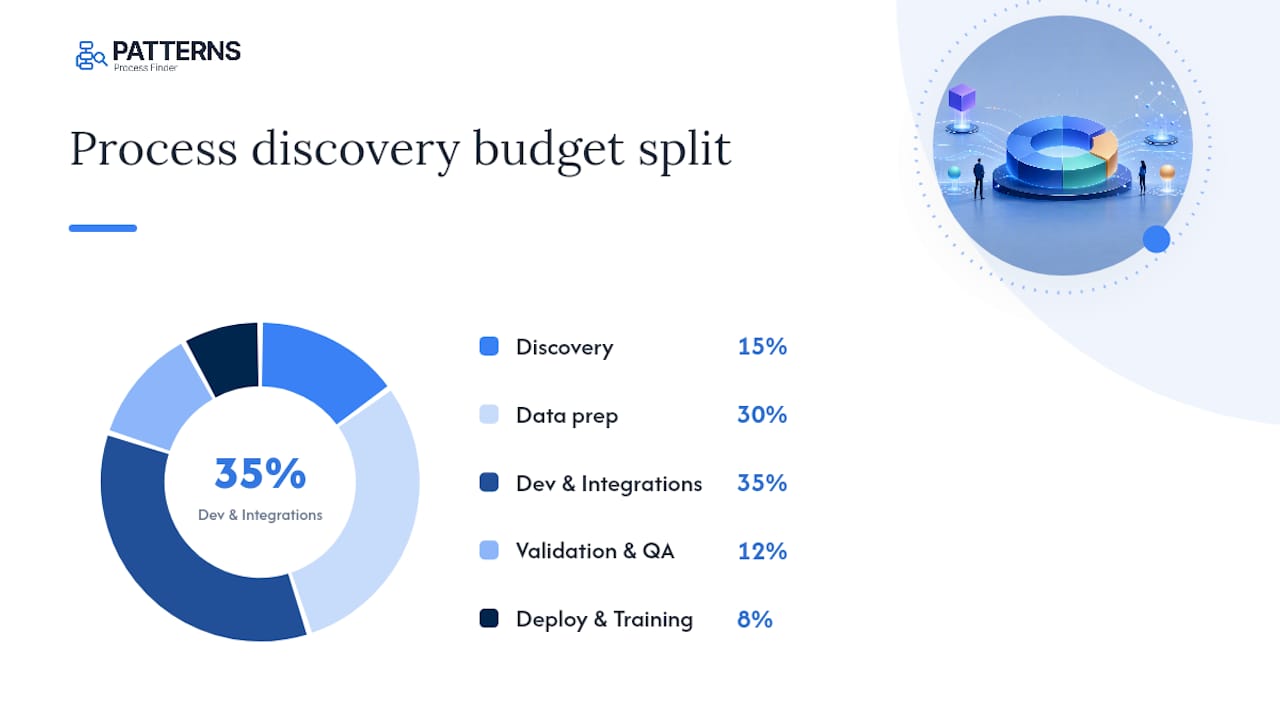
That split comes from analysis of practical AI and automation project breakdowns, and it holds up well against enterprise process mining deals too.
Beyond the build, several costs tend to surprise first-time buyers:
- Premium enterprise connectors, often priced US$10,000 to US$30,000 per connector per year.
- Cloud compute for storing and processing event logs at scale.
- Data retention and privacy compliance reviews, especially with cross-border data.
- Change management and ongoing licence renewals once the pilot proves out.
Pro Tip: *Data preparation usually dominates the budget, not licence fees. Before signing anything, ask the vendor to run a short data readiness check on your actual logs.
How long does a process discovery project actually take?
Timelines depend heavily on how clean your source data is, but most engagements follow a recognizable rhythm:
- Audit and scoping: 1 to 3 weeks.
- Data extraction and preparation: 2 to 6 weeks, the phase most likely to run long.
- Model building and analysis: 2 to 4 weeks.
- Validation with process owners: 1 to 2 weeks.
- Deployment and training: 1 to 3 weeks.
- Monitoring and iteration: ongoing, typically reviewed monthly or quarterly.
A single-process pilot can wrap in 6 to 8 weeks. A multi-domain enterprise rollout often stretches past six months once you factor in privacy reviews and ERP complexity. Poorly structured event logs, disconnected systems, and legal review of employee data tracking are the three dependencies most likely to blow past your original timeline.
Before you sign anything, insist that the statement of work names each system in scope, states expected log format, and sets a checkpoint date for the data readiness assessment. Vague scoping language is where timelines quietly slip by a month or more.
Negotiating vendor contracts and procurement questions to ask
Contract terms move price more than most buyers expect. Watch for these levers during negotiation:
- Data volume tiers (case counts and event volume thresholds that trigger a price step-up).
- Whether connectors are bundled or billed separately per system.
- Roll-out scope: single department versus company-wide rights.
- Seat-based discipline, since named-user pricing scales fast in larger teams.
- Renewal caps that limit year-over-year price increases.
Ask vendors these questions directly during procurement:
- What exact data formats and volumes does your quote assume?
- Are connectors included, or billed per system per year?
- What happens to price if we add a second business unit next year?
- Who owns the data once the contract ends?
- What’s included in “implementation” versus billed as professional services?
- Can you show a reference client with a similar system landscape?
Three signals should make you pause before signing: a quote issued without ever reviewing a data sample, vague language around “unlimited” connectors that turns out to exclude your core ERP, and renewal terms with no price cap.
Calculating ROI: a worked example
Justifying process discovery cost to finance means converting time savings into cash, not process diagrams. Here’s a simple version you can adapt:
- Baseline: Say a process consumes 4 FTE hours per case, across 5,000 cases annually, at a loaded cost of $40/hour. That’s $800,000 a year.
- Projected improvement: Discovery identifies rework and manual exceptions that a fix could cut by 20%, saving roughly $160,000 annually.
- Cost of the project: A mid-market engagement at $80,000.
- Payback: $80,000 ÷ $160,000 in annual savings equals a 6-month payback.
Benefits worth including in your business case: reduced cycle time, fewer manual exceptions, lower FTE burden on repetitive tasks, and better audit readiness for compliance-heavy processes. Finance teams typically want to see a documented baseline, conservative savings assumptions rather than best-case numbers, and a contingency line built into the total ask.
The spread here is real. Benchmarks show high-performing deployments reaching 300 to 800% ROI in year one, while projects run purely as analytics, with no funded action plan attached, often land under 100%. The gap isn’t the software. It’s whether findings get routed to a team with budget to fix what’s found.
Three scenarios: small, mid-market, and enterprise
- Small pilot: One process, one department. Cost around €7,000 to €20,000, 6 to 8 week timeline, payback often inside a year if the process is high-volume.
- Mid-market program: Three to five processes, two systems. Cost roughly $50,000 to $150,000, 3 to 5 month timeline, payback typically 6 to 12 months.
Every range above assumes reasonably clean data. Poor log quality or heavy integration work can push either the cost or the timeline well past these figures.
How company size and industry shape the price tag
A 200-person logistics firm and a 20,000-person bank will never see the same process discovery cost, even for a similarly scoped project. Organization size drives price mainly through system count and case volume. Larger firms run more disconnected systems, which means more connectors, more data cleanup, and more stakeholder sign-off before you can even start mapping.
Industry matters almost as much as headcount. Regulated sectors, banking, insurance, healthcare, carry compliance and data governance requirements that add real cost to the audit and validation phases. A discovery project touching patient records or financial transactions typically needs a privacy review before any log extraction begins, which can add weeks and a dedicated legal sign-off cost that a manufacturing floor process never faces.
Manufacturing and logistics companies, by contrast, often deal with less regulatory friction but more system fragmentation, since shop-floor systems, legacy scheduling tools, and modern ERPs rarely share a common data model. That fragmentation shows up directly in the data preparation line item, often pushing it above the typical 30% share.
Retail and e-commerce organizations tend to sit in the middle: fewer compliance hurdles than finance, but high transaction volume that can drive up compute and licensing costs tied to case count. If your organization operates across multiple countries, factor in that data residency rules can force separate processing environments per region, which multiplies infrastructure cost rather than simply adding a flat percentage.
The practical takeaway: don’t benchmark your quote against a generic “process discovery cost” figure from a different industry.
Why you need a contingency line, and how big to make it
Every process discovery budget should carry a contingency allowance, and skipping this line is one of the most common planning mistakes decision-makers make. Data almost never arrives as clean as the initial scoping call assumes. Hidden system quirks, undocumented manual workarounds, and inconsistent timestamp formats surface once extraction actually starts, and each one adds hours to the data preparation phase.

A contingency of 15% to 20% of total project cost is a reasonable starting point for a mid-market engagement, rising toward 25% for enterprise deployments spanning multiple legacy systems. That range isn’t arbitrary. It roughly matches how far the data preparation line item can swing once real logs replace the sample data used during scoping.
Build the contingency into the business case explicitly, rather than burying it inside a padded estimate for each line item. Finance teams respond better to a transparent “$15,000 contingency for data quality unknowns” than to an inflated development number that hides the same risk. It also gives you room to negotiate: if the contingency goes unused, you’ve got budget left for a second process or an extra training session, rather than an awkward conversation about a cost overrun.
One more thing worth budgeting for: legal and privacy review time, especially if the process touches employee monitoring or customer data. That review can add two to four weeks and a modest but real cost that’s easy to forget until it’s blocking your go-live date.
Scaling process discovery without scaling cost linearly
The mistake most organizations make when scaling from a single pilot to a company-wide program is assuming cost multiplies by the number of processes. It doesn’t have to. A tightly scoped pilot that produces a ranked backlog of automation opportunities, each with its own ROI estimate, gives you a prioritized roadmap instead of a flat list of “do everything” ambitions.

Start with the highest-volume, highest-friction process first. The math is simple: a process run 10,000 times a year with a two-minute inefficiency per case returns savings far faster than a process run 200 times a year with the same friction. Prioritizing by volume and cost-per-case, rather than by which department shouts loudest, keeps your second and third rollouts self-funding.
Reuse infrastructure wherever the vendor contract allows it. If your first engagement already paid for a connector to your core ERP, extending discovery to a second process on the same system usually costs a fraction of the original connector fee, not a repeat of it. This is where negotiating connector inclusion terms upfront pays off later.
Centralizing ownership under an automation centre of excellence also helps control cost as you scale, since a single team tracking what’s already been mapped avoids paying twice to rediscover the same process under a different department’s budget. Standardizing your data readiness checklist across business units means each new rollout starts faster, with fewer surprises in the preparation phase.
What experienced buyers wish they’d known earlier
Three mistakes show up again and again in how organizations plan this budget. Scope creep is the most common: teams start with one process and quietly expand to five before the data audit even finishes, blowing past the original estimate before development starts. Ignoring data readiness is a close second, since a quote built on assumed clean logs falls apart the moment real extraction begins. Under-provisioning for ongoing operations rounds out the list. Teams budget the build but forget that monitoring, licence renewals, and periodic re-validation carry a real annual cost.
If any of that sounds familiar, a scoped audit or a short trial against your actual data will tell you more than another vendor call.
Reducing your process discovery cost with the right tool
Traditional discovery engagements spend a third of their budget or more on data preparation and manual interviews, precisely the phase where cost overruns happen most. Patterns Process Finder cuts that phase down by capturing how employees actually execute workflows directly from desktop and browser activity, rather than relying on stakeholder interviews and static documentation that go stale within months.
That matters for your budget in a concrete way: less time spent reconstructing processes manually means fewer professional services hours billed to the data preparation and validation lines, the two categories that most often push a quote past its original estimate. Patterns Process Finder generates living Standard Operating Procedures that update as work actually changes, so you’re not paying a consultant to redocument a process every time a team finds a workaround. Free trials are available for basic usage, so you can test how the process discovery tool performs against your own systems before committing budget. Check current pricing plans to see which tier fits your organization’s scope.
Sources
- How Much Does an AI Project Cost? 2026 Prices | Kiwop
- Process Mining Consulting: Analyse before automation | Groenewold IT Solutions
FAQ
How much does process discovery cost for a first pilot?
A first scoping engagement or pilot commonly falls between €7,000 and €20,000, depending on log quality and how many systems are involved.
What is the best process mining software?
There’s no single best option since fit depends on whether you need traditional log-based mining or automated workflow capture; tools like Patterns Process Finder focus on capturing real user actions to build living SOPs rather than relying only on system event logs.
How much does RPA certification cost?
RPA certification costs vary by provider and level, and specific pricing isn’t consistently published across vendors, so check directly with the certifying body for current rates.
How big is the RPA market?
Market size estimates vary by research firm and methodology, so treat any single figure with caution and check the original source’s scope before citing it in a business case.
Can I get a fixed quote before a vendor sees my data?
No credible vendor should offer a fixed quote before reviewing a sample of your actual system data, since data quality is the single biggest driver of final process discovery cost.