Best process street alternatives for operations teams in 2026
For enterprise operations teams, Patterns Process Finder is the leading choice when your priority is understanding how work actually happens before you automate it. If you need a checklist-first SOP platform, visual task boards, a low-code workflow engine, or a lightweight knowledge hub, the shortlist below covers each scenario.
Top picks at a glance:
- Patterns Process Finder — automated process discovery, living SOPs from real execution data, and AI-powered process mining for enterprise teams facing high automation failure rates
- Visual task/Kanban boards (e.g., Kanban Tool, Monday.com, Nifty) — best for teams that need visual workflow tracking and project coordination without deep process documentation
- Knowledge-base/SOP-first platforms (e.g., Trainual, SweetProcess, ProcessKit) — best for teams whose primary need is structured SOP authoring and staff onboarding
- Low-code/no-code workflow engines (e.g., Kissflow, Nintex, Tallyfy) — best for automation-heavy programmes that need form-driven routing and approvals
- Collaborative project and work management suites (e.g., ProofHub, Teamwork.com) — best for cross-functional teams that need project management alongside lightweight process documentation
Aggregated ratings on G2 and Capterra confirm that the most common reasons teams look beyond Process Street are limited automation depth, weak cross-system integrations, and the absence of any discovery layer. The fastest path to a decision: run a two-week pilot with Patterns Process Finder if process discovery or automation governance is your core need, or trial a knowledge-base platform if SOP authoring is the only gap.
Table of Contents
- How do these process street alternatives compare at a glance?
- Detailed overviews: what each alternative actually delivers
- How to choose the right process street alternative for your team
- How we evaluated these categories
- What Process Street-style tools do and why teams look for alternatives
- Why process discovery changes what’s possible for enterprise teams
- How do these tools integrate with your existing systems?
- What does customer support look like across these alternatives?
- How easy are these tools to use day-to-day?
- How well do these alternatives scale and customise as your organisation grows?
- Key takeaways
- The gap between documented processes and real ones is where programmes fail
- Patterns Process Finder gives operations leaders a faster path to process truth
- Further reading and sources
- FAQ
How do these process street alternatives compare at a glance?
The table below maps each category against the dimensions that matter most to operations and transformation leaders.
| Category | Best for | Pricing shape | SOP / template features | Automation depth | Integrations & API | Ease of onboarding | Enterprise security | Process discovery |
|---|---|---|---|---|---|---|---|---|
| Automated process discovery (Patterns Process Finder) | Enterprise teams needing reality-based SOPs and automation governance | Tiered SaaS; free trial available | Living SOPs generated from real execution data | High — event-log mining, AI-assisted mapping | Native connectors + open API | Moderate; guided setup | SOC 2, audit trails, data residency controls | Native; core capability |
| Visual task/Kanban boards | Project tracking, visual workflow coordination | Per-user or per-workspace; free tiers common | Basic templates; limited SOP depth | Low to moderate; rule-based triggers | Wide; multiple app integrations | Low; intuitive drag-and-drop | Varies; enterprise tiers add SSO | None |
| Knowledge-base/SOP-first platforms | SOP authoring, staff onboarding, training | Per-user or per-seat; free trials common | Rich template libraries; structured SOPs | Low; simple conditional logic | Moderate; common HR/LMS integrations | Very low; minimal training needed | Basic; SSO on higher tiers | None |
| Low-code/no-code workflow engines | Form-driven approvals, cross-department routing | Per-user or per-process; enterprise quotes | Moderate; form and approval templates | High; multi-step routing, escalations | High; enterprise app connectors | Moderate; configuration required | Strong on enterprise tiers | Limited |
| Collaborative project/work management suites | Cross-functional project delivery with light process docs | Per-user; free tiers available | Light; task templates and checklists | Low to moderate | Wide; common productivity tools | Low | Moderate; enterprise add-ons | None |
For small operations teams whose main need is documenting standard procedures, a knowledge-base platform gets you running in days. Teams running automation programmes at scale need a low-code engine or, better, a discovery-first platform to avoid automating the wrong version of a process. Compliance-driven enterprises — those with SOC 2, HIPAA, or internal audit requirements — should prioritise platforms with immutable audit trails and data residency controls, which narrows the field considerably.
Detailed overviews: what each alternative actually delivers
Visual task and Kanban boards
Tools in this category — including Kanban Tool, Monday.com, and Nifty — are built around visual workflow tracking rather than process documentation. Their strength is speed: a team can model a workflow as a board in under an hour, assign owners, and start tracking status immediately. Monday.com adds form-based automations and a broad integration library, while Nifty layers in milestone tracking and document collaboration.

Where they fall short is depth. Kanban boards capture task state, not process logic. There is no mechanism to detect subprocess variants, no event-log capture, and no way to generate a living SOP from actual execution data. For teams whose processes cross multiple systems or involve exception handling, a board quickly becomes a status tracker rather than a process governance tool.
Pros: Fast setup, intuitive UI, wide integrations, strong for project coordination. Cons: No process discovery, limited SOP depth, automation is rule-based and shallow.
Pricing typically runs per user per month, with free tiers for small teams and enterprise tiers adding SSO, advanced permissions, and dedicated support.
Knowledge-base and SOP-first platforms
Trainual, SweetProcess, and ProcessKit sit squarely in this category. They are purpose-built for writing, organising, and distributing SOPs and training content. Trainual is particularly strong for onboarding: it structures content into subjects, topics, and steps, and tracks completion. SweetProcess offers a clean approval workflow for procedure sign-off. ProcessKit adds a client-facing layer useful for agencies.
The limitation is that every SOP in these tools is authored manually. There is no mechanism to observe how employees actually execute a process and surface the gaps between the written procedure and real behaviour. For SOP software comparisons, this distinction matters most when you are preparing for automation: a manually authored SOP often reflects how a process was designed, not how it runs today.
Pros: Excellent template libraries, very low learning curve, strong for onboarding and compliance documentation. Cons: No discovery layer, SOPs go stale without manual maintenance, limited automation primitives.
Pricing is per seat, with most platforms offering a free trial and paid plans scaling with team size.
Low-code and no-code workflow engines
Kissflow, Nintex, and Tallyfy represent this category. They are designed for building and automating multi-step approval workflows, form routing, and cross-department processes without writing code. Nintex is the most enterprise-capable of the three, with support for document generation, RPA connectors, and process mapping. Kissflow targets mid-market teams with a simpler interface. Tallyfy focuses on repeatable procedure tracking with a strong emphasis on accountability.
Enterprise orchestration at this level requires primitives that not all tools provide equally. According to technical analysis of orchestration requirements, platforms lacking structured retry policies, time-based escalations, and immutable audit trails push significant engineering effort onto customers. Nintex covers most of these on its enterprise tier; Kissflow and Tallyfy are lighter on audit trail depth.
Pros: Strong automation depth, form-driven routing, good enterprise app connectors. Cons: Configuration overhead is real, discovery capability is absent or limited, pricing scales quickly.
Pro Tip: Before committing to a low-code engine, ask the vendor to demonstrate how the platform handles a process exception — specifically, what happens when a step fails and how that failure is logged. Weak answers here predict high integration maintenance costs later.
Collaborative project and work management suites
ProofHub and Teamwork.com are the primary examples here. Both combine task management, project timelines, document storage, and team communication in a single workspace. Teamwork.com has a stronger focus on client-facing project delivery, with billing and time-tracking built in. ProofHub is a flat-fee platform, which makes it attractive for growing teams that want predictable costs.
Neither platform is designed for process governance. They work well when the “process” is a project with defined deliverables, but they do not support SOP versioning, process variant detection, or automation beyond task assignment rules. For operations teams that need both project coordination and process documentation, these suites often end up paired with a separate SOP tool.
Pros: All-in-one project management, flat-fee pricing (ProofHub), strong collaboration features. Cons: Process documentation is incidental, no discovery or mining capability, limited automation.
How to choose the right process street alternative for your team
The right choice depends on what is actually broken. Use this framework before you book a single demo.
Selection criteria, ordered by enterprise impact:
- Process discovery capability — Can the platform observe real execution and surface subprocess variants, or does it only support manual authoring?
- Integration coverage — Does it connect natively to the systems your processes actually touch (ERP, CRM, HRIS, RPA platforms)?
- Orchestration primitives — Does it support retry policies, time-based escalations, and conditional branching natively?
- Auditability — Does it produce immutable, timestamped audit trails that satisfy SOC 2 or internal audit requirements?
- Data residency and security — Where is process data stored, and does the vendor support your data governance requirements?
- SOP authoring ease — How quickly can a non-technical operations manager create, update, and publish a procedure?
- Change management and governance — Does the platform support version control, approval workflows for procedure changes, and ownership assignment?
Questions to ask vendors during demos:
- How does your platform surface subprocess variants that differ from the documented procedure?
- Do you produce immutable audit trails, and can you show us a sample audit log?
- What built-in retry and escalation controls exist when a workflow step fails?
- How does your API handle authentication and rate limiting for enterprise integrations?
- What is your data residency model, and which compliance certifications do you hold?
Red flags to watch for:
- Opaque or “contact us for pricing” models with no published tier structure
- No evidence of event-log or behaviour capture in the product demo
- Vendor lock-in through proprietary data formats with no export option
- Weak API documentation or no sandbox environment for integration testing
- Audit trail that can be edited or deleted by administrators
Timeline and cost expectations: A well-scoped pilot typically runs four to six weeks. Budget for integration effort — connecting a workflow platform to two or three enterprise systems often takes as long as the platform configuration itself. Standardising your process architecture before automating the stable core reduces long-term governance complexity and avoids hardcoding inconsistent rules into your automation layer.
Pro Tip: Prioritise tools that shorten discovery time over those that only simplify checklist authoring. A platform that shows you how work actually happens in week one is worth more than one that lets you write a beautiful SOP for a process that no longer reflects reality.
How we evaluated these categories
The evaluation behind this article drew on the following sources and criteria.
Evaluation criteria applied:
- Feature fit against common enterprise use cases (SOP authoring, approval routing, process discovery, audit compliance)
- Automation depth: native orchestration primitives vs. rule-based triggers
- Integration ecosystem: breadth of native connectors and API quality
- Enterprise security: SOC 2 certification, SSO, data residency, audit trail immutability
- Evidence of process discovery or event-log mining capability
- Pricing transparency: published tier structures vs. quote-only models
- Onboarding complexity: time to first working process for a non-technical user
Data sources used:
- Aggregated user reviews from G2 and Capterra for sentiment signals and recurring pain points
- Vendor documentation and product demos for feature verification
- Roundup analysis from The Digital Project Manager for category parity and shortlist signals
- Technical literature on orchestration primitives for enterprise automation requirements
- BA Copilot’s process discovery primer for discovery methodology standards
- TechTarget analyst commentary on enterprise workflow governance
This article was last reviewed in 2026. Readers are encouraged to run a short pilot aligned to the decision criteria above before committing to a platform, as pricing and feature sets change frequently.
What Process Street-style tools do and why teams look for alternatives
Process Street is a checklist-first SOP platform. Its core value is speed of authoring: an operations manager can build a structured checklist, add conditional logic, assign it to a team member, and track completion in a single session. For teams that need to document repeatable procedures quickly, it delivers. The template library is broad, the interface is approachable, and the learning curve is low.
The gaps become visible when teams try to scale. User reviews on G2 and Capterra consistently flag limited automation depth, weak cross-system integrations, and the absence of any mechanism to verify that documented procedures reflect how work actually runs. A checklist tells you what should happen; it cannot tell you what does happen.
Common triggers for switching:
- High automation failure rates caused by automating procedures that do not reflect real execution behaviour
- Fragmented process ownership across departments, with no single owner governing end-to-end workflows
- Scaling pain when processes cross multiple systems and a checklist tool cannot orchestrate across them
- Compliance and audit requirements that demand immutable, timestamped records of process execution
- Need for visual process mapping that reflects actual subprocess variants, not just the intended flow
The distinction between checklist-first and discovery-first platforms is the central decision point for operations leaders evaluating workflow management software in 2026.
Why process discovery changes what’s possible for enterprise teams
The gap between how a process is documented and how it actually runs is where automation programmes most often fail. Process discovery combines event-log mining, observation, and document review to produce as-is process maps that reflect real execution, including the subprocess variants and exception paths that never appear in a manually authored SOP. AI-assisted tools reduce the time to produce a first-draft process diagram from days to hours.
Patterns Process Finder is built specifically around this capability. It records real user actions across desktop and browser applications, identifies hidden subprocess branches and client-specific rules, and generates living SOPs that update as execution patterns change. The result is process intelligence grounded in what employees actually do, not what the procedure manual says they should do.
“Enterprises often fail because no single owner governs end-to-end workflows. Platforms should empower cross-functional governance and outcome-focused analytics — not just track local tasks.”
— TechTarget analyst commentary on enterprise workflow ownership
This observation maps directly to what Patterns Process Finder surfaces: ownership boundaries, outcome metrics, and the subprocess-level detail that cross-functional governance requires. Automated process mapping captures system event logs and delivers operational visibility far faster than manual mapping at enterprise scale, which is why it has become a prerequisite for AI governance and shadow-AI discovery programmes.
Feature-level differentiators that matter for enterprise teams:
- Immutable, timestamped audit trails suitable for SOC 2 and internal audit requirements
- Event-log mining that surfaces subprocess variants invisible to manual documentation
- Living SOPs generated from real execution data and updated continuously
- Operational visibility through AI-powered process mining and team performance analytics
- Privacy-conscious behaviour tracking with enterprise security protocol integration
How do these tools integrate with your existing systems?
Integration depth varies sharply across categories, and it is often the deciding factor for enterprise teams.
Visual task and Kanban boards typically offer the widest integration breadth in terms of raw connector count. Monday.com and Nifty connect to hundreds of applications through native integrations and Zapier-style middleware. The trade-off is depth: these connectors pass data between tools but do not orchestrate multi-step processes across systems.
Knowledge-base and SOP platforms integrate primarily with HR systems, learning management systems, and identity providers for SSO. Trainual connects to Gusto, Rippling, and Slack. SweetProcess offers Zapier connectivity. For teams whose SOPs need to trigger downstream actions in an ERP or CRM, these integrations are insufficient.
Low-code workflow engines offer the strongest integration story for approval-driven processes. Nintex connects to Salesforce, Microsoft 365, SAP, and ServiceNow natively. Kissflow supports a REST API and pre-built connectors for common enterprise apps. Understanding enterprise AI integration architectures is useful context here: the difference between a point-to-point connector and an event-driven integration architecture has real consequences for how a workflow platform scales.
Patterns Process Finder takes a different approach. Rather than routing data between applications, it observes interactions across applications to build a process map. Its API supports enterprise security protocols and connects to the same systems your employees already use, without requiring you to rebuild your integration layer.
For any platform under evaluation, ask for a live demonstration of the API with your specific systems in scope. Vendor integration lists are marketing assets; a working sandbox test is evidence.
What does customer support look like across these alternatives?
Support quality is rarely the deciding factor in a purchase decision, but it becomes critical during implementation and when something breaks in production.
Knowledge-base and SOP platforms generally offer the most accessible support for smaller teams: live chat, email, and extensive self-serve documentation. Trainual and SweetProcess both maintain active help centres and onboarding resources. Response times on paid plans are typically within a business day.
Low-code workflow engines at the enterprise tier usually include a dedicated customer success manager, SLA-backed support, and professional services for complex implementations. Nintex, for example, offers a partner network for implementation support across North America. The caveat is that enterprise support often requires an enterprise contract, and mid-market plans may receive only email or community-based support.
Visual task and Kanban boards vary widely. Monday.com has a large support organisation with 24/7 coverage on enterprise plans. Smaller tools in this category may rely heavily on community forums and documentation.
Collaborative project suites like ProofHub and Teamwork.com offer email and chat support, with Teamwork.com providing phone support on higher tiers. Both maintain knowledge bases that cover most common configuration questions.
For enterprise deployments, the support question to ask is not “how fast do you respond?” but “do you have a named implementation partner in our region, and what does your escalation path look like for a production incident?” A vendor that cannot answer that question clearly is a governance risk.
How easy are these tools to use day-to-day?
Ease of use splits cleanly along the complexity-capability axis. The tools that are easiest to start with tend to be the ones that do the least.
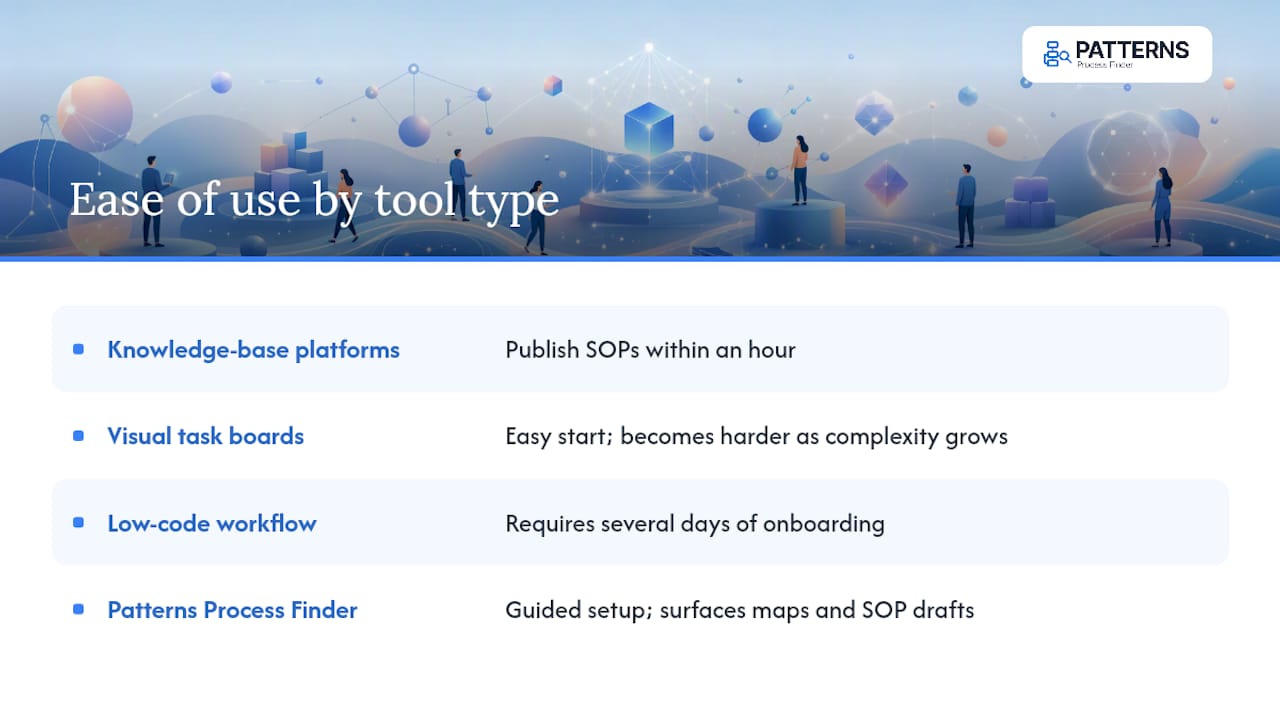
Knowledge-base platforms are the fastest to adopt. A non-technical operations manager can publish a structured SOP in Trainual or SweetProcess within an hour of signing up. The interface is intentionally simple, and the learning curve is minimal. This is a genuine strength for teams whose primary need is documentation rather than automation.
Visual task boards are similarly approachable. The drag-and-drop interface of Kanban Tool or Monday.com is familiar to anyone who has used a project management tool. The challenge is that as process complexity grows, the board model becomes harder to maintain: swimlanes multiply, automation rules conflict, and the visual clarity that made the tool attractive starts to erode.
Low-code workflow engines require more configuration. Building a multi-step approval workflow in Kissflow or Nintex involves form design, routing logic, and integration setup. Most teams need at least a few days of onboarding before they can build independently. The payoff is a more capable automation layer, but the initial investment is real.
Patterns Process Finder sits in a different position on this axis. The discovery layer requires a guided setup to deploy the behaviour-capture agent across the relevant applications, but once running, it surfaces process maps and SOP drafts automatically. The ongoing experience for an operations manager is reviewing and validating what the system has discovered, rather than authoring from scratch. For teams with complex, multi-system processes, this inversion of the authoring model is a significant time saving. Exploring work instruction software comparisons can help clarify where the authoring model matters most for your team’s specific documentation needs.
How well do these alternatives scale and customise as your organisation grows?
Scalability is where the category differences become most pronounced.
Knowledge-base platforms scale well for content volume but not for process complexity. You can add hundreds of SOPs and thousands of users without performance issues, but the underlying model remains a static document. When a process changes, someone must manually update every affected SOP. At scale, this maintenance burden becomes a governance problem.
Visual task boards scale for project volume but struggle with process governance. Monday.com handles large teams and complex project portfolios, but it was not designed to manage process variants, exception handling, or compliance documentation across an enterprise.
Low-code workflow engines scale well for automation volume. Nintex, in particular, is designed for enterprise deployment with multi-tenant architecture, role-based access control, and governance features that support large-scale automation programmes. Customisation is deep: you can build complex routing logic, integrate with enterprise identity providers, and configure data retention policies. The constraint is that every customisation requires configuration effort, and complex deployments can accumulate technical debt quickly.
Patterns Process Finder scales along a different dimension: as more employees use the applications being monitored, the process maps become richer and more accurate. The platform is designed for mid-sized to large organisations where process complexity and subprocess variation are the core challenge. Enterprise features include privacy-conscious behaviour tracking, data residency controls, and integration with enterprise security protocols. For teams running an automation centre of excellence, the ability to continuously update process maps as execution patterns evolve is a material advantage over static documentation approaches.
Key takeaways
The most effective approach to evaluating workflow management software is to match the tool’s core capability to the actual gap in your operations: discovery-first for automation governance, authoring-first for onboarding and compliance documentation.
| Point | Details |
|---|---|
| Match tool to core gap | Discovery-first platforms suit automation governance; SOP-authoring platforms suit onboarding and compliance documentation. |
| Audit trail is non-negotiable | Enterprise deployments require immutable, timestamped audit trails; verify this in a live demo before committing. |
| Standardise before automating | Standardise your process architecture first, then automate the stable core to avoid hardcoding inconsistent rules. |
| Integration depth over breadth | A platform with 10 deep, reliable connectors outperforms one with many shallow ones for cross-system process governance. |
| Patterns Process Finder for discovery | Patterns Process Finder is the recommended starting point for teams whose primary need is understanding how work actually runs before they automate it. |
The gap between documented processes and real ones is where programmes fail
Most operations leaders I speak with are not short of SOPs. They have binders of them, or Confluence pages, or Trainual courses. What they are short of is confidence that those documents reflect what their teams actually do on a Tuesday afternoon when the system behaves unexpectedly and the workaround becomes the process.
The tools in this roundup cover a wide range of needs, and several are genuinely excellent at what they do. But the evaluation question that separates a good pilot from a wasted one is this: are you trying to write better procedures, or are you trying to understand the procedures that already exist? If it is the latter, a checklist tool will not give you the answer. You need a platform that observes execution, surfaces the variants, and gives you a process map you can trust. From there, you can assign ownership, measure cycle time and rework rate, and build automation on a foundation that reflects reality. Prioritise end-to-end process owners and measurable outcome metrics from day one. The governance conversation is much easier when you have data.
Patterns Process Finder gives operations leaders a faster path to process truth
Operations teams that have tried to govern complex workflows with checklist tools know the ceiling. The SOPs exist, the automations are built, and yet failure rates stay high because the documented process and the executed process are two different things.
Patterns Process Finder closes that gap by capturing how work actually runs across desktop and browser applications, generating living SOPs from real execution data, and surfacing the subprocess variants and exception patterns that manual documentation misses entirely. For enterprise teams preparing for RPA deployment, AI governance, or a process standardisation programme, this is the foundation that makes downstream automation reliable rather than fragile.
To see it in action with your own processes, start with the process mining tool or request a demo at processfinder.ai. A typical pilot runs four to six weeks; bring two or three representative processes and access to the applications your team uses daily.
Further reading and sources
- Who owns the workflow? Why enterprises are managing the wrong thing | TechTarget
- ArXiv technical note on orchestration primitives
- 10 Best Process Street Alternatives Reviewed in 2026
- Process Discovery: The As-Is Engagement Explained | BA Copilot
- Automated vs. Manual Process Mapping: Which Is Right for You? | Larridin
- Process Street reviews | Capterra
- How to standardize enterprise workflows | Ective
FAQ
What are the best process street alternatives for enterprise teams?
Patterns Process Finder is the strongest option for enterprise teams that need process discovery and reality-based SOPs. For SOP authoring only, Trainual and SweetProcess are well-regarded; for automation-heavy workflows, Nintex and Kissflow are the leading low-code options.
How does process discovery differ from checklist-based SOP tools?
Checklist tools require manual authoring and cannot verify that documented procedures match real execution. Process discovery platforms like Patterns Process Finder capture actual user behaviour across applications, surface subprocess variants, and generate SOPs from real execution data.
What should I look for in a workflow management software pilot?
Prioritise evidence of immutable audit trails, native integration with your core systems, and the ability to surface process variants. A four-to-six-week pilot with two or three representative processes is enough to validate fit before broader rollout.
Why do automation programmes fail when built on manually authored SOPs?
Manually authored SOPs reflect how a process was designed, not how it runs today. Automating a procedure that does not match real execution behaviour produces failures at the subprocess level, which is why automated process mapping is increasingly a prerequisite for reliable RPA and AI deployments.
Is there a free trial available for Patterns Process Finder?
Patterns Process Finder offers a free trial for basic usage. Expanded deployment, advanced analytics, and enterprise features are available on paid plans. Visit processfinder.ai/process-mining-tool to get started.